

Saudi Arabia has focused strategy for scaling innovation in biotech: Bain Capital senior adviser

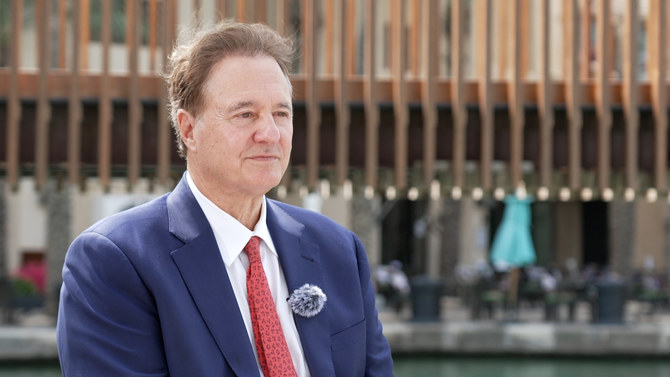
Stephen Pagliuca said Saudi Arabia has a focused strategy for scaling innovation in biotech. (SUPPLIED)
Short Url
Updated 16 February 2024
Follow

Saudi Arabia has focused strategy for scaling innovation in biotech: Bain Capital senior adviser

DUBAI: Saudi Arabia is paving the way for a thriving biotech sector, benefiting its citizens and the international community by launching the National Biotechnology Strategy, with a far-reaching impact on biomanufacturing and medical innovation, according to a leading investor in the industry.

On the sidelines of the World Governments Summit, senior adviser to Bain Capital, Stephen Pagliuca, who is also co-owner of the US basketball team the Boston Celtics, told Arab News that Saudi Arabia was making significant strides in scaling innovation in biotechnology.

“Saudi Arabia has a very focused strategy for scaling innovation in biotech, but it is still early in the stages of biotech,” he said.

As part of its efforts, NBS aims to contribute more than $34 billion to its non-oil GDP by 2040.

NBS’s strategic directions are vaccines, biomanufacturing, localization, genomics and plant optimization.

Pagliuca said that the country was on the path to successfully creating a significant impact once capital was raised.

“There are great universities in Saudi Arabia, with 50 percent of its citizens under 25. So they have got the ingredients, but they need the capital.”

Bain Capital has a lot of experience in the Gulf region and Saudi Arabia, the entrepreneur said.

“We work with the Saudi Public Investment Fund and other funds, too. So I’m hoping something will come out of that with the Saudis investing in biotech in the United States.”

He told Arab News that a golden age of biotechnology was beginning.

“Biotech is health tech, it is pharma. It is trying to find basic disease mechanisms and how to defeat those using modern techniques like gene editing and natural processes to solve those problems through biotech.”

Pagliuca said that 20 years ago, mapping one human genome costs billions of dollars. “Now, we have seen a revolution in supercomputing and AI, which has made biotech drug development a lot more efficient.” 

Pagliuca said that he had formed a company called Arena Bioworks to develop life-saving drugs using AI. He said that this combined the best-demonstrated practices from universities and foreign pharma companies and had them working together.

“Through the company, we are going to be talking to several Gulf countries on how they can leverage that to help build a biotech ecosystem.”

Pagliuca said that the public and private sectors must collaborate to accelerate the global biotech industry.

“At Arena Bioworks, we try to work with the government to get more speedy approvals of applications and trials, and get out life-saving drugs rather than have a bureaucracy that takes a long time to process everything.” 

Pagliuca said that with global communications, people and governments could work together to help humanity and produce products faster, better and cheaper.


Global trade isn’t deglobalizing — it’s reshuffling, Harvard economist says

Updated 09 February 2026
Follow

Global trade isn’t deglobalizing — it’s reshuffling, Harvard economist says

ALULA: Global trade is not retreating into deglobalization despite geopolitical shocks, but is instead undergoing a structural reshuffling led by US-China tensions, according to Harvard University economist Pol Antras. 

Presenting research at the AlUla Emerging Market Economies Conference, Antras said there is no evidence that countries are systematically turning inward. Instead, trade flows are being redirected across markets, creating winners and losers depending on export structure and exposure to Chinese competition. 

This comes as debate intensifies over whether supply-chain disruptions, industrial policy and rising trade barriers signal the end of globalization after decades of expansion. 

Speaking to Arab News on the sidelines of the event, Antras said: “I think the right way to view it is more a reorganization, where things are moving from some countries to others rather than a general trend where countries are becoming more inward looking, in a sense of producers selling more of their stuff domestically than internationally, or consumers buying more domestic products than foreign products.”  

He said a change of that scale has not yet happened, which is important to recognize when navigating the reshuffling — a shift his research shows is driven by Chinese producers redirecting sales away from the US toward other economies. 

He added that countries are affected differently, but highlighted that the Kingdom’s position is relatively positive, stating: “In the case of Saudi Arabia, for instance, its export structure, what it exports, is very different than what China exports, so in that sense it’s better positioned so suffer less negative consequences of recent events.” 

He went on to say that economies likely to be more negatively impacted than the Kingdom would be those with more producers in sectors exposed to Chinese competition. He added that while many countries may feel inclined to follow the United States’ footsteps by implementing their own tariffs, he would advise against such a move.  

Instead, he pointed to supporting producers facing the shock as a better way to protect and prepare economies, describing it as a key step toward building resilience — a view Professor Antras underscored as fundamental. 

Elaborating on the Kingdom’s position amid rising tensions and structural reorganization, he said Saudi Arabia holds a relative advantage in its economic framework. 

“Saudi Arabia should not be too worried about facing increased competitive pressures in selling its exports to other markets, by its nature. On the other hand, there is a benefit of the current situation, which is when Chinese producers find it hard to sell in US market, they naturally pivot to other markets.” 

He said that pivot could benefit importing economies, including Saudi Arabia, by lowering Chinese export prices. The shift could increase the Kingdom’s import volumes from China while easing cost pressures for domestic producers.