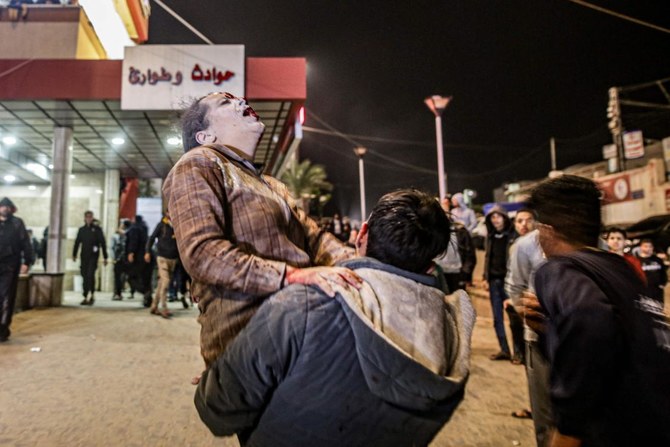
RAFAH, Gaza Strip: Palestinians have begun evacuating the main hospital in the southern Gaza town of Khan Younis, according to videos shared by medics on Wednesday.
Weeks of heavy fighting had isolated the medical facility and claimed the lives of several people inside it.
The war between Israel and Hamas, now in its fifth month, has devastated Gaza’s health sector, with less than half of its hospitals even partially functioning as scores of people are killed and wounded in daily bombardments. Israel accuses the militants of using hospitals and other civilian buildings as cover.
Khan Younis is the main target of a rolling ground offensive that Israel has said will soon be expanded to Gaza’ southernmost city of Rafah. Some 1.4 million people — over half the territory’s population — are crammed into tent camps and overflowing apartments and shelters in the town on the Egyptian border.
The United States, which has provided crucial military and diplomatic support to Israel, has been working with Qatar and Egypt to try and broker a ceasefire and the return of the remaining 130 hostages, around a fourth of whom are believed to be dead.
The negotiators held talks in Cairo on Tuesday that were attended by CIA chief William Burns and David Barnea, the head of Israel’s Mossad spy agency, but there were no signs of a breakthrough. Israeli media reported on Wednesday that Israeli Prime Minister Benjamin Netanyahu told his delegation not to return to the talks unless Hamas softens its demands.
Netanyahu has vowed to continue the war until “total victory” over Hamas and the return of all the hostages.
Hamas has said it will not release all the captives until Israel ends its offensive, withdraws from Gaza and releases a large number of Palestinian prisoners, including top militants. Netanyahu has rejected those demands, calling them “delusional.”
In northern Israel, meanwhile, a rocket attack wounded at least eight people on Wednesday when one of the projectiles hit a home in the town of Safed. Israeli media reported that a woman was killed in the attack, but the military did not immediately confirm the reports.
Israel carried out airstrikes in southern Lebanon in response, killing four people, including a Syrian woman and her two Lebanese children, and wounding at least nine, Lebanese security officials and local media said.
Israel and Lebanon’s Hezbollah militant group, which supports Hamas, have traded fire along the border nearly every day since the start of the war in Gaza, raising the risk of a wider conflict. Hezbollah did not immediately claim responsibility for the rocket attack.
The videos of the evacuation in Khan Younis showed dozens of Palestinians carrying their belongings in sacks and making their way out of the Nasser Hospital complex. A doctor wearing green hospital scrubs walked ahead of the crowd, some of whom were carrying white flags.
The Israeli military said it had opened a secure route to allow civilians to leave the hospital, while medics and patients could remain inside. Troops have been ordered to “prioritize the safety of civilians, patients, medical workers, and medical facilities during the operation,” it said.
The military had ordered the evacuation of the hospital and surrounding areas last month. But as with other health facilities, medics said patients were unable to safely leave or be relocated, and thousands of people displaced by fighting elsewhere remained there. Palestinians say nowhere is safe in the besieged territory, as Israel continues to carry out strikes in all parts of it.
The Gaza Health Ministry said last week that Israeli snipers on surrounding buildings were preventing people from entering or leaving the hospital. It said 10 people have been killed inside the complex over the past week, including three shot and killed on Tuesday.
The ministry says around 300 medical staff were treating some 450 patients, including people wounded in strikes. It says 10,000 displaced people were sheltering in the facility.
The war erupted after Hamas launched a surprise attack into Israel on Oct. 7, killing some 1,200 people, mostly civilians, and taking around 250 captive. Over 100 hostages were released during a weeklong ceasefire in November in return for 240 Palestinians imprisoned by Israel.
Israel responded to the attack by launching one of the deadliest and most destructive air and ground offensives in recent history. At least 28,576 Palestinians have been killed, mostly women and children, according to Gaza’s Health Ministry, which does not distinguish between civilians and combatants.
That includes over 100 bodies brought to hospitals in the last 24 hours. Over 68,000 people have been wounded in the war, including around 11,000 in need of evacuation for urgent treatment, according to the ministry.
Around 80 percent of Gaza’s 2.3 million people have been driven from their homes, large areas in northern Gaza have been completely destroyed and a humanitarian crisis has left a quarter of the population starving.


![]()

Displaced Palestinians leave one of Gaza’s main hospitals after weeks of being isolated by fighting
Short Url
https://arab.news/44bvq
Displaced Palestinians leave one of Gaza’s main hospitals after weeks of being isolated by fighting
- Weeks of heavy fighting had isolated the medical facility and claimed the lives of several people inside it
- Israel accuses the militants of using hospitals and other civilian buildings as cover


Latest updates



Recommended


© 2026 SAUDI RESEARCH & PUBLISHING COMPANY, All Rights Reserved And subject to Terms of Use Agreement.