‘Deplorable’: Condemnation from Pakistan as Israeli bombing in Rafah kills nearly 70 people

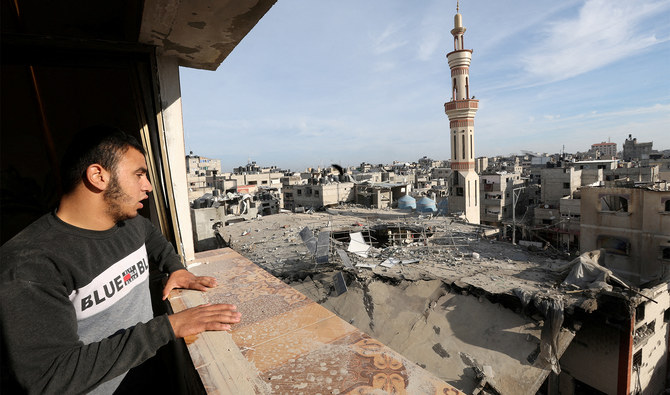
A Palestinian man looks at the site of an Israeli strike on a mosque, amid the ongoing conflict between Israel and the Palestinian Islamist group Hamas, in Rafah in the southern Gaza Strip, on February 12, 2024. (REUTERS)
Short Url
Updated 13 February 2024
Follow

‘Deplorable’: Condemnation from Pakistan as Israeli bombing in Rafah kills nearly 70 people

  • Caretaker Foreign Minister Jalil Abbas Jilani calls Israel’s action a violation of international law, human rights
  • Palestinian death toll has surpassed 28,000 since October 7, with over a quarter of Gaza’s residents starving

ISLAMABAD: Caretaker Foreign Minister Jalil Abbas Jilani on Tuesday condemned Israel for relentlessly bombing Rafah, a Palestinian city in the southern Gaza Strip, where it killed about 70 people, including women and children, while carrying out what it described as a rescue operation to free two Israeli-Argentine hostages.

Israel besieged Gaza and launched airstrikes after a surprise attack was initiated by Hamas on Oct. 7 in response to the deteriorating condition of Palestinian people living under Israeli occupation.

The international community widely condemned the administration of Prime Minister Benjamin Netanyahu for launching a disproportionate response to the Hamas attack that killed about 1,200 people before the Palestinian group took around 250 hostages.

In recent weeks, nearly 1.4 million Palestinians fled to Rafah to escape Israel-Hamas fighting. Many of these people have lost their homes and dozens of family members in Israeli airstrikes that have left much of the Gaza Strip uninhabitable.

“Israel’s recent bombing and offensive in Rafah is deplorable and a grave violation of international law and human rights,” Jilani said in a social media post. “Pakistan condemns these acts of violence against innocent Palestinians and calls for an immediate ceasefire. The world cannot afford to look away.”

Pakistan and much of the rest of the world community have been consistently demanding a ceasefire by Israel, though the Netanyahu administration has been supported by the United States and its European allies to continue military operation.

The Palestinian death toll from the war has surpassed 28,000, according to the Health Ministry in Gaza, with more than a quarter of Gaza’s residents starving.


From classrooms to screens: Pakistan schools go online amid Middle East war-driven oil crisis

Updated 4 sec ago
Follow

From classrooms to screens: Pakistan schools go online amid Middle East war-driven oil crisis

  • Government orders school closures, remote work and fuel cuts to conserve energy
  • Measures follow oil price surge linked to US-Israeli strikes on Iran and regional tensions

RAWALPINDI: Some schools in Pakistan shifted to online learning this week as authorities introduced emergency fuel-saving measures after global oil prices surged due to the escalating conflict involving the United States, Israel and Iran.

The government has ordered a series of austerity steps aimed at reducing fuel consumption, including temporary school closures, remote work arrangements for a portion of government and private sector employees, and sharp cuts in fuel allocations for official vehicles. The measures were introduced after international oil prices jumped amid fears the widening Middle East conflict could disrupt supplies passing through the Strait of Hormuz, a vital global energy shipping route, raising costs for import-dependent economies such as Pakistan.

Parents in cities including Rawalpindi said many educational institutions had already informed families through social media that classes would be conducted online while campuses remained closed.

“Hopefully, all the schools will remain closed today because many of the institutions have already shared the message on social media that we will be taking classes online for the students,” said Misam Abbas, a 30-year-old father of schoolchildren.

Pakistan’s education system is still recovering from severe disruptions during the COVID-19 pandemic, when schools across the country remained closed for extended periods and millions of students shifted to remote learning. 

The closures lasted around 10.5 months in some areas, affecting nearly 40 million school-age children, while limited Internet access and digital devices meant many students could not fully participate in online classes. Education experts say the prolonged shutdowns caused significant learning losses and pushed some children permanently out of the school system. 

Even after the pandemic, schooling in Pakistan has faced repeated interruptions due to environmental and health emergencies. In recent years, dense winter smog, extreme heatwaves and cold spells have frequently forced authorities to suspend classes, sometimes for 10 to 12 days at a time, shortening the academic year and disrupting teaching schedules. 

Analysts warn that repeated closures and the shift to online learning, often difficult for students without reliable Internet access, continue to strain an already fragile education system. 

For many families, the sudden switch to remote learning has also raised concerns about prolonged disruptions to education if the austerity measures remain in place.

“They [the government] should not close [schools] for a long time because it suffers a lot. The students… should think that they are to close the school for two to three days, not for all the weeks, not for two to three weeks because that can suffer the studies of these small kids,” Abbas said.

Pakistan imports most of its crude oil and refined petroleum products, making domestic energy costs highly sensitive to global price swings during geopolitical crises.

“Our situation should not be affected by the world’s situation. The world is already in a bad situation. But in our country, we should have some good system so that people cannot be affected by those circumstances,” Abbas said.