

Saudi Heritage Commission unveils latest archaeological finds at ancient site in Asir

1 / 2
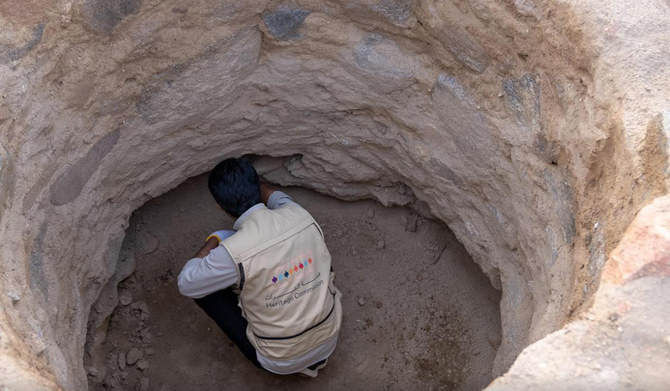
The commission said its archaeological projects aim to explore, document, preserve and champion archaeological sites. (SPA)
2 / 2
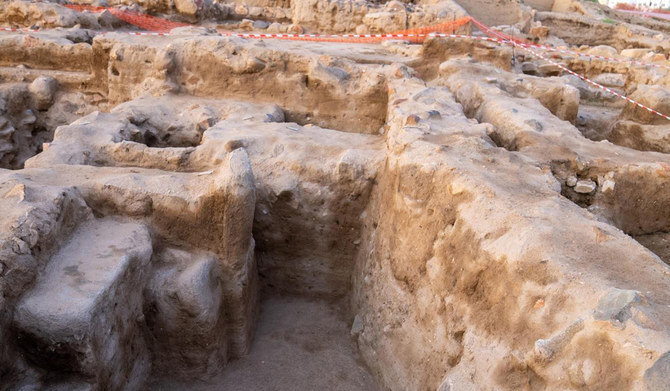
The commission said its archaeological projects aim to explore, document, preserve and champion archaeological sites. (SPA)
Short Url
Updated 12 February 2024
Follow

Saudi Heritage Commission unveils latest archaeological finds at ancient site in Asir

  • Discoveries include stone-and-mud dwellings, an innovative irrigation mechanism, and artifacts including a granite stone with a three-line Islamic inscription
  • Other finds include stone tools used for daily tasks, decorations, pottery pieces, inscriptions and beads crafted from precious stones

JEDDAH: The Saudi Heritage Commission has revealed what it described as groundbreaking archaeological findings at the Jerash dig sit in Asir region, southeast of Khamis Mushayt.

The commission said the discoveries, which came to light during its 15th season of excavations, underscore the archaeological importance of the site as a key location in the southern part of the Kingdom.

Experts working at the location found the remains of dwellings built from stone and mud with novel architectural features that, building on previous discoveries, provide further insights into the site.


The commission said its archaeological projects aim to explore, document, preserve and champion archaeological sites. (SPA)

In addition, the teams found evidence of what at the time would have been an ingenious and revolutionary irrigation technique, in which a well meticulously crafted from stacked stones was intricately linked to a central channel that distributed water to basins adjacent to residences. They also unearthed numerous hearths and platforms, again crafted from stone and mud.

Regarding specific artifacts, one particularly significant find was a granite stone with a three-line Islamic inscription, which was the second discovery of its kind at the site. Other items included stone tools used for daily tasks, decorations, pottery pieces and inscriptions.

The wide variety of tools included pestles, mills, and an assortment of querns, hand tools used for grinding grain, of various shapes and sizes. The pottery fragments included glazed pieces, glass artifacts, and soapstone embellishments used on the body, edges and handles of pots. A treasure trove of beads crafted from precious stones was also cataloged.


The commission said its archaeological projects aim to explore, document, preserve and champion archaeological sites. (SPA)

The commission said its archaeological projects aim to explore, document, preserve and champion archaeological sites as invaluable cultural and economic national assets, in keeping with its wider mandate to safeguard and celebrate the Kingdom’s rich cultural heritage and promote its legacy on a global stage.

This month the Historic Jeddah Program, in collaboration with the Heritage Commission, announced 25,000 discoveries at four archaeological sites, the oldest of which dates back to the 1st and 2nd centuries of the Hijri calendar (the 7th and 8th centuries A.D.).


Absher Hackathon finalists highlight scale of Saudi tech talent

Updated 14 December 2025
Follow

Absher Hackathon finalists highlight scale of Saudi tech talent

  • World’s largest hackathon underscores growing national enthusiasm for tech innovation

RIYADH: Saudi Arabia’s push to position itself as a global hub for digital innovation was on display this weekend as the Absher Tuwaiq Hackathon 2025 — billed as the world’s largest hackathon — concluded with the announcement of finalist teams competing for prizes totaling SR1 million ($266,000). 

The three-day hackathon, organized by the Ministry of Interior in partnership with Tuwaiq Academy, brought together innovators from across the Kingdom to develop digital solutions aligned with the ministry’s digital transformation goals. 

The finalist teams recognized for their projects were: Shadow, Wusool, Watheeq , Tanabbah, HRS, Ikhlaa, Amal, Mustabiq, Al‑Dahna, Inspire, Saqour Al‑Watan, Thaqib, Sawt Al‑Mustaqbal, Manee, and YS Advance International. 

The finalists were announced at the end of the three-day Absher Tuwaiq Hackathon organized by the Ministry of Interior in partnership with Tuwaiq Academy. (AN photo/Supplied)

In addition to cash prizes, the competition offered SR450,000 in support from the National Technology Development Program, along with incubation opportunities at Invi Lab to help teams turn prototypes into market-ready products.   

Tariq Al‑Hamid, official spokesperson for the Absher Conference, told Arab News that the hackathon has generated strong momentum nationwide.  

This year’s event included more than 4,000 participants from all regions of the Kingdom — “a reflection of the growing national enthusiasm for digital innovation,” he said. 

HIGHLIGHT

The Absher Tuwaiq Hackathon brought together innovators from across the Kingdom to develop digital solutions aligned with the ministry’s digital transformation goals. 

According to Al‑Hamid, the 2025 event was structured around four specialized tracks: digital identity and security applications; artificial intelligence for predictive and proactive security; Internet of Things applications supporting field operations; and innovations to enhance or expand services on the Absher Platform. 

Tariq Al-Hamid (center) said that the hackathon’s impact extends beyond prize money. (Supplied)

He added that this focused approach allowed participants “to present high‑quality ideas and advanced prototypes at levels comparable to international competitions.” 

Participants also took part in more than 80 training programs delivered by global partners including Google Cloud, Meta, NVIDIA, and Huawei, an experience Al-Hamid said significantly strengthened both the competition and participants’ skills. 

Al-Hamid said that the hackathon’s impact extends beyond prize money. “More important than the cash reward is the opportunity to turn creative ideas into real products that make an impact on citizens, residents, and visitors.” 

Standout participants often attract the attention of leading national technology companies seeking new talent, he added. 

Participation was open to individuals and teams from across Saudi Arabia, from high school students to industry professionals, highlighting the inclusivity of the event and the breadth of the Kingdom’s innovation ecosystem.  

The hackathon forms part of the wider Absher Tuwaiq initiative, a core pillar of the upcoming Absher Conference 2025, which will empower more than 100,000 participants across seven technical tracks in 16 cities, in partnership with 20 local and international organizations. 

The conference, organized by the Ministry of Interior and Tuwaiq Academy, sponsored by Elm Company and held in strategic partnership with the Saudi Data and Artificial Intelligence Authority, will take place in Riyadh from Dec. 17 -19. 

The event will showcase national digital innovations and reinforce Saudi Arabia’s role in global technology.