

Pakistan stock market sheds over 3,000 points in two consecutive sessions amid uncertainty after polls

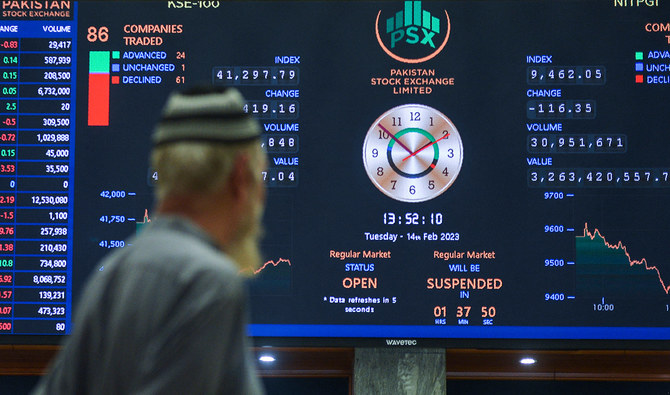
A broker looks at an index board showing the latests share prices at the Pakistan Stock Exchange in Karachi on February 14, 2023. (AFP/File)
Short Url
Updated 12 February 2024
Follow

Pakistan stock market sheds over 3,000 points in two consecutive sessions amid uncertainty after polls

  • Thursday’s national election in Pakistan presented no clear winner, with major parties scrambling to form alliances in bid to secure majority
  • Analysts say market will remain jittery for the next few days until a new government comes in with clarity on IMF program, economic policy

KARACHI: Pakistan’s stock market has lost more than 3,000 points in two consecutive sessions, traders and analysts said, amid uncertainty surrounding formation of a new government after Thursday’s indecisive vote.

Thursday’s vote presented no clear winner, with independent candidates, most backed by former prime minister Imran Khan’s Pakistan Tehreek-e-Insaf (PTI) party winning 101 parliamentary seats, according to official results.

Three-time former prime minister Nawaz Sharif’s Pakistan Muslim League-Nawaz (PML-N) bagged 75 seats, while former foreign minister Bilawal Bhutto-Zardari-led Pakistan Peoples Party won 54 seats. Currently, major parties are scrambling to form alliances in their bid to secure the simple majority of 169 seats.

Amid a lack of clarity about the future, the benchmark KSE100 index of the Pakistan Stock Exchange (PSX) has remained in negative in the last two consecutive trading sessions after the Feb. 8 election.

The index shed 3,079 points, or 4.8 percent of its value, in the last two sessions on Friday and Monday due to the uncertainty, while it recorded its ninth highest day-on-day (DoD) decline of 1,878 points on Monday, closing at 61,065 points.

Analysts say the current drop at the Pakistani bourse has broken the traditional trend of rallying after the elections.

“Normally, we have seen in the past that post elections market normally goes up or enjoys the clarity, the direction and who’s coming to form the government,” Khurram Schehzad, chief executive officer (CEO) of the Alpha Beta Core financial advisory firm, told Arab News.

“But this time around, this is a little unprecedented because as the results came in, nobody could even guess who’s going to make the government.”

Schehzad said either of the two sessions posted a loss of Rs214 billion ($767 million) in market capitalization, with the cumulative loss in both sessions recorded at Rs427 billion ($1.53 billion).

Analysts say investors typically expect a majority party to form the government, but Thursday’s vote did not present a clear winner.

“So, this uncertainty, lack of direction, lack of clarity, actually leads to investor nervousness, the volatility in the market,” Schehzad explained.

Zafar Moti, CEO of Zafar Moti Capital Securities, also attributed the current bearish trend to the post-election uncertainty, saying the market was doing “quite well technically and fundamentally” before the elections.

“There’s still nothing wrong with our market. We are giving out best payouts, best dividends and best results. And in between these times when Dr. Shamshad was on board, we saw a 67,000[-point] level of peaks also, which was highest in our lifetime,” he said.

Moti said an expected coalition government had still not taken shape in the country three days after the polls.

“Our situation is getting grimmer because this government with so many coalition partners, it’s not taking shape and the results were still giving jitters to the investors,” he added.

Before the elections, foreign funds were getting jitters, but now Pakistani fund managers were giving orders to sell off, according to Moti.

Ahsan Mehanti, CEO of the Arif Habib Corporation securities and brokerage house, said some of the support the key index received during the trading was from strong financial results and “upbeat data on $2.4 billion remittances, up by 26 percent, in January 2024.”

To a question about future outlook of the equity market, analysts said the market needed a “clear direction” after the formation of the government.

“Unless and until we see a peaceful transition of new government and the government without any honeymoon period starts working, the capital market will be in doldrums for coming week,” Moti said.

Schehzad concurred with Moti, saying: “We can see this to continue for the next few days until the new government comes in and someone forms the government and gets some clarity on the IMF (International Monetary Fund) program, on the overall economic management.”

Pakistan’s current $3 billion IMF bailout program is set to expire next month after which the country will have to negotiate a fresh bailout.


Pakistan showcases fiscal turnaround, reform agenda at Saudi-hosted AlUla forum

Updated 6 sec ago
Follow

Pakistan showcases fiscal turnaround, reform agenda at Saudi-hosted AlUla forum

  • Pakistan has delivered successive primary surpluses and reduced its fiscal deficit from around 8 percent of GDP to approximately 5.4 percent
  • Muhammad Aurangzeb says fiscal space created through consolidation, reforms is being directed toward priority growth-enabling sectors

KARACHI: Finance Minister Muhammad Aurangzeb on Monday highlighted Pakistan’s recent fiscal progress, ongoing reforms and strategy to build buffers while sustaining growth at the AlUla Conference for Emerging Market Economies, underscoring the importance of institutional strengthening in navigating economic and climate-related shocks.

The second edition of the annual AlUla conference was launched by the Saudi Arabia’s Ministry of Finance and the International Monetary Fund (IMF) on Sunday. The conference brings together economic decision-makers, finance ministers, central bank governors, leaders of international financial institutions and a select group of experts and specialists from around the world.

Pakistan, which nearly defaulted on its foreign debt obligations in 2023, is currently making efforts to stabilize its economy under a $7 billion International Monetary Fund (IMF) program. The program, agreed in Sept. 2024, accompanied reforms such as privatization of loss-making, state-owned enterprises (SOEs), tax regime overhaul and ending various subsidies for fiscal consolidation.

Attending a high-level panel discussion “Fiscal Policy in a Shock‑Prone World” on the 2nd day of the AlUla Conference, Aurangzeb shared Pakistan’s experience in managing structural constraints, strengthening revenue mobilization, reducing debt vulnerabilities, and responding to shocks while protecting priority development spending.

“Pakistan’s fiscal strategy has been shaped by a history of boom-and-bust cycles, persistent structural deficits, high debt levels, and limited fiscal space,” he said, stressing that it has been critical to carefully safeguard the fiscal progress achieved over the past two to three years.

“Pakistan has delivered successive primary surpluses and reduced its fiscal deficit from around 8 percent of GDP (gross domestic product) to approximately 5.4 percent, with the current trajectory pointing toward a further reduction below five percent.”

This year’s conference highlighted the rapid transformations in the global economy and challenges and the opportunities they presented for emerging market economies, particularly in international trade, monetary and financial systems.

Aurangzeb stressed the discussion around fiscal buffers is not academic for Pakistan but rooted in lived experience as a climate-vulnerable country.

Recalling the catastrophic floods of 2022, he noted that Pakistan was forced to make an immediate international appeal even for rescue and relief operations. In contrast, he said, the country was able to mobilize its own resources despite limited fiscal space during the large-scale floods affecting multiple provinces and river systems this year, demonstrating the practical value of rebuilding fiscal buffers to absorb exogenous shocks.

On the revenue side, he outlined sustained efforts to expand the tax base and strengthen compliance.

“Pakistan’s tax-to-GDP ratio has risen from below 10 percent to close to 12 percent,” the minister said, highlighting the transformation of the tax authority through reforms in people, processes and technology, including the use of AI-led production monitoring systems across various sectors to improve enforcement, curb leakages and reduce corruption by minimizing human intervention.

“The tax policy function has been separated from tax collection and placed within the Ministry of Finance to ensure that budgetary decisions are guided by economic value and policy considerations rather than purely arithmetic targets, while maintaining overall fiscal discipline.”

About expenditure management, the finance minister noted that Pakistan’s federal structure adds complexity, requiring close coordination between the federation and provinces. He shared that a national fiscal framework has been agreed upon and that work is ongoing to strengthen fiscal coordination and discipline across all tiers of government.

“Pakistan’s debt-to-GDP ratio, which had reached around 74 percent, has been reduced to approximately 70 percent,” he said, underscoring ongoing domestic liability management operations aimed at lowering debt servicing costs, which remain the single largest expenditure item in the budget.

“Continued fiscal discipline would further ease debt pressures and help create additional fiscal space.”

Pakistan faced a prolonged economic crisis in recent years, marked by fiscal pressure, high debt levels and balance-of-payments difficulties. Officials now say that decreasing levels of inflation and higher foreign exchange reserves reflect the government’s prudent fiscal policies and debt management.

“The fiscal space created through consolidation and reforms is being directed toward priority growth-enabling sectors, including human capital development, agriculture, information technology, and other areas with strong growth potential,” Aurangzeb said, adding that rebuilding buffers, dampening pro-cyclicality, and sustaining growth require persistence, institutional reform and disciplined policymaking, particularly for countries facing repeated structural and climate-related shocks.