

Qatar frees ex-Indian Navy officers previously on death row

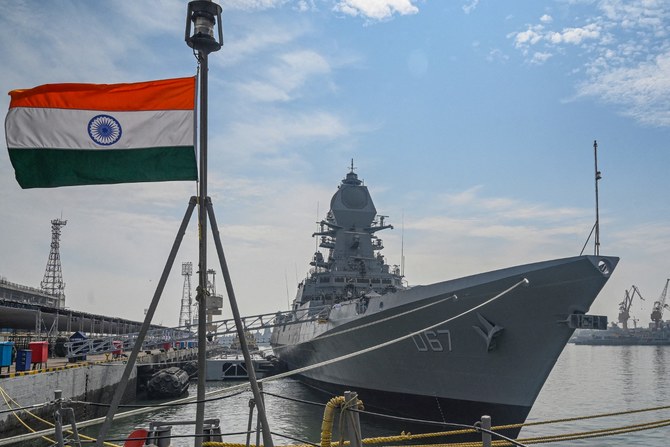
In this file photo taken on Dec. 15, 2022 the second stealth guided missile destroyer of Project 15B, Mormugao of the Indian Navy, is seen docked at the Naval Dockyard in Mumbai. (AFP)
Short Url
Updated 12 February 2024
Follow

Qatar frees ex-Indian Navy officers previously on death row

  • Eight Indian nationals held in custody in Qatar since August 2022
  • Seven of the men have already returned to India, New Delhi’s foreign ministry said

New Delhi: Eight Indian nationals detained in Qatar and previously sentenced to death by a court in the Gulf nation have been released, India’s Ministry of External Affairs said on Monday. 

The men, employees of the security firm Dahra — a private company providing training to the Qatari Emiri Naval Forces — had been held in custody since August 2022. 
Neither Qatar nor India detailed the official charges against the men, whose arrests made front-page headlines across the South Asian nation in 2022. It was widely reported then that the eight former Indian Navy officers were arrested after allegedly spying for Israel. 
The ministry said on Monday that seven of the men have returned to India. 
“The government of India welcomes the release of eight Indian nationals working for the Dahra Global company who were detained in Qatar … We appreciate the decision by the Emir of the State of Qatar to enable the release and home-coming of these nationals,” the ministry said.
India said in October it was “deeply shocked” after the Court of First Instance in Qatar sentenced the men to death, and New Delhi subsequently filed an appeal against the sentence. 
In December, the Indian foreign ministry said its ambassador to Qatar had met the eight former Indian Navy officers, announcing later the same month that the Court of Appeal of Qatar had commuted their death penalty. 
Several of the freed men thanked the Indian government and Prime Minister Narendra Modi while talking to reporters after their arrival in New Delhi on Monday morning, with at least three saying that their release would not have been possible without the premier’s “personal intervention.” 
New Delhi and Doha have historically friendly ties, with India sourcing around 40 percent of its liquefied natural gas needs from Qatar, which is also home to hundreds of thousands of the Indian diaspora who send back a considerable share of foreign remittances. 
Last week, the two countries signed a $78 billion deal to extend India’s LNG imports from Qatar until the end of 2048.


What is Trump’s ‘Board of Peace’?

Updated 10 sec ago
Follow

What is Trump’s ‘Board of Peace’?

  • Countries asked to pay $1 billion for a permanent spot on the board
  • The board was originally conceived to oversee the rebuilding of Gaza

BRUSSELS: US President Donald Trump’s government has asked countries to pay $1 billion for a permanent spot on his “Board of Peace” aimed at resolving conflicts, according to its charter seen by AFP.

The board was originally conceived to oversee the rebuilding of Gaza, but the charter does not appear to limit its role to the occupied Palestinian territory.

WHAT WILL IT DO?

The Board of Peace will be chaired by Trump, according to its founding charter.

It is “an international organization that seeks to promote stability, restore dependable and lawful governance, and secure enduring peace in areas affected or threatened by conflict,” reads the preamble of the charter sent to countries invited to participate.

It will “undertake such peace-building functions in accordance with international law,” it adds.

WHO WILL RUN IT?

Trump will be chairman but also “separately serve as inaugural representative” of the US.

“The chairman shall have exclusive authority to create, modify, or dissolve subsidiary entities as necessary or appropriate to fulfil the Board of Peace’s mission,” the document states.

He will pick members of an executive board to be “leaders of global stature” to “serve two-year terms, subject to removal by the chairman.”

He may also, “acting on behalf of the Board of Peace,” “adopt resolutions or other directives.”

The chairman can be replaced only in case of “voluntary resignation or as a result of incapacity.”

WHO CAN BE A MEMBER?

Member states must be invited by the US president, and will be represented by their head of state or government.

Each member “shall serve a term of no more than three years,” the charter says.

But “the three-year membership term shall not apply to member states that contribute more than USD $1,000,000,000 in cash funds to the Board of Peace within the first year of the charter’s entry into force,” it adds.

The board will “convene voting meetings at least annually,” and “each member state shall have one vote.”

But while all decisions require “a majority of member states present and voting,” they will also be “subject to the approval of the chairman, who may also cast a vote in his capacity as chairman in the event of a tie.”

WHO’S ON THE EXECUTIVE BOARD?

The executive board will “operationalize” the organization’s mission, according to the White House, which said it would be chaired by Trump and include seven members:

US Secretary of State Marco Rubio

Steve Witkoff, Trump’s special negotiator

Jared Kushner, Trump’s son-in-law

Tony Blair, former UK prime minister

Marc Rowan, billionaire US financier

Ajay Banga, World Bank president

Robert Gabriel, loyal Trump aide on the National Security Council

WHICH COUNTRIES ARE INVITED?

Dozens of countries and leaders have said they have received an invitation.

They include China, India, Russia’s President Vladimir Putin, Ukraine’s Volodymyr Zelensky and Canada’s Prime Minister Mark Carney.

Egypt’s President Abdel Fattah El-Sisi and Argentina’s President Javier Milei have also confirmed an invite.

Other countries to confirm invites include Jordan, Brazil, Paraguay, Pakistan and a host of nations from Europe, Central Asia and the Middle East.

WHO WILL JOIN?

Countries from Albania to Vietnam have indicated a willingness to join the board.

Hungarian Prime Minister Viktor Orban, Trump’s most ardent supporter in the European Union, is also in.

Canada said it would take part, but explicitly ruled out paying the $1-billion fee for permanent membership.

It is unclear whether others who have responded positively — Armenia, Belarus, Kazakhstan, Morocco and Vietnam among them — would be willing to pay the $1 billion.

WHO WON’T BE INVOLVED?

Long-time US ally France has indicated it will not join. The response sparked an immediate threat from Trump to slap sky-high tariffs on French wine.

Zelensky said it would be “very hard” to be a member of a council alongside Russia, and diplomats were “working on it.”

WHEN DOES IT START?

The charter says it enters into force “upon expression of consent to be bound by three States.”