

Yemen’s Houthi missiles hit Iran-bound ship in Red Sea
Despite Houthi claims that targeted ship was American, information shows that it left Brazil on Jan. 12 and was sailing to Iran’s Bandar Imam Khomeini port
Updated 12 February 2024
Saeed Al-Batati
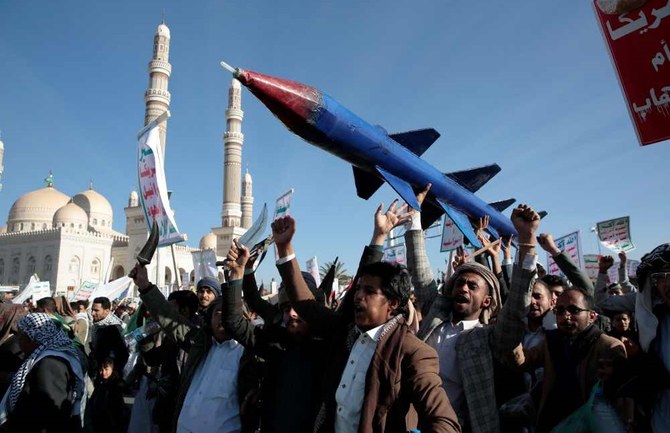
AL-MUKALLA: Yemen’s Houthis claimed credit on Monday for shooting two missiles at what the militia believed to be an American ship, the Star Iris, in the Red Sea, resuming assaults on ships in the critical commerce channel after a four-day lull.
Houthi military spokesperson Yahya Sarea said that their naval troops launched “a number of” anti-ship missiles at the American ship in the Red Sea, adding that their actions are both in support of Palestinians and in retaliation to US and UK bombings on Yemeni territory under their control.
The UK Maritime Trade Operations agency reported receiving a warning on Monday morning regarding an incident 40 nautical miles south of Yemen’s Mocha town in which two missiles impacted a vessel, inflicting minor damage. “Vessel and crew are safe. Vessel proceeding to next port of call,” it said in its alert.
Ambrey, a British marine security firm, identified the ship as a Marshall Islands-flagged, Greece-owned bulk carrier that was hit by Houthi missiles twice while passing through the Bab Al-Mandab Strait.
Despite the Houthis’ claims that the targeted ship was American, the ship’s information on www.marinetraffic.com, which provides up-to-date information about ship locations and movements, shows that it left Vila do Conde port in Brazil on Jan. 12 and was sailing to Iran’s Bandar Imam Khomeini port. Last week, the Houthi militia leader, Abdulmalik Al-Houthi, accused US ships of flying the Marshall Islands flag to avoid attacks.
The Houthis captured a commercial ship in November and launched dozens of drones and ballistic missiles against commercial and naval ships in the Red Sea, blocking the Red Sea from all Israel-linked and Israel-bound ships.
The Yemeni militia claims that their strikes are intended to force Israel to ease its embargo on Gaza and enable humanitarian aid to enter the Palestinian territory.
Since Friday, the US Central Command has claimed the destruction of 12 explosive-laden drone boats and cruise missiles planned for launch by the Houthis in Yemen.
Civilians and aid operations bare brunt of drone strikes in Sudan’s Kordofan
At least 77 people killed and dozens injured in various attacks in Kordofan, mostly by the paramilitary Rapid Support Forces
Residents say RSF drone strikes are taking place almost daily around the two key cities of Kadugli and Dilling
Updated 3 sec ago
AP
CAIRO: A surge in drone strikes in the Sudanese region of Kordofan has taken a growing toll on civilians and hampered aid operations, analysts and humanitarian workers said Wednesday, as the war in Sudan nears the three-year mark. At least 77 people were killed and dozens injured in various attacks, mostly by the paramilitary Rapid Support Forces, in densely populated areas, according to Sudan Doctors Network, a group that tracks violence through the war. Many of the victims were civilians. The conflict between the RSF and the Sudanese military erupted into a full-blown war in April 2023. So far, at least 40,000 people have been killed and 12 million displaced, according to the World Health Organization. Aid groups say the true toll could be many times higher, as the fighting in vast and remote areas impedes access. The military increased its use of drones and airstrikes in Kordofan over the past year as the conflict shifted westward, making the region “a primary theater of operations,” said Jalale Getachew Birru, senior analyst for East Africa at the nonprofit Armed Conflict Location & Event Data, ACLED. Two weeks ago, the military said it broke the RSF siege of Kadugli, the capital of South Kordofan province, and the neighboring town of Dilling after more than two years. However, Birru said the sieges were not fully broken. “These cities are still encircled, and the fight for the control of these cities and the wider region is ongoing,” he told The Associated Press.
Daily drone strikes
Walid Mohamed, a resident of Kadugli, told the AP that breaking the siege allowed more goods and medicines to enter the city, reopening the corridor with Dilling and driving down food prices after a dire humanitarian situation unfolded there. However, he said RSF drone strikes have since occurred almost daily, mainly targeting hospitals, markets and homes. Omran Ahmed, a resident of Dilling, also said drone strikes had increased, “spreading fear and terror among residents as they see more civilians become victims.” UN High Commissioner for Human Rights Volker Türk on Wednesday sounded the alarm that drone strikes killed more than 50 civilians over two days this week. “These latest killings are yet another reminder of the devastating consequences on civilians of the escalating use of drone warfare in Sudan,” said Türk, condemning the attacks on civilian sites including markets, health facilities and schools. UN spokesperson Stéphane Dujarric said there was evidence that both sides had used drones against civilians in this week’s attacks. “These civilians have been at one time or another in government-controlled areas and areas controlled by the RSF, which would make us believe that both sides are using them,” he said. Two military officials, who spoke on condition of anonymity because they weren’t authorized to brief the media, told the AP this week that the army doesn’t target civilian infrastructure. A UN convoy reached Dilling and Kadugli with aid for more than 130,000 people, the first major delivery in three months, United Nations agencies said Wednesday. However, aid workers are concerned about escalating violence. Mathilde Vu, an advocacy manager with the Norwegian Refugee Council told the AP there’s “huge concern” about the “unacceptable” escalation in Kordofan and that it could “shatter lives and obstruct any hope to reverse the famine/ starvation” in the region. “It’s very indiscriminate. Between Kordofan, Darfur and the east (Sennar), it’s now every other day we receive messages like ‘drone attack here, hit a civilian infrastructure, killed people,’” Vu said.
Kordofan battlefront shifts
Much of the recent fighting in Sudan has been centered in Kordofan, where the army wants to create a route into the neighboring region of Darfur, Kholood Khair, founding director of Confluence Advisory, a think tank, told the AP. El-Fasher city, the capital of North Darfur, was the army’s last stronghold in the region but fell to the RSF in October. Its recapture could allow the army to restore important supply and logistic lines between Kordofan and Darfur. Meanwhile, the RSF wants to create a route out of Kordofan, back to the center of the country and the capital, Khartoum, Khair said. Both the military and the RSF have used drones, especially in North Kordofan. Civilians have been hard-hit. Last year, 163 air and drone strikes across the country targeted civilians, killing 1,032 people, according to ACLED data. The army reportedly carried out 83 strikes that caused 568 deaths, while the RSF conducted 66 strikes that killed 288 people. Both sides have stepped up their use of drones in Kordofan over the past few weeks, according to Federico Donelli, associate professor of international relations at the University of Trieste. Donelli said several factors are driving the increase, including the army’s acquisition of new weapons and drones manufactured and supplied by foreign actors. “This has enabled the army to rely more heavily on precision strikes, mirroring tactics that the Rapid Support Forces have been using for some time,” he said, Both sides may be struggling to maintain troop strength, he said. “Consequently, drones are favored over deploying armed units on the ground, particularly in contested areas such as Kordofan.” Khair, from Confluence Advisory, said the fighting in Kordofan could shift in the upcoming period, with the army potentially seeking to push into Darfur, particularly toward el-Fasher, where war crimes have been reported. “We expect to see the bombing campaigns not only continue but increase in frequency and volume,” she said.