


Houthis launch new wave of missile attacks on ships off Yemeni coast

1 / 2
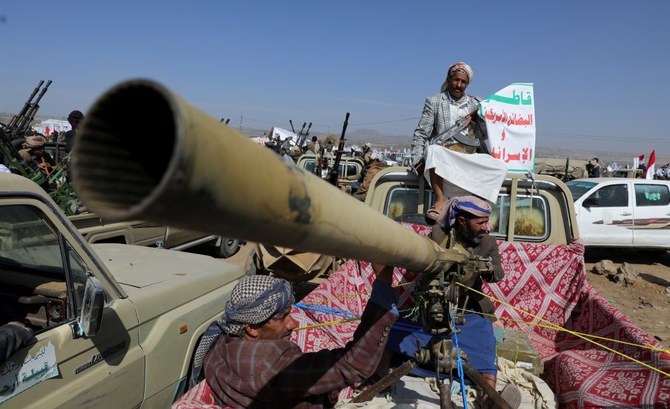
Houthi tribesmen parade in a show of defiance after US and UK air strikes on Houthi positions near Sanaa, Yemen, Feb. 4, 2024. (Reuters)
2 / 2
Houthi commandos capture the Galaxy Leader cargo vessel in the Red Sea, in November of last year. (AFP)
Short Url
Updated 06 February 2024
Follow

Houthis launch new wave of missile attacks on ships off Yemeni coast

  • British-owned and Barbados-flagged cargo ship damaged in a drone attack while navigating through the southeast Red Sea
  • Greek-owned and Marshall Islands-flagged vessel sailing from the US to India was targeted 53 nautical miles southwest of Aden

AL-MUKALLA: Yemen’s Houthi militia on Tuesday launched another wave of missiles toward ships in the Red Sea and Gulf of Aden as the group’s leader vowed to continue attacks until Israel lifted its blockade of Gaza.

A cargo vessel sailing 57 nautical miles west of the Houthi-controlled port city of Hodeidah sustained minor damage to its bridge after one of the weapons passed through its deck, according to British maritime agencies the UK Maritime Trade Operations, and Ambrey.

The UKMTO reported that a small boat had been spotted off the ship’s port side.

Meanwhile, Ambrey officials said a British-owned and Barbados-flagged cargo ship had been damaged in a drone attack while navigating through the southeast Red Sea.

On Tuesday, the UKMTO warned shipping companies operating in the Gulf of Aden to exercise caution after receiving reports of an explosion near to a commercial vessel 50 nautical miles south of the Yemeni city of Aden.

And Ambrey reported that a Greek-owned and Marshall Islands-flagged vessel sailing from the US to India was targeted 53 nautical miles southwest of Aden.

The warnings were issued shortly after eyewitnesses in the Houthi-controlled Ibb province said on Tuesday that a missile had been fired from the Al-Hamza military camp in Ibb’s Al-Sabrah area.

The Iran-backed Houthis have launched dozens of explosive-rigged drones and ballistic missiles at commercial and naval ships passing through Bab El-Mandeb (the strait that connects the Red Sea with the Gulf of Aden), the Red Sea, and the Gulf of Aden in what the militia group has described as military action in support of Palestine aimed at pressuring Israel into lifting its siege of Gaza.

On Tuesday, Houthi military spokesperson Yahya Sarea claimed group responsibility for firing anti-ship missiles at the Marshall Islands-flagged bulk carrier Star Nasia, and the cargo ship Barbados Morning Tide.

He said the first ship was American and the second British and that both vessels sustained direct hits. Sarea added that the attacks were in support of Palestine and retaliation for US and UK bombardments of Yemeni areas under Houthi control.

Since Jan. 12, American and British forces have conducted dozens of attacks on bases in Sanaa, Hodeidah, Hajjah, Al-Bayda, Saada, and other sites in a bid to diminish Houthi military capabilities to fire on ships.

On Tuesday, Houthi media said that the US and UK had conducted three attacks in the northern province of Saada, the Houthi stronghold.

And Houthi militia leader Abdul Malik Al-Houthi claimed that the US was flying the Marshallese flag on its ships to evade strikes, adding that attacks on shipping in the Red Sea would continue.

Meanwhile, the Yemeni riyal rose modestly on Tuesday morning after the internationally recognized Presidential Leadership Council head named a new prime minister. Yemen’s Foreign Minister Ahmed Awad bin Mubarak will succeed Maeen Abdulmalik Saeed, who was made an adviser to PLC president, Rashad Al-Alimi.

In a post on X, the new PM promised to focus on improving living standards for Yemenis, reviving government institutions, and putting an end to the Houthi military seizure of power in Yemen.

Bin Mubarak said: “I assume this position today with the determination to improve the lives of every Yemeni man and woman, mindful of the suffering of our honorable people.”


Jordan, Germany committed to two-state solution

King Abdullah of Jordan receives German Chancellor Friedrich Merz in Aqaba. (Petra)
Updated 59 min 7 sec ago
Follow

Jordan, Germany committed to two-state solution

  • Chancellor Merz calls for more humanitarian aid to flow into the war-torn Gaza Strip

AMMAN: Jordan’s King Abdullah has warned of “the danger of continued Israeli escalations in the West Bank,” which Israel has occupied since 1967.

King Abdullah received German Chancellor Friedrich Merz during his brief stopover in Jordan on Saturday.

Their discussions in Aqaba focused mainly on the peace process in Israel and the Palestinian territories, AFP reported.

Merz called for more humanitarian aid to flow into the Gaza Strip and for Hamas fighters to lay down their weapons, adding that both Jordan and Germany are committed to a negotiated two-state solution.

FASTFACT

Jordan’s royal palace said in a statement that King Abdullah underlined ‘the need to commit to implementing all stages of the agreement to end the war and deliver humanitarian aid to all areas of the Gaza Strip.’

“There can be no place for terrorism and antisemitism in this shared future,” Merz said.

Jordan’s royal palace said in a statement that King Abdullah had underlined “the need to commit to implementing all stages of the agreement to end the war and deliver humanitarian aid to all areas of the strip.”

The meeting discussed ways to strengthen the partnership between Jordan and Germany, focusing on the deep-rooted ties between the two countries, Jordanian news agency Petra reported.

King Abdullah emphasized the importance of expanding cooperation in various domains, including the economic and defense sectors, and continuing to coordinate in support of efforts to achieve stability in the region, according to Petra.

The leaders highlighted the need to pursue a “political horizon to achieve a just and comprehensive peace in the region.”

Chancellor Merz expressed Germany’s readiness to strengthen cooperation with Jordan in various sectors.

The Syrian Arab Republic’s Sana news agency reported that the two leaders discussed ways to support Syria and Lebanon in maintaining their security, stability, and sovereignty.

They stressed the importance of respecting the sovereignty of regional countries and reviewed key developments in the Middle East.

Deputy Prime Minister and Foreign Minister Ayman Safadi had previously affirmed that Jordan continues to support Syria after years of war and destruction, expressing hope for a stable and secure future that ensures Syria’s territorial unity, Sana added.

King Abdullah separately met with Kaja Kallas, EU high representative for foreign affairs and security policy and European Commission vice president on Sunday to discuss ways to strengthen cooperation within the framework of the strategic and comprehensive partnership between Jordan and the EU.

The meeting at Basman Palace covered the importance of building on available economic opportunities, particularly through the Jordan-EU Summit, scheduled to be held in Amman in January 2026, as well as the joint economic forum scheduled for next year, with participation from investors on both sides.

The meeting also touched on regional developments and the need to achieve comprehensive calm and preserve the sovereignty of states.

The two sides emphasized that the two-state solution is the only way to achieve just and comprehensive peace.

The king reiterated the need to adhere to the terms of the agreement to end the war in Gaza and ensure the flow of relief aid, as well as to stop unilateral measures against Palestinians in the West Bank.

For her part, Kallas emphasized the importance of the EU’s partnership with Jordan and the shared commitment to deepen cooperation in various fields, noting Jordan’s pivotal role in the region.