

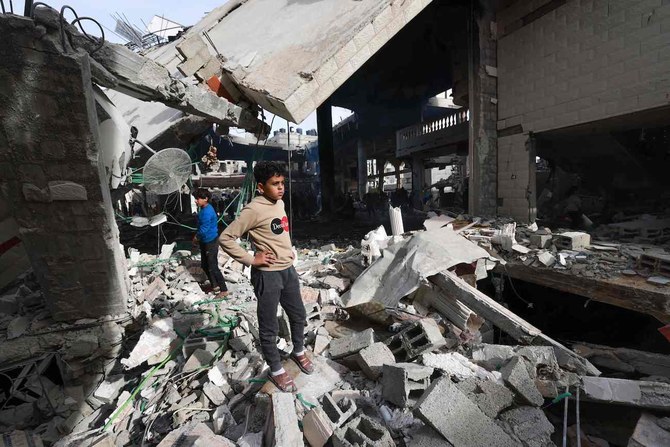

DOHA/JERUSALEM: An Israeli rescue operation freed two Israeli-Argentine hostages held by Hamas militants in Rafah on Monday, but supporting airstrikes killed nearly 70 Palestinians in the southern Gaza city where about one million displaced civilians have sought refuge from months of bombardments.
The mission by the Israeli military, the Shin Bet security service and a special police unit freed Fernando Simon Marman, 60, and Louis Hare, 70, the military said. They were among 250 people seized during the Oct. 7 raid by Hamas militants that triggered Israel’s war on Gaza.
More than four months on, much of the densely-populated strip of land on the Mediterranean is in ruins, with 28,340 Palestinians dead and 67,984 wounded, according to Gaza health officials, with many others believed to be buried under rubble.
The Israeli military says 31 hostages have died in that time, but Prime Minister Benjamin Netanyahu said Monday’s rescue showed that military pressure should continue and he brushed aside international alarm at its plans for a ground assault on Rafah.
“Fernando and Louis, welcome home,” he said, saluting the Israeli forces who rescued them. “Only continued military pressure, until total victory, will bring about the release of all of our hostages.”
The Gaza health ministry said 67 Palestinians had been killed overnight and the number could rise as rescue operations were under way. A Reuters journalist at the scene saw a vast area of rubble where buildings, including a mosque, had been destroyed.
“I’ve been collecting my family’s body parts since the morning, said Ibrahim Hassouna as a woman knelt over the body of a young child nearby. “I only recognized their toes or fingers.”
An Israeli military spokesman said the hostages were being held on the second floor of a building that was breached with explosives during the raid amid heavy exchanges of gunfire with surrounding buildings.
“We’ve been working a long time on this operation,” Lt Col. Richard Hecht said. “We were waiting for the right conditions.”
The Argentine government thanked Israel for the rescue of the two men, who it said were dual nationals. Video footage showed them hugging relatives in Israel’s Sheba hospital, looking frail but relieved.
“Last prayers”
Israel’s military said airstrikes had coincided with the raid to allow its forces to be extracted.
Hassouna, displaced with his relatives from northern Gaza, said they were killed at least 4 km (2 miles) from the military operation.
“We have nothing to do with anything. Why did you bomb us?” he asked.
People in Rafah said two mosques and several residential buildings were hit in more than an hour of strikes by Israeli warplanes, tanks and ships which caused widespread panic.
“Death was so near as shells and missiles landed 200 meters from our tent camp,” businessman Emad, a father of six, told Reuters via a chat app. He said it was the worst night of bombing since they arrived in Rafah last month.
Some feared Israel had begun a long-expected ground offensive in the city, where more than a million people displaced by the war are sheltering with nowhere else to go.
“My family and I said our last prayers,” Emad said.
A relative of one of the hostages said he had seen both freed men following their rescue and found them “a bit frail, a bit thin, a bit pale” but overall in good condition.
Idan Bejerano, Hare’s son-in-law, said the hostages had been sleeping when “within a minute” the commandos were in the building and covering them as they fought the captors.
Hamas said the attack on Rafah was a continuation of a “genocidal war” and forced displacement attempts Israel has waged against the Palestinian people.
Hamas militants killed 1,200 people in southern Israel, in the Oct. 7 incursion that sparked the war, according to Israeli tallies. Israel said it had killed more than 12,000 Hamas militants and taken out three-quarters of its battalions, of which it said earlier that four were in Rafah.
Dutch court blocks export of fighter jet parts to Israel
Many Western leaders have expressed alarm at Israel’s offensive while continuing to support the country.
However, a Dutch appeals court said it had blocked the export of F-35 fighter jets parts to Israel over a “clear risk of violations of international humanitarian law” in Gaza.
Israeli government spokeperson Eylon Levy said Israel was fighting to prevent “extremism and terrorism from spiralling further in Europe” and expected its allies to stand by it.
Britain urged Israel to agree to a truce to free its hostages rather than attack Rafah where people were trapped.
Foreign Secretary David Cameron said: “We think it is impossible to see how you can fight a war among these people. There’s nowhere for them to go.”
US President Joe Biden says Israel needs a credible evacuation plan. Israel’s Levy called on UN aid agencies to help. “Work with us to find a way,” he said.
Aid agencies say an assault on Rafah would be catastrophic. Egypt has reinforced its border with the city, saying it fears Gazans will be pushed across, never to return.
An Israeli official has said people will be evacuated further north, but its forces are also active in central Gaza. Palestinian medics said 15 people had been killed in an airstrike in the central town of Deir Al-Balah.
A senior Hamas leader said at the weekend that any Israeli ground offensive in Rafah would “blow up” hostage-exchange negotiations.
The US and other Western leaders hope Middle Eastern countries will help rebuild Gaza after the war. The United Arab Emirates’ ambassador to the United Nations said for that to happen, there must be an “irreversible progression” toward a two-state solution to decades of Israeli-Palestinian conflict — each side recognizing the other’s right to their own state.


