Ukraine aid package clears key procedural vote in US Senate

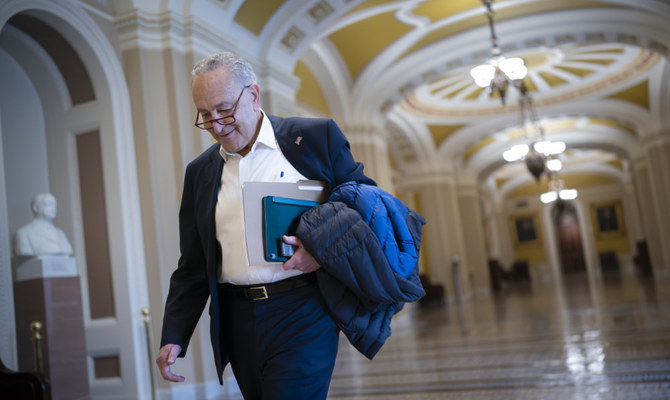
Senate Majority Leader Chuck Schumer, D-NY, arrives as the Senate prepares to take a procedural vote on an emergency spending package that would provide military aid to Ukraine and Israel, replenish US weapons systems and provide food, water and other humanitarian aid to civilians in Gaza, at the Capitol in Washington, Feb. 11, 2024. (AP)
Short Url
Updated 12 February 2024
Follow

Ukraine aid package clears key procedural vote in US Senate

  • The Senate, which has a very slim Democratic majority, voted 67-27 to break a procedural hold placed on the bill, making it almost certain it will pass a final simple-majority vote around midweek

WASHINGTON: A sweeping US foreign aid package, including $60 billion for Ukraine, passed a key procedural vote Sunday, although opposition from right-wing Republicans may block it from becoming law.
The $95 billion package includes funding for Israel’s fight against Hamas militants and for key strategic ally Taiwan, but the lion’s share would help pro-Western Ukraine restock depleted ammunition supplies, weapons and other crucial needs as it enters a third year of war.
The Senate, which has a very slim Democratic majority, voted 67-27 to break a procedural hold placed on the bill, making it almost certain it will pass a final simple-majority vote around midweek.
It is unusual for the Senate to hold votes on the weekend, with Sunday’s session also coinciding with the all-important NFL championship game.
“I can’t remember the last time the Senate was in session on Super Bowl Sunday, but as I’ve said all week long, we’re going to keep working on this bill until the job is done,” Senate Majority Leader Chuck Schumer said before the vote.
“As we speak, Vladimir Putin’s invasion of Ukraine has rendered parts of Eastern Europe a war zone the likes of which we have not seen in those regions since the Second World War,” the New York senator said.
“The only right answer to this threat is for the Senate to face it down unflinchingly, by passing this bill as soon as we can.”
The aid had looked dead in the water after Republicans rejected an earlier version on Wednesday that also featured many of the Mexico border security measures they had spent months championing.
Under pressure from ex-president Donald Trump, who is running for office again and wants to exploit Joe Biden’s perceived weakness on immigration, Republicans instead appeared to decide that they would prefer stopping any border reforms until after November’s election.
But Republican senators relented in a dramatic vote Thursday after the Democrats, who have a slim majority in the upper chamber, decoupled the aid from the border issue entirely.
The two parties have been able to agree on little ahead of the elections. However, much of the dysfunction has been blamed directly on Trump, who looks almost certain to be the Republican standard-bearer in November despite losing the presidency to Biden in 2020 and being embroiled in criminal charges.
Senate Republicans originally demanded border security as a condition for supporting pro-Western Ukraine as it battles the invasion launched by Putin in February 2022.
But Trump is running for a return to the White House on a platform centered on accusing Biden of failing to resolve the border issue.
A hard-fought bipartisan compromise — combining Ukraine and Israel aid with some of the toughest immigration curbs in decades — was initially celebrated as a breakthrough on some of the most consequential issues facing the country.
However, the plan collapsed within days of its weekend release, as Trump warned lawmakers to reject it.
Even if the foreign aid advances from the Senate, it would still have to pass through the much more Trump-friendly House of Representatives.
Republican House Speaker Mike Johnson has not revealed whether he would be willing even to put a foreign aid-only bill on the floor for a vote.
Ukraine’s President Volodymyr Zelensky posted on X, formerly Twitter, that the vote was a “very important first step” in freeing up more aid for his country, and a “bad day” for the Russian president.


Russia and Ukraine trade attacks as US and European officials prepare for peace talks

Updated 5 sec ago
Follow

Russia and Ukraine trade attacks as US and European officials prepare for peace talks

Moscow pounded Ukrainian power infrastructure with drone and missile strikes on Saturday and Kyiv launched a deadly strike of its own on southwestern Russia, a day before talks involving senior European and US officials aimed at ending the war were set to resume.
Ukrainian President Volodymyr Zelensky said Ukrainian, US and European officials will hold a series of meetings in Berlin in the coming days, adding that he will personally meet with US President Donald Trump’s envoys.
“Most importantly, I will be meeting with envoys of President Trump, and there will also be meetings with our European partners, with many leaders, concerning the foundation of peace — a political agreement to end the war,” Zelensky said in an address to the nation late Saturday.
Trump’s special envoy Steve Witkoff and his son-in-law Jared Kushner are traveling to Berlin for the talks, according to a White House official, who spoke on condition of anonymity.
American officials have tried for months to navigate the demands of each side as Trump presses for a swift end to Russia’s war and grows increasingly exasperated by delays. The search for possible compromises has run into major obstacles, including which combatant will get control of Ukraine’s eastern Donbas region, which is mostly occupied by Russian forces.
“The chance is considerable at this moment, and it matters for our every city, for our every Ukrainian community,” Zelensky said. “We are working to ensure that peace for Ukraine is dignified, and to secure a guarantee — a guarantee, above all — that Russia will not return to Ukraine for a third invasion.”
As diplomats push for peace, the war grinds on.
Russia attacked five Ukrainian regions overnight, targeting the country’s energy and port infrastructure. Zelensky said the attacks involved more than 450 drones and 30 missiles. And with temperatures hovering around freezing, Ukraine’s interior minister, Ihor Klymenko, said more than a million people were without electricity.
An attack on Odesa caused grain silos to catch fire at the coastal city’s port, Ukrainian deputy prime minister and reconstruction minister Oleksiy Kuleba said. Two people were wounded in attacks on the wider Odesa region, according to regional head Oleh Kiper.
Kyiv and its allies say Russia is trying to cripple the Ukrainian power grid and deny civilians access to heat, light and running water for a fourth consecutive winter, in what Ukrainian officials call “weaponizing” the cold.
The drone attack in Russia’s Saratov region damaged a residential building and killed two people, said the regional governor, Roman Busargin, who didn’t offer further details. Busragin said the attack also shattered windows at a kindergarten and clinic. Russia’s Defense Ministry said it shot down 41 Ukrainian drones over Russian territory overnight.
On the front lines, Ukrainian forces said Saturday that the northern part of Pokrovsk was under Ukrainian control, despite Russia’s claims this month that it had taken full control of the critical city. The Associated Press was not able to independently verify the claims.
The latest attacks came after Kremlin foreign affairs adviser Yuri Ushakov reaffirmed Friday that Moscow will give its blessing to a ceasefire only after Ukraine’s forces have withdrawn from parts of the Donetsk region that they still control.
Ukraine has consistently refused to cede the remaining part of the region to Russia.
Ushakov told the business daily Kommersant that Russian police and national guard troops would stay in parts of eastern Ukraine’s Donbas even if they become a demilitarized zone under a prospective peace plan — a demand likely to be rejected by Ukraine as US-led negotiations drag on.
Ushakov warned that a search for compromise could take a long time, noting that the US proposals that took into account Russian demands had been “worsened” by alterations proposed by Ukraine and its European allies.
“We don’t know what changes they are making, but clearly they aren’t for the better,” Ushakov said, adding: “We will strongly insist on our considerations.”
In other developments, about 480 people were evacuated Saturday from a train traveling between the Polish city of Przemysl and Kyiv after police received a call concerning a threat on the train, Karolina Kowalik, a spokesperson for the Przemysl police, told The Associated Press. Nobody was hurt and she didn’t elaborate on the threat.
Polish authorities are on high alert since multiple attempts to disrupt trains on the line linking Warsaw to the Ukrainian border, including the use of explosives in November, with Polish authorities saying they have evidence Russia was behind it.