Pakistan reminds Hajj 2024 pilgrims to submit travel documents to banks before Feb. 26

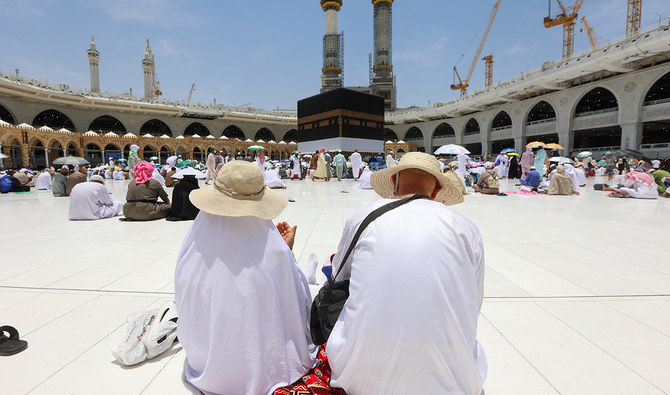
Muslim pilgrims gather around the Kaaba, Islam's holiest shrine, at the Grand Mosque in the holy city of Mecca on June 30, 2023 during the annual Hajj pilgrimage. (AFP/File)
Short Url
Updated 11 February 2024
Follow

Pakistan reminds Hajj 2024 pilgrims to submit travel documents to banks before Feb. 26

  • Over 63,000 Pakistani pilgrims expected to perform annual Islamic pilgrimage under government’s scheme 
  • Saudi Arabia has restored Pakistan’s pre-pandemic Hajj quota of 179,210 pilgrims for this year’s Hajj pilgrimage 

ISLAMABAD: Pakistan’s religion ministry this week reminded the country’s Hajj 2024 pilgrims to submit their travel documents and confirmation emails to concerned banks before Feb. 26.

Pakistan announced the results of a draw for Hajj 2024 last December, with more than 63,000 applicants selected for the pilgrimage under the government scheme. Those remaining will be applying for the pilgrimage through private tour operators.

“Hajj Pilgrims can complete their biometrics at home through the Visa Bio app,” the religion ministry wrote on social media platform X on Saturday. “And submit confirmation emails along with passports to the concerned banks before 26th February.”

Hajj is an annual Islamic pilgrimage that is one of the five pillars of Islam. Every adult Muslim is required to undertake a journey to the holy Islamic sites in Makkah at least once in their lifetime if they are financially and physically able.

Saudi Arabia has restored Pakistan’s pre-pandemic Hajj quota of 179,210 pilgrims and abolished the upper age limit of 65 years to perform the annual Islamic pilgrimage. More than 81,000 Pakistani pilgrims performed Hajj under the government scheme in 2023 while the rest used private tour operators.

Pakistani Religious Affairs Minister Aneeq Ahmed met Saudi Arabia’s Ambassador Nawaf Bin Said Al-Malki in Islamabad on Feb. 1 to discuss finalizing arrangements for the pilgrimage.



Pakistan’s seafood exports to China rise 24% to $240 million in 2025

Updated 17 sec ago
Follow

Pakistan’s seafood exports to China rise 24% to $240 million in 2025

  • The Chinese embassy cites strong growth in agricultural trade with Pakistan
  • Islamabad aims to expand food exports amid effort to boost foreign reserves

ISLAMABAD: Pakistan’s seafood exports to China rose 24% year-on-year to $240 million in the first 11 months of 2025, the Chinese embassy in Islamabad said on Wednesday, highlighting growing agricultural trade between the two countries.

China is one of Pakistan’s largest seafood export markets, alongside destinations such as Thailand, Vietnam and countries in the Middle East. Pakistan exports fish, shrimp and other marine products sourced from coastal areas in Balochistan and Sindh, including Gwadar, Pasni and Karachi, with shipments typically consisting of frozen fish, frozen shrimp and a smaller volume of processed seafood.

The figure cited by the Chinese embassy fits into a longer upward trend, supported by rising Chinese demand, improvements in cold-chain logistics and market access approvals for Pakistani exporters.

“Pakistan’s seafood exports to China hit [nearly] $240 million from Jan-Nov 2025, soaring by 24% compared with the same period in 2024, which fully shows the strong vitality of the agricultural trade between China & Pakistan,” the embassy said. “[China looks] forward to more export of high-quality Pakistani products to China in the future.”

China is Pakistan’s closest regional ally and a key destination for its agricultural and food exports, which Islamabad has been seeking to expand to bolster foreign exchange earnings.

The two countries enjoy strong strategic and economic cooperation, with Chinese support seen as vital to Pakistan’s efforts to diversify its export base beyond textiles and reduce reliance on external financing.

Beijing and Islamabad are also working closely on energy and infrastructure projects as part of broader efforts to enhance regional connectivity and support industrial development in Pakistan.