

Saudi Embassy in UK celebrates first International Day of the Arabian Leopard at London Zoo

1 / 7
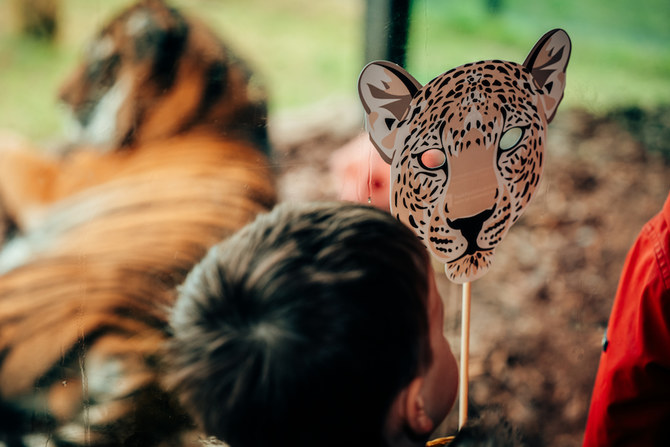
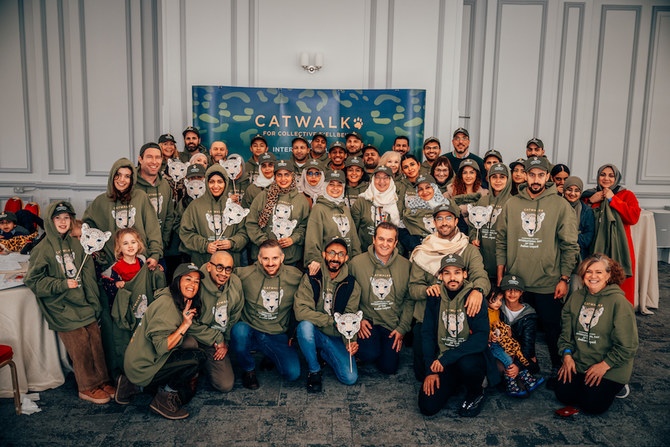
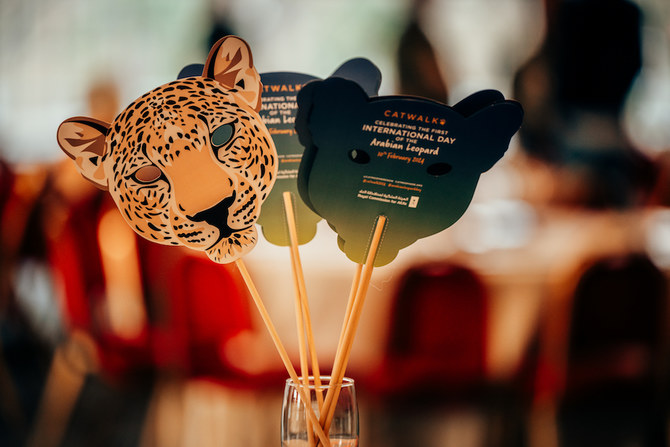
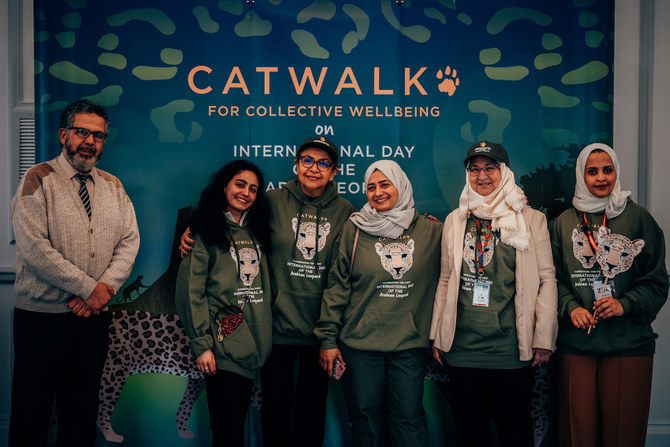
The Saudi Embassy in the UK on Saturday invited families and visitors to celebrate the first International Day of the Arabian Leopard at London Zoo. (Supplied)
2 / 7
The Saudi Embassy in the UK on Saturday invited families and visitors to celebrate the first International Day of the Arabian Leopard at London Zoo. (Supplied)
3 / 7
The Saudi Embassy in the UK on Saturday invited families and visitors to celebrate the first International Day of the Arabian Leopard at London Zoo. (Supplied)
4 / 7
The Saudi Embassy in the UK on Saturday invited families and visitors to celebrate the first International Day of the Arabian Leopard at London Zoo. (Supplied)
5 / 7
The Saudi Embassy in the UK on Saturday invited families and visitors to celebrate the first International Day of the Arabian Leopard at London Zoo. (Supplied)
6 / 7
The Saudi Embassy in the UK on Saturday invited families and visitors to celebrate the first International Day of the Arabian Leopard at London Zoo. (Supplied)
7 / 7
The Saudi Embassy in the UK on Saturday invited families and visitors to celebrate the first International Day of the Arabian Leopard at London Zoo. (Supplied)
Short Url
Updated 16 February 2024
Follow

Saudi Embassy in UK celebrates first International Day of the Arabian Leopard at London Zoo

  • Full-day event was hosted by Royal Commission for AlUla and Catmosphere

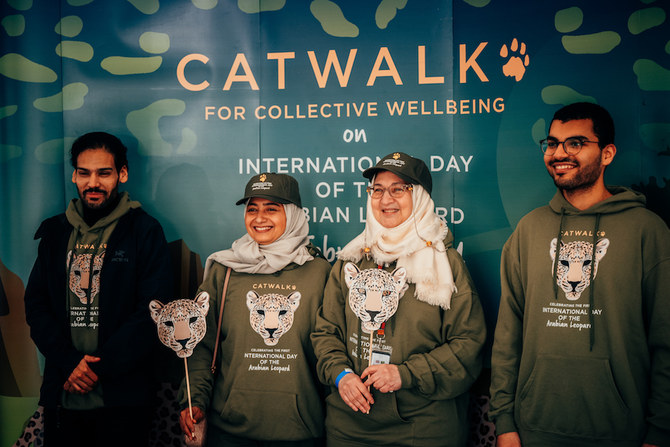
LONDON: The Saudi Embassy in the UK on Saturday invited families and visitors to celebrate the first International Day of the Arabian Leopard at London Zoo and take part in the third annual Catwalk.
The full-day event was hosted by the Royal Commission for AlUla and Catmosphere, a foundation that encourages people to take action to protect the environment and habitats of big cats.

“The Royal Commission for AlUla has responsibility across the Kingdom to bring back the Arabian leopard, and part of that work is to raise awareness of the plight of the Arabian leopard,” Stephen Browne, vice president of wildlife and natural heritage at RCU, told Arab News.

The day has been marked by Saudi Arabia for the last three years, but this year saw it celebrated globally after Catmosphere and the Arabian Leopard Fund collaborated with the Saudi Mission to the UN in New York to gain international recognition for the day on Feb. 10 each year.

“The result of that designation is now we have the first international day recognizing a big cat species, and the importance of that is that we can bring together people across the world to unite behind the species to then improve its conservation, but also to raise awareness about conservation globally,” Browne said.
He added that RCU wanted to make the initiative global and chose various places worldwide, including in London at the world’s oldest scientific zoo, to try to engage as much as possible with international experts and organizations.
“The Zoological Society of London is one of the world’s best and oldest conservation organizations, having been in existence for 200 years, and we hope in due course to partner with them and hopefully they’ll be able to support us in our work in AlUla,” Browne said.
“Anywhere in the world that has endangered cats, which is pretty much everywhere, we’d like them to take part in this to raise awareness (of) big cats and their conservation, also through our endeavors to get people to get out and about to improve their own well-being by doing exercise, by being out, meeting people, discussing topics, enjoying green spaces. So it’s more than just the conservation of big cats.”
There are less than 200 Arabian leopards left in the wild in the world, which puts this species at a higher risk of extinction, and baby leopards are very rare, Browne said.

“It’s very hard for members of the public to actually contribute directly through anything, so events like this allow people to engage in conservation by helping to raise awareness, by drawing sort of media attention,” he added.
“But in terms of beyond the Arabian leopard, if you look at the Catwalk, which is for seven species, it’s possible that people could actually engage on the ground by doing the various initiatives in their respective countries.”
Leopards in Saudi Arabia have a long cultural association, particularly in AlUla, which has rock carvings going back 7,000 years.
“It’s a species that people have related to for a long time, and we’re trying to use it as an emblem around which people can build national pride in that species, maybe national pride in conservation,” Browne said.
But to bring back the Arabian leopard, its whole ecosystem must also be brought back, developed and protected, including its food and the grasslands that the leopard food feeds on, habitat enhancement and reintroducing new species, he added.

In 2021, Catmosphere, which was founded by Saudi Ambassador to the US Princess Reema bint Bandar, launched a flagship mass-participation campaign called Catwalk. 
The annual, global, outdoor walk of up to 7 km is designed to raise awareness of our interconnected wellbeing by highlighting the plight of the seven species of big cats.
“Catwalk invites participants to get active in nature as a way of underlining the critical need that big cats have for their natural habitats, while simultaneously triggering appreciation of the physical and mental benefits of outdoor physical activity,” the Saudi Embassy in Washington DC said in November 2022.
In 2021 and 2022 cumulatively, the initiative inspired more than 90,000 people to walk to support conservation and well-being in 136 countries.
Dr. Amal Fatani, the Saudi cultural attache to the UK, expressed pride that the day was being marked in many cities worldwide, including more than 16 locations in Riyadh.
She said 350 Saudi students in the UK registered to attend the event at London Zoo along with their families, while more than 35 cultural bureaus also registered to attend.
“You can tell by the number of people here today that they are totally enjoying it but also learning about it … This is very important,” Fatani added.


Blacklisted naphtha tanker from Russia enters Venezuelan waters while another diverts, ship data shows

Updated 56 min 28 sec ago
Follow

Blacklisted naphtha tanker from Russia enters Venezuelan waters while another diverts, ship data shows

  • Under U.S. sanctions related to Russia, the ship has a different sanctions profile than Skipper, the tanker that was seized by the U.S. on December 10

HOUSTON: A tanker subject to U.S. sanctions carrying some 300,000 barrels of naphtha from Russia entered Venezuelan waters late ​on Thursday, while another began redirecting course in the Atlantic Ocean, ship tracking data showed, a reflection of diverging last-minute decisions by ship owners after President Donald Trump ordered a "blockade" of oil tankers under sanctions bound for the OPEC country earlier this week.
The move ramped up pressure on Venezuelan president Nicolas Maduro by targeting the country's main source of income and followed the seizure by the U.S. of an oil tanker off the coast of Venezuela earlier in December.
Vessels that were not subject to sanctions began setting sail on Wednesday from Venezuelan waters after a week's pause, helping drain the country's mounting crude stocks.

HIGHLIGHTS

• Trump's 'blockade' aims to halt sanctioned oil tankers to Venezuela

• Hyperion's sanctions profile differs from seized Skipper tanker

• Venezuela condemns US actions as violating international law

Gambia-flagged medium tanker Hyperion docked on Friday at Amuay ‌Bay on Venezuela's ‌western coast, according to LSEG ship tracking data. It loaded near ‌Murmansk ⁠in ​Russia in ‌late November.
Under U.S. sanctions related to Russia, the ship has a different sanctions profile than Skipper, the tanker that was seized by the U.S. on December 10.
The U.S. can only seize vessels outside of its jurisdiction, or vessels that aren't heading to or from the country, if Washington has placed them under sanctions for links to groups it designates as terrorist, said David Tannenbaum, a director at consulting firm Blackstone Compliance Services that specializes in sanctions and anti-money laundering compliance.
Skipper, formerly called the Adisa, was under sanctions for what the U.S. says was involvement in Iranian oil trading that generated ⁠revenue for Iranian groups it has designated as foreign terrorist organizations.
With the Hyperion, though, sanctions were imposed to reduce Russian revenues from energy because of ‌its war with Ukraine.
"The Hyperion doesn't have known ties to ‍terrorism, and therefore unless they can prove it's subject ‍to the jurisdiction of the U.S., Washington can't grab it extraterritorially," said Tannenbaum, who previously worked with the ‍U.S. Treasury's Office of Foreign Assets Control that administers and enforces economic and trade sanctions.

REDIRECTS AND U-TURNS
The Angola-flagged Agate, another medium tanker under sanctions that loaded in Russia and had been sailing toward the Caribbean, was seen redirecting on Friday, according to LSEG ship tracking. The vessel was pointing towards Africa, but had not yet signaled a new destination.
Oman-flagged Garnet, also under sanctions ​and loaded in Russia, continued on its track, signaling the Caribbean as its destination on Friday.
Benin-flagged tanker Boltaris, under sanctions and carrying some 300,000 barrels of Russian naphtha bound for Venezuela, made ⁠a U-turn earlier this month and was heading for Europe without having discharged, according to LSEG vessel monitoring data.
Two very large crude carriers not subject to sanctions set sail for China on Thursday from Venezuela, according to sources familiar with Venezuela's oil export operations, marking only the second and third tankers unrelated to Chevron to depart the country since the U.S. seized Skipper.
The American oil major, which has continued to ship Venezuelan crude under a U.S. authorization, exported a crude cargo on Thursday bound for the U.S., LSEG data showed.
Secretary of State Marco Rubio on Friday said the U.S. was not concerned about the four vessels that sailed from Venezuela on Thursday, as those were not ships under sanctions.
"Sanctioned boats, we have the capabilities necessary to enforce our laws. We'll have a judicial order, we'll execute on those orders and there's nothing that will impede us from being able to do that," Rubio said.
Venezuela's government ‌called Trump's blockade a "grotesque threat" in a statement on Tuesday, saying it violates international law, free commerce and the right of free navigation.