

US destroys Houthi boats, cruise missiles in Yemen

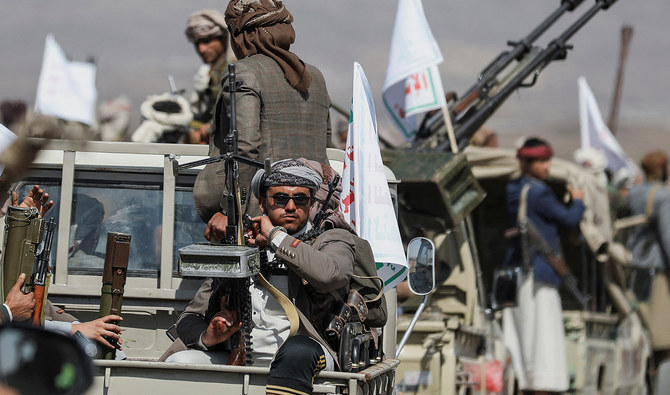
Houthi tribesmen gather to show defiance after U.S. and UK air strikes on Houthi positions near Sanaa, Yemen February 4, 2024. (Reuters)
Short Url
Updated 10 February 2024
Follow

US destroys Houthi boats, cruise missiles in Yemen

  • CENTCOM said on X that its forces carried out “self-defense strikes” on Friday
  • US and UK have conducted dozens of strikes on Houthi-controlled areas of Yemen

AL-MUKALLA: The US Central Command said on Saturday that it had destroyed numerous Houthi missiles and explosive-laden remotely operated boats in Yemen as the Yemeni militia rejected America’s ultimatum to cease attacks before its decision to redesignate the Houthis as “global terrorists” takes effect on Feb. 16.

CENTCOM said on X that its forces carried out “self-defense strikes” on Friday, targeting two explosive-laden Houthi drone boats, four anti-ship cruise missiles, and one land-attack cruise missile that were ready to launch against US Navy and commercial ships in the Red Sea.

“These actions will protect freedom of navigation and make international waters safer and more secure for the US Navy and merchant vessels,” it added.

Houthi official media said on Friday that the US and the UK conducted two strikes on Baqoum district in the northern province of Saada, the militia’s stronghold, but made no mention of any assaults on their naval forces. 

Since Jan. 12, the US and the UK have conducted dozens of strikes on Houthi-controlled areas of Yemen, targeting radar stations, missile and drone launchers, military sites, ammunition depots, and other locations — attacks that the two countries say are intended to degrade Houthi military power and force the group to stop their attacks in the Red Sea.

The new round of bombings came as the Houthis ignored Washington’s request to end their Red Sea operations by Feb. 16, before the terror-designation decision is due to come into effect.

Stephen Fagin, US ambassador to Yemen, said earlier that the US would remove the Houthis’ terrorist label if the Yemeni militia stopped attacking ships in the Red Sea and the Gulf of Aden by Friday.

“The designation of the Houthis as a terrorist group will take effect Feb. 16, but it can be reviewed if the Houthi militia ceases their activities in the Red Sea and the Gulf of Aden,” Fagin said on X.

The Houthis warned they would continue to attack ships in the Red Sea, Bab Al-Mandab, and the Gulf of Aden, and threatened to expand those attacks if Israel did not lift its blockade on Gaza.

Abdulsalam Jahaf, a member of the Houthi Shoura Council, said on X that if Israel does not end its war in Gaza, or if the US and UK continue to bombard parts of Yemen under their control, they will launch more attacks on ships, adding that the Houthis are not concerned about the US terrorism designation.

“The terrorism card does not (frighten) us, but rather assures us that we are on the right track, and it is a badge of pride,” Jahaf said. 

The Houthis have seized commercial ships and fired dozens of drones and missiles against commercial and naval ships in seas around Yemen, enforcing their ban on any Israeli-linked or Israeli-affiliated ships passing through the Red Sea. The Houthis say that their strikes are intended to force Israel to end its embargo on Gaza.

Asked about the US ambassador’s ultimatum to the Houthis, Elisabeth Kendall, a Middle East expert and mistress of Girton College at Cambridge University, told Arab News that the US knows the Houthis will not stop their attacks before the Feb. 16 deadline, but has set the ultimatum in order to indicate it has exhausted its options before resuming or expanding its military operations.

“It is not in the nature of the Houthi leadership to respond positively to ultimatums. Presumably, the US leadership knows this and is simply issuing an ultimatum so that it can claim that all routes had been tried before continuing or escalating its military operations,” she said.


Palestinians attempt to use Gaza’s Rafah Border crossing amidst delays

Updated 08 February 2026
Follow

Palestinians attempt to use Gaza’s Rafah Border crossing amidst delays

  • The Rafah Crossing opened to a few Palestinians in each direction last week, after Israel retrieved the body of the last hostage held in Gaza and several American officials visited Israel to press for the opening

CAIRO: Palestinians on both sides of the crossing between Gaza and Egypt, which opened last week for the first time since 2024, were making their way to the border on Sunday in hopes of crossing, one of the main requirements for the US-backed ceasefire. The opening comes as Prime Minister Benjamin Netanyahu is expected to travel to Washington this week, though the major subject of discussion will be Iran, his office said.
The Rafah Crossing opened to a few Palestinians in each direction last week, after Israel retrieved the body of the last hostage held in Gaza and several American officials visited Israel to press for the opening. Over the first four days of the crossing’s opening, just 36 Palestinians requiring medical care were allowed to leave for Egypt, plus 62 companions, according to United Nations data.
Palestinian officials say nearly 20,000 people in Gaza are seeking to leave for medical care that they say is not available in the war-shattered territory. The few who have succeeded in crossing described delays and allegations of mistreatment by Israeli forces and other groups involved in the crossing, including and an Israeli-backed Palestinian armed group, Abu Shabab.
A group of Palestinian patients and wounded gathered Sunday morning in the courtyard of a Red Crescent hospital in Gaza’s southern city of Khan Younis, before making their way to the Rafah crossing with Egypt for treatment abroad, family members told The Associated Press.
Amjad Abu Jedian, who was injured in the war, was scheduled to leave Gaza for medical treatment on the first day of the crossing’s reopening, but only five patients were allowed to travel that day, his mother, Raja Abu Jedian, said. Abu Jedian was shot by an Israeli sniper while he was building traditional bathrooms in the central Bureij refugee camp in July 2024, she said.
On Saturday, his family received a call from the World Health Organization notifying them that he is included in the group that will travel on Sunday, she said.
“We want them to take care of the patients (during their evacuation),” she said. “We want the Israeli military not to burden them.”
The Israeli defense branch that oversees the operation of the crossing did not immediately confirm the opening.
A group of Palestinians also arrived Sunday morning at the Egyptian side of the Rafah crossing border to return to the Gaza Strip, Egypt’s state-run Al-Qahera News satellite television reported.
Palestinians who returned to Gaza in the first few days of the crossing’s operation described hours of delays and invasive searches by Israeli authorities and an Israeli-backed Palestinian armed group, Abu Shabab. A European Union mission and Palestinian officials run the border crossing, and Israel has its screening facility some distance away.
The crossing was reopened on Feb. 2 as part of a fragile ceasefire deal that stopped the war between Israel and Hamas. Amid confusion around the reopening, the Rafah crossing was closed Friday and Saturday.
The Rafah crossing, an essential lifeline for Palestinians in Gaza, was the only crossing not controlled by Israel prior to the war. Israel seized the Palestinian side of Rafah in May 2024, though traffic through the crossing was heavily restricted even before that.
Restrictions negotiated by Israeli, Egyptian, Palestinian and international officials meant that only 50 people would be allowed to return to Gaza each day and 50 medical patients — along with two companions for each — would be allowed to leave, but far fewer people than expected have crossed in both directions.
