

Palestinian groups say UN official failed to warn of possible Gaza genocide

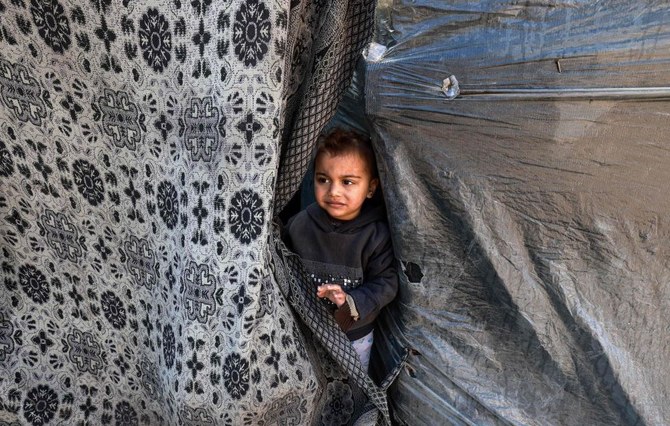
A child peeks out of a tent sheltering displaced Palestinians in Rafah, southern Gaza Strip, Feb. 8, 2024. (AFP)
Short Url
Updated 08 February 2024
Follow

Palestinian groups say UN official failed to warn of possible Gaza genocide

  • Alice Wairimu Nderitu has only issued one statement since Oct. 7 attacks on Israel
  • Groups tell Guterres she has failed to engage with them, canceled meetings

LONDON: Palestinian human rights organizations have accused UN Special Advisor on the Prevention of Genocide Alice Wairimu Nderitu of failing to warn of a possible genocide in Gaza. 

Sixteen groups have written to UN Secretary-General Antonio Guterres after Nderitu issued a statement in October that failed to criticize Israel for its military actions in Gaza, saying only “innocent civilians should never pay the price of a conflict for which they bear no responsibility.”

The signatories complained there had been a “glaring absence of any action in response to the sustained mass atrocities endured by Palestinians in Gaza,” and that the statement by Nderitu raised “significant concerns about the special adviser’s capability to execute her mandate with due effectiveness and impartiality.”

Nderitu’s role includes working on initiatives to safeguard people from crimes against humanity, genocide, war crimes and ethnic cleansing.

The groups, including the Palestinian Human Rights Council, said Nderitu had failed to engage with them on the issue of Gaza, canceled meetings with human rights advocates, failed to warn of a potential genocide in Gaza or speak out more broadly against Israel’s actions, and made no comment following the January findings by the International Court of Justice that there was a strong risk to Palestinian civilians in the enclave under the Genocide Convention.

The letter compared her to nine UN special rapporteurs who all highlighted the imminent risk of genocidal acts in Gaza on Oct. 19, eight others who did so on Nov. 2, and a further 41 UN independent experts who called for action to stop a genocide in Gaza on Nov. 16.

The letter continued, saying that “principles of genocide prevention must be universally applied, without making any special allowances or exceptions for anyone, including Israel.”

It added: “The foundation of the special adviser’s mandate is grounded in the lessons learned from past failure by the international community as a whole, including the UN, to undertake meaningful preventive efforts ahead of the genocide in Rwanda or Srebrenica.”

In January, Israel rejected allegations of genocidal behavior by its forces in Gaza. Israeli Prime Minister Benjamin Netanyahu responded to the ICJ findings, saying: “The charge of genocide leveled against Israel is not only false, it’s outrageous, and decent people everywhere should reject it.”


Israel police to deploy around Al-Aqsa for Ramadan, Palestinians report curbs

Updated 17 February 2026
Follow

Israel police to deploy around Al-Aqsa for Ramadan, Palestinians report curbs

  • The Al-Aqsa compound is a central symbol of Palestinian identity and also a frequent flashpoint

JERUSALEM: Israeli police said Monday that they would deploy in force around the Al-Aqsa Mosque during the Muslim holy month of Ramadan, which begins this week, as Palestinian officials accused Israel of imposing restrictions at the compound.
Over the course of the month of fasting and prayer, hundreds of thousands of Palestinians traditionally attend prayers at Al-Aqsa — Islam’s third-holiest site, located in east Jerusalem, which Israel captured in 1967 and later annexed.
Arad Braverman, a senior Jerusalem police officer, said forces would be deployed “day and night” across the compound, known to Jews as the Temple Mount, and in the surrounding area.
He said thousands of police would also be on duty for Friday prayers, which draw the largest crowds of Muslim worshippers.
Braverman said police had recommended issuing 10,000 permits for Palestinians from the occupied West Bank, who require special permission to enter Jerusalem.
He did not say whether age limits would apply, adding that the final number of people would be decided by the government.
The Palestinian Jerusalem Governorate said in a separate statement it had been informed that permits would again be restricted to men over 55 and women over 50, mirroring last year’s criteria.
It said Israeli authorities had blocked the Islamic Waqf — the Jordanian?run body administering the site — from carrying out routine preparations, including installing shade structures and setting up temporary medical clinics.
A Waqf source confirmed the restrictions and said 33 of its employees had been barred from entering the compound in the week before Ramadan.
The Al-Aqsa compound is a central symbol of Palestinian identity and also a frequent flashpoint.
Under long?standing arrangements, Jews may visit the compound — which they revere as the site of their second temple, destroyed by the Romans in 70 AD — but they are not permitted to pray there.
Israel says it is committed to maintaining this status quo, though Palestinians fear it is being eroded.
Braverman reiterated Monday that no changes were planned.
In recent years, a growing number of Jewish ultranationalists have challenged the prayer ban, including far?right politician Itamar Ben-Gvir, who prayed at the site while serving as national security minister in 2024 and 2025.