ISLAMABAD: At least five people were killed in militant attacks as Pakistan held a general election on Thursday after temporarily suspending mobile phone services across the country and closing some land borders to maintain law and order.
The interior ministry said it took the steps after at least 26 people were killed in two explosions near electoral candidates’ offices in the southwestern province of Balochistan on Wednesday. Islamic State later claimed responsibility for those attacks.
“As a result of the recent incidents of terrorism in the country precious lives have been lost, security measures are essential to maintain the law and order situation and deal with possible threats,” the ministry said in a post on messaging platform X.
Thousands of troops were deployed on the streets and at polling stations across the country and borders with Iran and Afghanistan were temporarily closed.
Four policemen were killed in a bomb blast and firing targeting a police patrol in the Kulachi area of Dera Ismail Khan district in the northwest, local police chief Rauf Qaisrani said.
One person was killed when gunmen opened fire on a security forces vehicle in Tank, about 40 km (25 miles) to the north.
Grenade attacks were also reported in different parts of Balochistan, but polling remained unaffected since there were no casualties, Saeed Ahmed Umrani, commissioner of the Makran division, told Reuters.
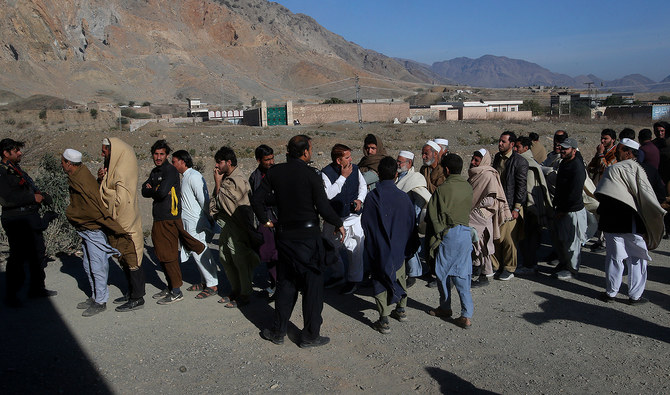
In spite of the security worries and bitter winter cold, long queues began forming at polling stations hours before voting was due to start. “The country is at stake, why should I come late?” said 86-year-old Mumtaz, a housewife a decade older than Pakistan itself as she queued up in Islamabad.
Besides militant violence, the election is also being held in the midst of a deep economic crisis and in a highly polarized political environment, and many analysts believe no clear winner may emerge.
The move to suspend mobile networks sparked criticism from leaders of opposition parties, with the Pakistan Peoples Party’s Bilawal Bhutto Zardari, the 35-year-old son of former premier Benazir Bhutto, calling for its “immediate restoration.”
“(I) have asked my party to approach both ECP (Election Commission of Pakistan) and the courts for this purpose,” he posted on X.
Chief Election Commissioner Sikandar Sultan Raja said the decision on mobile networks was made by “law and order agencies” following Wednesday’s violence and the commission would not interfere in the matter.
REMOVE PASSWORDS
Jailed former Prime Minister Imran Khan’s Pakistan Tehreek-e-Insaf (PTI) party, in a post on X, called on people to remove passwords from their personal Wifi accounts “so anyone in the vicinity can have access to Internet on this extremely important day.”
Some voters also expressed anger at the move to suspend mobile services.
“Due to this, the communication with voters and others are very difficult ... we are facing so many problems due to the Internet closure,” said 50-year-old Mehmood Chaudry, a school teacher who cast his vote in the city of Rawalpindi.
The network suspension also follows Imran Khan’s call to his supporters, who had clashed with security forces while protesting his arrest last year, to wait outside polling booths until results are announced.
Khan cast his vote via postal ballot from a prison in Rawalpindi on Thursday morning, his party’s media team told Reuters.
Unofficial first results in the election are expected a few hours after voting closes at 5 p.m. (1200 GMT) and a clearer picture is likely to emerge early on Friday.
The main contests are expected to be between candidates backed by Khan, whose party won the last national election, and the Pakistan Muslim League of three-time premier Nawaz Sharif, who is considered the front-runner.
Analysts say there may be no clear winner and the powerful military could play a role but Sharif emphasized the need for a “clear majority.”
“Don’t talk about a coalition government. It is very important for a government to get a clear majority...it should not be relying on others,” Sharif told reporters after casting his vote in the eastern city of Lahore.
The military has dominated the nuclear-armed country either directly or indirectly in its 76 years of independence but for several years it has maintained it does not interfere in politics.
“The deciding factor is which side the powerful military and its security agencies are on,” said Abbas Nasir, a columnist. “Only a huge turnout in favor of (Khan’s) PTI can change its fortunes.”
He added: “Economic challenges are so serious, grave, and the solutions so very painful that I am unsure how anyone who comes to power will steady the ship.”
If the election does not result in a clear majority for anyone, as analysts are predicting, tackling multiple challenges will be tricky — foremost being seeking a new bailout program from the International Monetary Fund (IMF) after the current one expires in March.


![]()

Five killed in Pakistan elections, mobile services suspended
Short Url
https://arab.news/4q7ze
Five killed in Pakistan elections, mobile services suspended
- Four policemen killed in bomb blast and firing targeting police patrol in Kulachi area in northwest Pakistan
- One person killed when gunmen opened fire on security forces vehicle in Tank in Khyber Pakhtunkhwa province
Latest updates


© 2026 SAUDI RESEARCH & PUBLISHING COMPANY, All Rights Reserved And subject to Terms of Use Agreement.