WASHINGTON: Wartime aid for Ukraine was left hanging in the Senate Wednesday after Republicans blocked a bipartisan border package that had been tied to the funding, then struggled to coalesce around a plan to salvage the aid for Kyiv.
After GOP senators scuttled months of negotiations with Democrats on legislation intended to cut back record numbers of illegal border crossings, Senate Majority Leader Chuck Schumer tried to push ahead to a crucial test vote on a $95 billion package for Ukraine, Israel and other US allies — a modified package with the border portion stripped out.
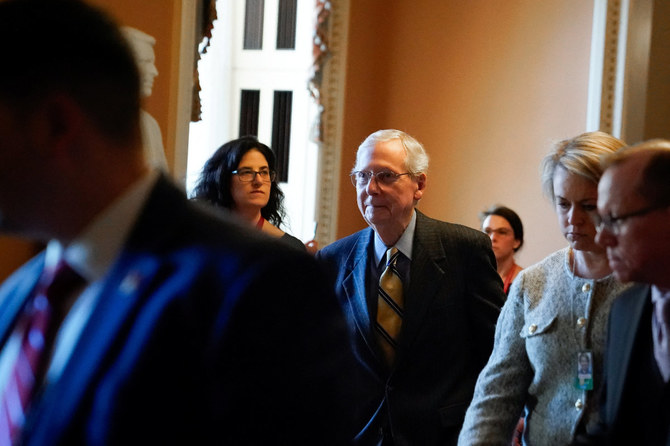
But a deeply divided Republican conference was scrambling to find support for the wartime funding, even though it has been a top priority for Senate Republican Leader Mitch McConnell. It was the latest sign of the longtime Republican leader’s slipping control over his conference and underscored how the traditional GOP tenet of robust foreign involvement is giving way to Donald Trump’s “America First” nationalism. At stake is the future of Ukraine’s defense against Russia.
The Senate floor settled into an hours-long stall Wednesday night as Republicans huddled to see if they could gain the votes necessary to push it through the chamber. Schumer then closed the floor, saying he would “give our Republican colleagues the night to figure themselves out” ahead of a crucial test vote Thursday.
Republicans planned to meet in the morning to plot a path forward.
Some GOP senators have grown skeptical of sending money to Ukraine in its war with Russia, but Schumer warned earlier Wednesday that “history will cast a permanent and shameful shadow” on those who attempt to block it.
“Will the Senate stand up to brutish thugs like Vladimir Putin and reassure our friends abroad that America will never abandon them in the hour of need?” Schumer asked as he opened the Senate.
The roughly $60 billion in Ukraine aid has been stalled in Congress for months because of growing opposition from hard-line conservatives in the House and Senate who criticize it as wasteful and demand an exit strategy for the war.
“We still need to secure America’s borders before sending another dime overseas,” Republican Sen. Mike Lee of Utah wrote in a post on X.
The impasse means that the US has halted arms shipments to Kyiv at a crucial point in the nearly two-year-old conflict, leaving Ukrainian soldiers without ample ammunition and missiles as Russian President Putin has mounted relentless attacks.
Ukraine’s cause still enjoys support from many Senate Republicans, including McConnell, but the question vexing lawmakers has always been how to craft a package that could clear the Republican-controlled House.
A pairing of border policies and aid for allies — first proposed by Republicans — was intended to help squeeze the package through the House, where archconservatives hold control. But GOP senators — some within minutes of the bill’s release Sunday — rejected the compromise as election-year politics set in.
Many Republicans said the compromise wasn’t enough and they would rather allow the issue be decided in the presidential election. Supporters of the bill insisted it represented the most comprehensive bipartisan border proposal in years and included many Republican priorities.
The vote failed 49-50 — far short of the 60 ayes needed to take up the bill — with four Republicans voting to move forward with the legislation and six Democrats, some of whom said the border compromise went too far, voting against it.
The bipartisan group of senators who negotiated the compromise for the last four months said it was a missed opportunity to try to make some progress on one of the most intractable issues in American politics.
In a speech on the Senate floor just before the vote, Republican Sen. James Lankford of Oklahoma, who crafted the proposal, said it was a chance for the Senate to decide “if we’re going to do nothing, or something.”
“It’s an issue that’s bedeviled, quite frankly, this body for decades,” Lankford said. “It’s been three decades since we’ve passed anything into law to be able to change border security.”
Independent Sen. Kyrsten Sinema of Arizona blamed Republicans for not giving the bill a chance.
“Finally, it seemed, we had the opportunity to solve the nightmare my state has lived for over 40 years,” she said, scolding Republicans for using the border for “campaign photo ops” but rejecting the chance to enact law.
“Turns out they want all talk and no action,” she said. “It turns out border security is not a risk to our national security. It’s just a talking point for the election.”
The White House said President Joe Biden believes there should be new border policy but would also support moving the aid for Ukraine and Israel alone, as he has from the start.
“We support this bill which would protect America’s national security interests by stopping Putin’s onslaught in Ukraine before he turns to other countries, helping Israel defend itself against Hamas terrorists and delivering life-saving humanitarian aid to innocent Palestinian civilians,” said White House spokesman Andrew Bates.
The standalone $95 billion package would invest in domestic defense manufacturing, send funding to allies in Asia, and provide $10 billion for humanitarian efforts in Ukraine, Israel, Gaza and other places.
The revamped package includes legislation to authorize sanctions and anti-money laundering tools against criminal enterprises that traffic fentanyl into the US A separate section of the compromise border legislation that would have provided a long-awaited pathway to residency for tens of thousands of Afghan refugees was dropped in the slimmed-down bill.
Still, it was not clear whether the new plan, even if it passed the Senate, would gain support from House Speaker Mike Johnson. House Republicans are still insisting on a border plan, even though they rejected the deal negotiated in the Senate as insufficient.
“We’ll see what the Senate does,” Johnson told reporters Wednesday morning. “We’re going to allow the process to play out.”
Some were skeptical that a standalone aid package would be viable in the House.
“I don’t see how that moves in this chamber. I don’t know how the speaker puts that on the floor,” House Armed Services Committee Chairman Mike Rogers, R-Alabama, said, adding that he still wanted tougher border policies attached.
After Donald Trump, the likely Republican presidential nominee, eviscerated the Senate’s bipartisan border proposal, Johnson quickly rejected it. Trump has also led many Republicans to question supporting Ukraine, suggesting he could negotiate an end to the war and lavishing praise on Russian President Vladimir Putin, including after Moscow’s February 2022 invasion of Ukraine.
Johnson said this week he wanted to handle wartime aid for Israel and Ukraine in separate packages, but a bill he advanced that only included funds for Israel failed on the House floor Tuesday night.
House Democratic Leader Hakeem Jeffries was still hoping the House could take up the comprehensive package next week.
“That is the only path forward,” he said.

Republican senators block bipartisan US border package, then scramble to find support for Ukraine aid
Short Url
https://arab.news/bwf4g
Republican senators block bipartisan US border package, then scramble to find support for Ukraine aid
- Republicans had sought to tie US aid for Ukraine, Israel and other allies to an illegal border crossings legislation
- When the border-wartime aid package was up for voting, Republicans killed it to deny Biden an election campaign material
Columbia student detained by ICE is abruptly released after Mamdani meets with Trump
- Ellie Aghayeva, an Azerbaijani, hasn’t been publicly linked to any of the pro-Palestinian demonstrations
- Mamdani asked Trump to drop cases against other students facing deportation for their roles in protests against Israel
NEW YORK: Federal immigration authorities arrested a Columbia University student early Thursday, triggering protests on campus along with allegations that agents had entered the university-owned residence under false pretenses.
Just hours after detaining student Ellie Aghayeva, though, the federal government abruptly reversed course, permitting her to walk free after an apparent intervention by President Donald Trump.
In a social media post Thursday afternoon, Mayor Zohran Mamdani said he expressed concerns about the arrest during an unrelated meeting with Trump, who then agreed to release her immediately.
“I am safe and okay,” Aghayeva wrote on Instagram, minutes after Mamdani’s post, adding she was in “complete shock” from the experience.
The head-spinning series of events marked the latest development to emerge from the Republican president’s unlikely relationship with a democratic socialist mayor he once threatened to have deported.
On Thursday, while pitching Trump on a massive housing project, Mamdani also called on the president to drop cases against several other current and former students facing deportation for their roles in protests against Israel.
Aghayeva, a senior from Azerbaijan studying neuroscience and politics, hasn’t been publicly linked to any of the pro-Palestinian demonstrations that roiled Columbia’s campus. A self-described content creator, she has amassed a large social media following by sharing day-in-the-life videos and tips for navigating college as an immigrant.
Early Thursday, federal agents gained entry to her apartment by claiming they were searching for a missing person, according to a petition from her lawyers and a statement released by Columbia. She quickly dashed off a message to her more than 100,000 followers on Instagram: “DHS illegally arrested me. Please help.” A photo accompanying the post appeared to show her legs in the backseat of a vehicle.
A Department of Homeland Security spokesperson said Aghayeva’s student visa had been terminated in 2016 for failing to attend classes. Inquiries to Columbia about her visa status and how long she had been enrolled in the university were not returned.
In their petition, attorneys for Aghayeva said she had entered the country on a visa in or around 2016. They declined to provide additional comment, including details about her immigration status.
A spokesperson for DHS, Tricia McLaughlin, denied allegations levied by some state officials that agents had gained entry to her apartment by posing as New York City police officers. She didn’t respond to questions about whether they had claimed to be seeking a missing person.
The use of disguises or other misrepresentations by immigration authorities has drawn attention in recent months, after federal agents were seen posing as utility workers and other service employees in Minneapolis and elsewhere.
The practice is legal, in most cases. But immigration attorneys say such ruses are becoming increasingly common, adding to concerns about the Trump administration’s dramatic reshaping of immigration enforcement tactics nationwide.
In recent weeks, Trump has once again intensified his attacks on several universities, including Harvard and UCLA. The arrest would seem to mark the first federal enforcement action against at Columbia since the university agreed to pay more than $220 million to the administration over the summer.
“It’s a horrifying sign that the roving eye of the administration is turning back to Columbia,” said Michael Thaddeus, a mathematics professor at Columbia and vice president of the university’s chapter of the American Association of University Professors, which has sued Trump. “The idea that secret police would abduct and imprison students in our midst is something we’d expect from an authoritarian regime.”
Many students and faculty called on Columbia to increase protections for international students following the arrest last March of Mahmoud Khalil, a former graduate student and pro-Palestinian activist, whose deportation case remains ongoing.
In an email to the Columbia community Thursday, acting president Claire Shipman said that residential staff had been reminded not to allow federal law enforcement into university buildings without a subpoena or warrant.
“If you encounter or observe DHS/ICE agents conducting enforcement activities on or near campus, immediately contact Public Safety,” Shipman wrote. “Do not allow them to enter non-public areas or accept service of a warrant or subpoena.”
Just hours after detaining student Ellie Aghayeva, though, the federal government abruptly reversed course, permitting her to walk free after an apparent intervention by President Donald Trump.
In a social media post Thursday afternoon, Mayor Zohran Mamdani said he expressed concerns about the arrest during an unrelated meeting with Trump, who then agreed to release her immediately.
“I am safe and okay,” Aghayeva wrote on Instagram, minutes after Mamdani’s post, adding she was in “complete shock” from the experience.
The head-spinning series of events marked the latest development to emerge from the Republican president’s unlikely relationship with a democratic socialist mayor he once threatened to have deported.
On Thursday, while pitching Trump on a massive housing project, Mamdani also called on the president to drop cases against several other current and former students facing deportation for their roles in protests against Israel.
Aghayeva, a senior from Azerbaijan studying neuroscience and politics, hasn’t been publicly linked to any of the pro-Palestinian demonstrations that roiled Columbia’s campus. A self-described content creator, she has amassed a large social media following by sharing day-in-the-life videos and tips for navigating college as an immigrant.
Early Thursday, federal agents gained entry to her apartment by claiming they were searching for a missing person, according to a petition from her lawyers and a statement released by Columbia. She quickly dashed off a message to her more than 100,000 followers on Instagram: “DHS illegally arrested me. Please help.” A photo accompanying the post appeared to show her legs in the backseat of a vehicle.
A Department of Homeland Security spokesperson said Aghayeva’s student visa had been terminated in 2016 for failing to attend classes. Inquiries to Columbia about her visa status and how long she had been enrolled in the university were not returned.
In their petition, attorneys for Aghayeva said she had entered the country on a visa in or around 2016. They declined to provide additional comment, including details about her immigration status.
A spokesperson for DHS, Tricia McLaughlin, denied allegations levied by some state officials that agents had gained entry to her apartment by posing as New York City police officers. She didn’t respond to questions about whether they had claimed to be seeking a missing person.
The use of disguises or other misrepresentations by immigration authorities has drawn attention in recent months, after federal agents were seen posing as utility workers and other service employees in Minneapolis and elsewhere.
The practice is legal, in most cases. But immigration attorneys say such ruses are becoming increasingly common, adding to concerns about the Trump administration’s dramatic reshaping of immigration enforcement tactics nationwide.
In recent weeks, Trump has once again intensified his attacks on several universities, including Harvard and UCLA. The arrest would seem to mark the first federal enforcement action against at Columbia since the university agreed to pay more than $220 million to the administration over the summer.
“It’s a horrifying sign that the roving eye of the administration is turning back to Columbia,” said Michael Thaddeus, a mathematics professor at Columbia and vice president of the university’s chapter of the American Association of University Professors, which has sued Trump. “The idea that secret police would abduct and imprison students in our midst is something we’d expect from an authoritarian regime.”
Many students and faculty called on Columbia to increase protections for international students following the arrest last March of Mahmoud Khalil, a former graduate student and pro-Palestinian activist, whose deportation case remains ongoing.
In an email to the Columbia community Thursday, acting president Claire Shipman said that residential staff had been reminded not to allow federal law enforcement into university buildings without a subpoena or warrant.
“If you encounter or observe DHS/ICE agents conducting enforcement activities on or near campus, immediately contact Public Safety,” Shipman wrote. “Do not allow them to enter non-public areas or accept service of a warrant or subpoena.”
© 2026 SAUDI RESEARCH & PUBLISHING COMPANY, All Rights Reserved And subject to Terms of Use Agreement.