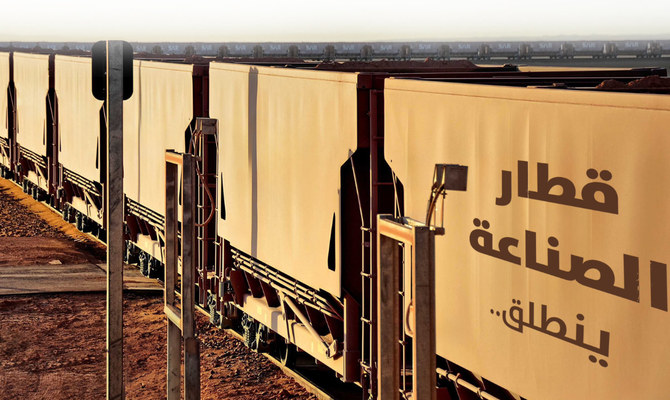
Saudi Arabia Railways transports 11m passengers, 25m tonnes of cargo in 2023

Saudi Arabia Railways said on Wednesday that the total amount of cargo transported increased by more than 25 million tonnes, which represented a growth rate in excess of 10 percent. (X: @SaudiTransport)
Short Url
Updated 08 February 2024
Follow

Saudi Arabia Railways transports 11m passengers, 25m tonnes of cargo in 2023

  • The figures were revealed as the company signed two memorandums of understanding for the development of rail transport and logistics solutions in industrial cities

RIYADH: Saudi Arabia Railways transported more than 11 million passengers in 2023, a growth rate of more than 50 percent.

The company said on Wednesday that the total amount of cargo transported increased by more than 25 million tonnes, which represented a growth rate in excess of 10 percent. This resulted in the removal of more than 2 million trucks from the nation’s roads each year, the Saudi Press Agency reported.

The figures were revealed on Wednesday as the Saudi Authority for Industrial Cities and Technology Zones, also known as MODON, and SAR signed two memorandums of understanding for the development of rail transport and logistics solutions in industrial cities, in support of the National Industrial Development and Logistics Program.

During the signing ceremony, which took place in Dammam’s 2nd Industrial City, Saleh Al-Jasser, the minister of transport and logistic services and chairman of SAR’s board of directors, said that the latest international indicators, including the Logistics Performance Index, the Quality Interdependence Index and the Maritime Interdependence Index, showed that the Kingdom is making progress in global rankings for transportation and logistics as a result of major projects in the country.

“The partnership with the industrial sector is a long-established one, which started with the construction of roads over the decades that benefit the industrial sector,” he said.

Various projects, including the development of the northern railway, have helped support the industrial and mining sectors by connecting the cities of Dammam, Jubail and Ras Al-Khair to ports in the Eastern Province, he added, and other projects are under way that will provide more benefits.

Efforts to improve the integration of transport and logistics systems with the industrial sector, through the work of the National Industrial Development and Logistics Program, reflect the importance of cooperation and integration between government sectors, Al-Jasser said, which aids the development of Saudi industry.

Speaking at the same event, Minister of Industry and Mineral Resources Bandar Alkhorayef stressed the importance of the role of the transportation and logistics sector in developing the industrial and mining industry, and consolidating the Kingdom’s position as a global logistics hub in line with the goals of Saudi Vision 2030.

Linking the industrial cities in the Riyadh and eastern regions to the train network will contribute to raising the efficiency of logistical operations in the industrial sector and opening new paths for trade and export, he said.

Alkhorayef emphasized that NIDLP plays an important role in maximizing the benefits achieved from the four sectors that it supervises — industry, mining, energy, and logistics services — noting that the cost associated with transportation is an essential element for the penetration of industrial goods and their access to local and global markets.

He went to say that railway transportation is one of the best means in terms of cost, price of products and the environment.

The minister concluded by saying that the signing of the MoUs between MODON and SAR aims to enhance integration and partnership between the industrial and transportation systems, empower industrial sector supply chains in the central and eastern regions and support supply chains with global standards.


Gulf-EU value chain integration signals shift toward long-term economic partnership: GCC secretary general

Updated 03 February 2026
Follow

Gulf-EU value chain integration signals shift toward long-term economic partnership: GCC secretary general

RIYADH: Value chains between the Gulf and Europe are poised to become deeper and more resilient as economic ties shift beyond traditional trade toward long-term industrial and investment integration, according to the secretary general of the Gulf Cooperation Council.

Speaking on the sidelines of the World Governments Summit 2026 in Dubai, Jasem Al-Budaiwi said Gulf-European economic relations are shifting from simple commodity trade toward the joint development of sustainable value chains, reflecting a more strategic and lasting partnership.

His remarks were made during a dialogue session titled “The next investment and trade race,” held with Luigi Di Maio, the EU’s special representative for external affairs.

Al-Budaiwi said relations between the GCC and the EU are among the bloc’s most established partnerships, built on decades of institutional collaboration that began with the signing of the 1988 cooperation agreement.

He noted that the deal laid a solid foundation for political and economic dialogue and opened broad avenues for collaboration in trade, investment, and energy, as well as development and education.

The secretary general added that the partnership has undergone a qualitative shift in recent years, particularly following the adoption of the joint action program for the 2022–2027 period and the convening of the Gulf–European summit in Brussels.

Subsequent ministerial meetings, he said, have focused on implementing agreed outcomes, enhancing trade and investment cooperation, improving market access, and supporting supply chains and sustainable development.

According to Al-Budaiwi, merchandise trade between the two sides has reached around $197 billion, positioning the EU as one of the GCC’s most important trading partners.

He also pointed to the continued growth of European foreign direct investment into Gulf countries, which he said reflects the depth of economic interdependence and rising confidence in the Gulf business environment.

Looking ahead, Al-Budaiwi emphasized that the economic transformation across GCC states, driven by ambitious national visions, is creating broad opportunities for expanded cooperation with Europe. 

He highlighted clean energy, green hydrogen, and digital transformation, as well as artificial intelligence, smart infrastructure, and cybersecurity, as priority areas for future partnership.

He added that the success of Gulf-European cooperation should not be measured solely by trade volumes or investment flows, but by its ability to evolve into an integrated model based on trust, risk-sharing, and the joint creation of economic value, contributing to stability and growth in the global economy.

GCC–EU plans to build shared value chains look well-timed as trade policy volatility rises.

In recent weeks, Washington’s renewed push over Greenland has been tied to tariff threats against European countries, prompting the EU to keep a €93 billion ($109.7 billion) retaliation package on standby. 

At the same time, tighter US sanctions on Iran are increasing compliance risks for energy and shipping-related finance. Meanwhile, the World Trade Organization and UNCTAD warn that higher tariffs and ongoing uncertainty could weaken trade and investment across both regions in 2026.