

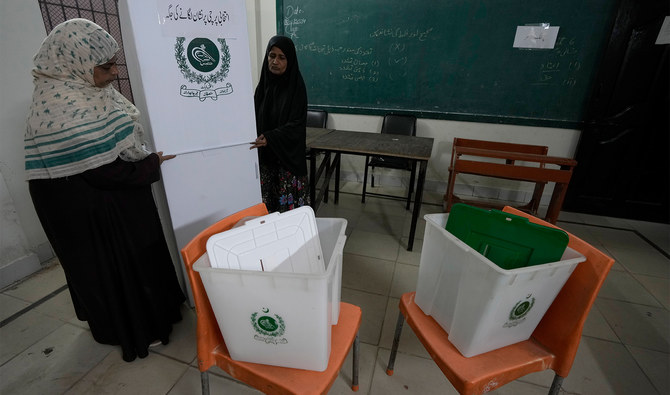

ISLAMABAD: About 128 million registered voters are set to cast their ballots in Pakistan’s general elections today, Thursday, amid prolonged political uncertainty, record inflation and a deteriorating security situation even as one of the country’s most popular politicians remains incarcerated and barred from contesting the polls.
As dozens of political parties field candidates across various constituencies for the national polls, the spotlight focuses on the intense rivalry between former prime minister Imran Khan’s party and that of his three-time predecessor, Nawaz Sharif, who is widely regarded as the frontrunner for the country’s top political position.
Sharif spearheaded the Pakistan Muslim League-Nawaz (PML-N) party’s campaign efforts for weeks, traversing the provinces of Punjab and Khyber Pakhtunkhwa to rally public support for his candidates, aspiring to secure governance both at the center and in Punjab, the most populous province.
In stark contrast, Khan’s Pakistan Tehreek-e-Insaf (PTI) party complained of facing significant restrictions, with leaders unable to organize major rallies and many candidates remaining underground to elude arrest.
Pakistan, having conducted 11 elections since 1970, has a history marred by controversy, as each election has been shadowed by allegations of rigging, casting doubts on the fairness of the electoral process.
“Each time, one party or another has been targeted as the party that must be kept out of power and this time that party is PTI,” Husain Haqqani, a former Pakistani ambassador to the United States and currently a scholar at Washington’s Hudson Institute, told Arab News.
“The pattern is not new nor are the [security] establishment’s tactics,” he said. “PTI’s vast social media presence and the celebrity status of its leader, Imran Khan, is amplifying the controversy more than in the past.”
The military wields enormous power in Pakistan but maintains it doesn’t interfere in politics, though analysts said the army was supporting Sharif in these elections after pushing Khan to power in 2018.
“The military usually proceeds by defining an enemy and that enemy right now is Imran Khan,” Haqqani said.
The military has directly ruled Pakistan for over three decades since its creation in 1947, though it has said to have wielded influence through a hybrid model by relying on chosen politicians or parties since 2002.
“Pakistan seems stuck with the hybrid model of partial democracy and military intervention,” Haqqani continued. “That will not change with this election. The only issue is whether Imran Khan’s popularity will dent the next hybrid regime’s ability to function effectively.”
Khan’s party still remains a force despite being denied its election emblem of “cricket bat” by the Supreme Court in a verdict last month. All PTI candidates are now running as independents with different electoral symbols each.
Political commentator Zebunnisa Burki said the election campaign of all parties was lackluster in PTI’s absence, and it was expected the election would result in a coalition government at the center.
“The upcoming government and parliament will have questions over its legitimacy due to severe allegations of the pre-poll rigging,” she told Arab News. “One can only hope at this stage the new government will work for the restoration of political and economic stability in the country.”
Pakistan has witnessed a surge in militant violence with recent attacks targeting the offices of different parties and candidates amid frayed relations with neighboring countries like Afghanistan and Iran.
“The issues of foreign policy and Pakistan’s diplomatic relations with its neighbors remained missing from campaign of all political parties,” Dr. Human Baqai, a political analyst, told Arab News, adding the parties probably thought the topic would not resonate with the electorate.
“People are buried by the double-digit inflation and unemployment, so the political leaders tried to placate them by promising free electricity and state support to the poor if they were elected to power,” she said.
In two separate bomb blasts in Quetta targeting election candidates, at least 27 people were killed and over 40 injured. Pakistan’s Balochistan province has been particularly vulnerable to violence in the run-up to polls with over two dozen attacks recorded since last week.
Zaigham Khan, a security analyst, said the southern parts of Khyber Pakhtunkhwa and some areas of Balochistan provinces were facing a “fresh wave” of militant attacks to target political parties and their candidates.
“The Pakistani state has taken up the issue of terrorism with neighboring Afghanistan and Iran to check cross-border attacks,” he told Arab News. “The country has also introduced a new visa policy for Afghans to keep an eye on people crossing the border.”
“This is a long and arduous battle that Pakistani has been waging against terrorists to eliminate them from our soil,” he added. “The next government will have no other option but to go full-scale after the militants.”


