

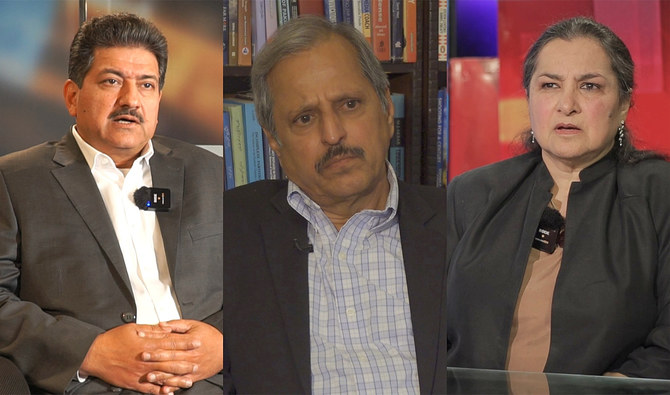

ISLAMABAD: As millions go to the vote in Pakistan today, Thursday, renowned Pakistani journalists share some of their most compelling stories from the campaign trail in years past.
1993 elections
The 1993 elections were hotly contested between the Pakistan Muslim League-Nawaz (PML-N) party of Nawaz Sharif and the Pakistan People’s Party (PPP) led by Benazir Bhutto. The PPP won the polls and Bhutto became prime minister, her second term in the top office.
Hamid Mir, a top Pakistani journalist and talk show host, recalled traveling with Bhutto on the campaign trail ahead of the 1993 polls.
“I told her, ‘You will not get more than 85 seats. You will be able to form the government [at the center] but you will not get more than 85 seats’,” Mir told Arab News at his office in Islamabad.
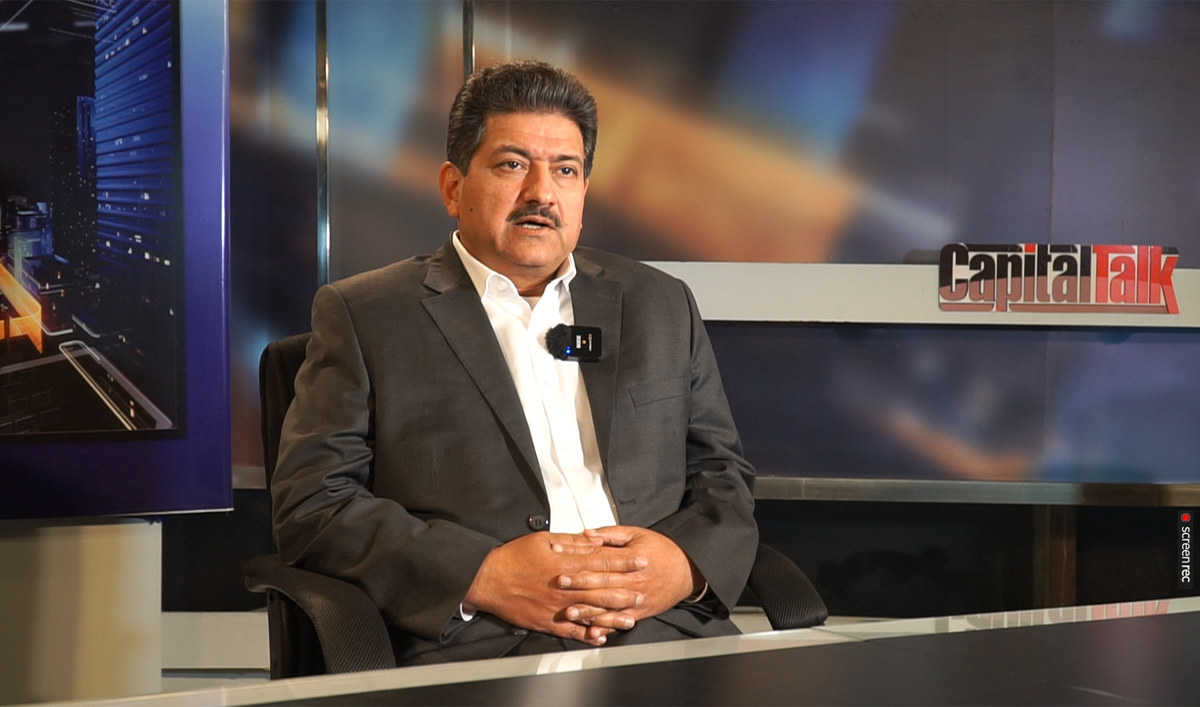
Pakistani journalist Hamid Mir speaks to Arab News Pakistan in Karachi, Pakistan, on January 29, 2024. (AN photo)
The PPP won more than 85 seats.
“Then after the elections were held and she became the prime minister, she asked me, ‘Why were you saying this?’” Mir said.
Expressing the skepticism of many Pakistani journalists over elections that are often marred by rigging, manipulation, and intimidation and where results are sometimes pre-decided, Mir replied thus to Bhutto:
“You are such an experienced politician, don’t you know that elections in Pakistan are never free and fair? A decision is always made before [the elections].”
“And after that, when the 2008 election was about to be held, the same Benazir Bhutto was telling me, ‘They will murder me before the elections.’ And I didn’t reply and she said, ‘I understand’,” Mir said.
Bhutto was killed in a gun-and-bomb attack in Rawalpindi on Dec 27, 2007, weeks before elections on Feb. 18, 2008.
2002 elections
Karachi-based journalist Mazhar Abbas, a longtime observer of Pakistani politics who has covered multiple elections, remembered when Bhutto’s nomination papers were rejected by an election officer, meaning she could be out of the 2002 elections.
Polls that year were conducted by a Pakistani regime led by military ruler Pervez Musharraf, who was starkly opposed to Bhutto and also to Sharif, whose government he had toppled in a coup in 1999.
“I was in Larkana on that day [Aug. 30, 2002] when Benazir Bhutto’s nomination papers were rejected by the RO [returning officer],” Abbas told Arab News.
“I was present in that courtroom and the RO did not know what decision he was taking,” the journalist added with a smile, referring to the RO acting on orders from the then administration of Musharraf.
“And later, I even spoke with the RO and he said, ‘We have to take these decisions. We are pressurized’.”
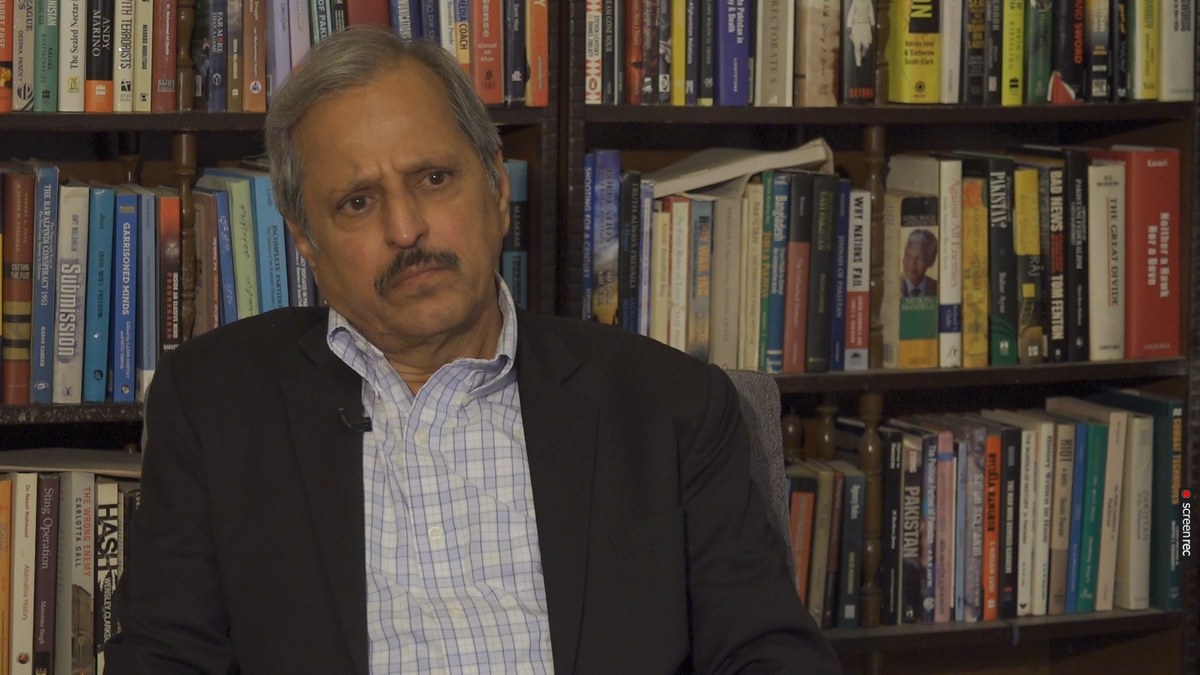
Pakistani journalist Mazhar Abbas speaks to Arab News Pakistan in Karachi, Pakistan, on January 12, 2024. (AN photo)
2013 elections
Well-known Pakistani journalist, author, and political analyst Nasim Zehra recalled one of her “really down days” as a journalist on the campaign trail with Nawaz Sharif ahead of 2013 polls.
Zehra was traveling with Sharif in a helicopter and interviewed him while onboard.
“We went in the helicopter with him for the interview, but when we came back and listened to the interview, all we could hear was the helicopter’s noise,” Zehra recalled, laughing. “That turned out to be one of my really down days in journalism.”
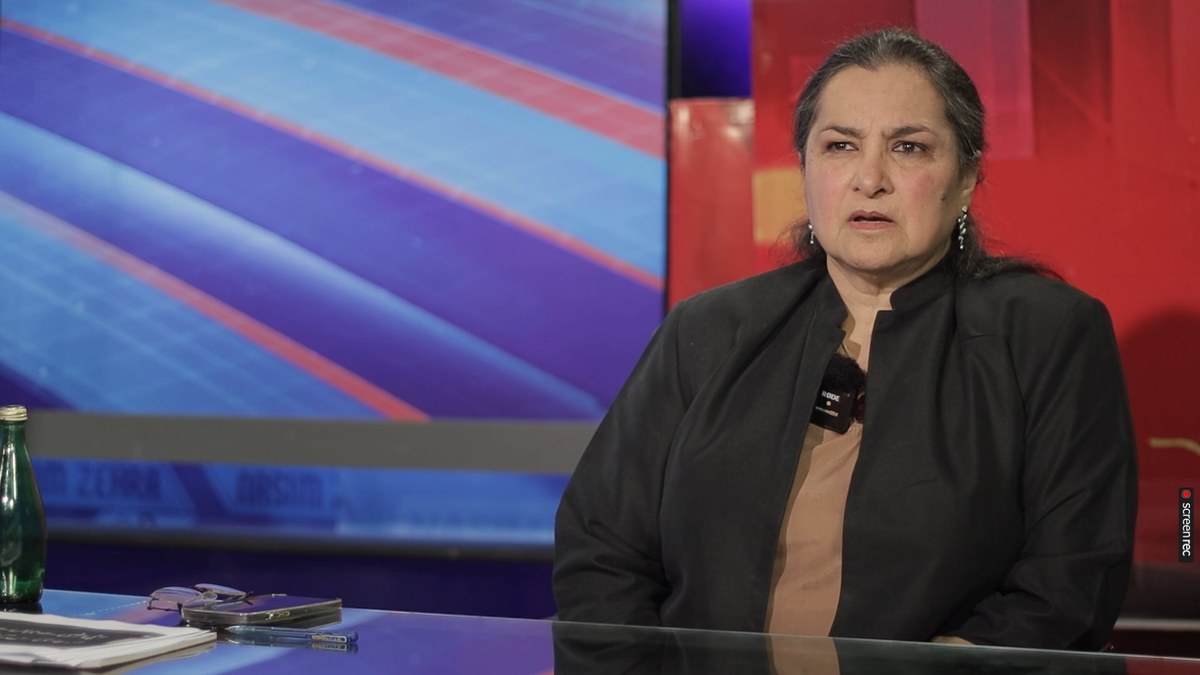
Pakistani journalist, author, and political analyst Nasim Zehra speaks to Arab News Pakistan in Karachi, Pakistan, on January 14, 2024. (AN photo)
2024 elections
Hamid, Abbas, and Zehra all raised questions about the latest election exercise, given widespread allegations of pre-poll rigging and a state-backed crackdown against the Pakistan Tehreek-e-Insaf party of former Pakistani Prime Minister Imran Khan.
Zehra noted that the environment in the run up to the Feb. 8 election was “very unusual.”
“It doesn’t feel like you are headed to elections,” she said. “The entire focus is to break up one particular party [PTI] and end it.”
Mir concurred.
“The date [of 2024 elections] was announced very late. Elections should have taken place last year, according to the constitution,” he said. “The political parties have only now started announcing manifestos, just eight to ten days before the elections, which means even they did not believe [that elections would be held].”
But a wry Abbas said this was the way elections always took place in Pakistan.
“Elections in Pakistan will happen in the same way that they have been happening [in the past], governments will be made the way they have been made [in the past],” he said.
“If relations with someone deteriorate, they will be removed,” he said, referring to Khan’s ouster in 2022 and Bhutto and Sharif’s governments being prematurely dissolved multiple times in the past.
“Ties will be mended with those with whom they were strained earlier and the one who is favored [today] will again become an opponent [in the future].”


