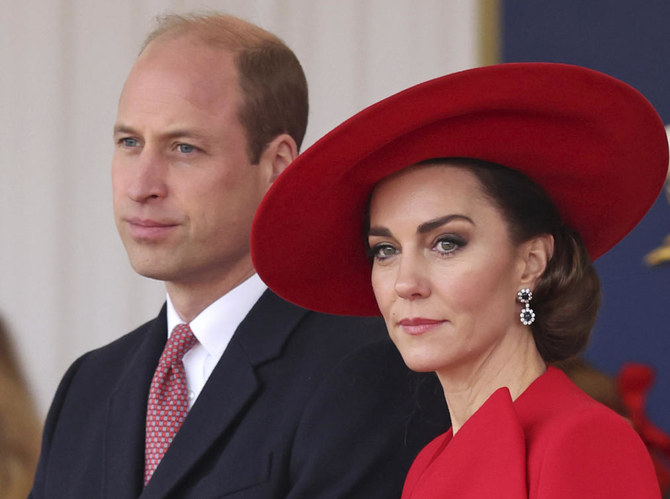
LONDON: With his father King Charles III undergoing cancer treatment and his wife recovering from surgery, Britain’s Prince William found himself thrust back to the frontline of royal duties on Wednesday.
The king’s shock cancer diagnosis, announced on Monday, and Catherine’s abdominal operation have left William, 41, shouldering a heavy royal burden.
Charles’s eldest son and heir to the throne, William postponed public engagements to care for his wife, the Princess of Wales, and their three children after she was admitted to hospital on January 16.
But on Wednesday he was back on duty, hosted an investiture ceremony at Windsor Castle, west of London, handing out honors for citizens recognized for their community work and other good deeds.
It had been three week since he last appeared at a major royal event.
Later, he will attend a London Air Ambulance fundraising gala.
Charles, who left London on Tuesday for his Sandringham residence in eastern England, will meanwhile hold his weekly meeting with Prime Minister Sunak by telephone for a change.
“We have agreed with the palace in this specific instance to confirm that they will be speaking on the phone later,” Sunak’s spokesman said.
Sunak made a brief reference to the king’s cancer diagnosis in parliament.
“I know the thoughts of the house and the country are with the king, and his family,” he told the House of Commons.
“We wish his majesty a speedy recovery and look forward to him resuming his public-facing duties in due course,” he added.
William is also expected to take on some of his father’s duties while he undergoes treatment, alongside Charles’s sister Princess Anne and his wife Queen Camilla.
Buckingham Palace has not specified the type of cancer the 75-year-old monarch has, although it is understood not to be prostate cancer and Sunak has said it was “caught early.”
The diagnosis comes just 17 months into Charles’s reign following the death of his 96-year-old mother, Queen Elizabeth II, on September 8, 2022.
Adding to the drama, the king’s estranged son Prince Harry flew back from his US home on Tuesday.
The pair had a 45-minute meeting at Charles’s Clarence House residence in London before the king left for Sandringham.
Harry’s return has sparked speculation it could serve as a catalyst to heal family tensions that have blighted Charles’s reign.
Harry and his brother William have reportedly not spoken in months because of bad feeling caused by Harry’s public criticism of his family.
Harry quit royal duties in 2020 and relocated to California where he now lives with his American wife Meghan and their two young children.
Harry has repeatedly aired his complaints about the way he feels he and his wife were mistreated during their time as working royals, culminating in January 2023 with his autobiography “Spare.”
The Press Association news agency reported that there were no plans for the brothers to meet while Harry was in the UK.
Royal commentator Richard Fitzwilliams described the rift between William and Harry, also known as the Duke of Sussex, and the rest of the royal family as “very deep.”
Reports said he had stayed at a luxury London hotel overnight following Charles’s decision to block him from using his former home on the Windsor estate.
It was not known how long Harry was due to stay in the country.
Citizens expressed sympathy for William, who they noted now faced the double burden of maintaining his family life with extra official duties.
“He’s got a hard job because his wife is poorly at the moment, so that’s an added pressure on poor William, but I’m sure that he will cope,” pensioner Sue Hazell told AFP outside Buckingham Palace on Tuesday.
His wife Kate is expected to be out of action until at least March 31, her office has said.
Officials have not given details of her surgery except to say it was not linked to cancer.
Canadian tourist Sarah Paterson, a 44-year-old entrepreneur, said that William must be “beside himself” given the recent deaths of his grandfather and his grandmother, along with the health problems faced by his father and his wife.
But she was “1,000 percent” confident that William would be a good stand-in, adding: “I think he’ll probably be king sooner than he hoped.”

William fills royal void during King Charles cancer treatment
https://arab.news/z65yg
William fills royal void during King Charles cancer treatment
- The king’s shock cancer diagnosis, announced on Monday, and Catherine’s abdominal operation have left William, 41, shouldering a heavy royal burden
- “We have agreed with the palace in this specific instance to confirm that they will be speaking on the phone later,” Sunak’s spokesman said
US envoys juggle two crisis talks, raising questions about prospects for success
- “Trump seems more focused on quantity over quality instead of the difficult detailed work of diplomacy,” said Bruen
- A regional official close to Iran’s leadership said the US team’s double agenda in Geneva reinforced doubts
WASHINGTON/GENEVA/DUBAI: Even for a US president long fixated on deal-making, Donald Trump’s assignment of his favorite envoys to juggle two sets of negotiations – the Iranian nuclear standoff and Russia’s war in Ukraine — in a single day in Geneva has left many in the foreign policy world scratching their heads.
The shuttle diplomacy on Tuesday by US special envoy Steve Witkoff and Trump’s son-in-law Jared Kushner has raised questions not only about whether they are overstretched and outmatched, but about their serious prospects for resolving either of the twin crises, experts say.
Trump, who has frequently boasted about having ended multiple wars and conflicts in the first year of his second four-year term, has made clear he is looking to add more international deals that he can tout in his quest for the Nobel Peace Prize.
But the high-stakes negotiations over the two long-running issues were arranged quickly, and the choice of Geneva as the setting for both was never clearly explained, except for the city’s long history of hosting international diplomacy.
“Trump seems more focused on quantity over quality instead of the difficult detailed work of diplomacy,” said Brett Bruen, who was a foreign policy adviser in the Obama administration and now heads the Global Situation Room strategic consultancy. “Tackling both issues at the same time in the same place doesn’t make a lot of sense.”
Iran was the opening act in a carefully choreographed diplomatic dance in Geneva, where talks took place under high security in two locations on different sides of the Swiss, French-speaking city.
After 3-1/2 hours of indirect discussions between the US team and Iranian Foreign Minister Abbas Araqchi mediated by Oman, both sides indicated that some progress was made, but there was no suggestion that an agreement was imminent in the longstanding dispute over Iran’s nuclear program.
As long as the diplomatic process continues, Trump can keep expanding his massive military buildup near Iran, making clear that use of force remains on the table. That is likely to keep the Middle East on edge, with many fearing that US strikes could escalate into a wider regional war.
’OVERSTRETCH’?
With barely a pause on Tuesday, the US delegates went straight from the Iran talks at Oman’s diplomatic mission to the five-star InterContinental hotel for the first of two days of Russia-Ukraine negotiations over a war that Trump, during the 2024 presidential campaign, had promised to end in a day.
Expectations were low for a breakthrough in the latest round of talks to end Europe’s biggest war since World War Two ended in 1945.
A regional official close to Iran’s leadership said the US team’s double agenda in Geneva reinforced doubts about whether Washington was sincere about either of the diplomatic efforts.
“The approach risks overstretch,” the official, who spoke on condition of anonymity, told Reuters. “It resembles an emergency room with two critically ill patients and a single doctor unable to give either case sustained attention, increasing the likelihood of failure.”
Mohanad Hajj-Ali of the Carnegie Middle East Center in Beirut said there was too much at stake in the Iran crisis for the US to handle diplomacy this way.
“Having a team of Witkoff and Kushner tasked with resolving all the world’s problems is, frankly, a shocking reality,” he said.
Some experts said the two, both from Trump’s world of New York real estate development, lack the depth of knowledge and experience to go up against veteran negotiators like Araqchi and their Russian interlocutors and that they were in over their heads in such complicated conflicts.
Absent from the Geneva meetings was US Secretary of State Marco Rubio, Trump’s top diplomat, who is known as a foreign policy wonk.
Asked for comment, White House spokesperson Anna Kelly said Trump and his team “have done more than anyone to bring both sides together to stop the killing and deliver a peace deal” in Ukraine. She denounced anonymous “critics” of the president’s approach but did not provide answers to Reuters’ specific questions for this story.
’ENVOY FOR EVERYTHING’
Administration officials have long defended Witkoff and Kushner’s roles, citing their skills as dealmakers, the trust Trump puts in them, and the failings over the years of more traditional diplomatic approaches. Witkoff, a longtime Trump friend often called the “envoy for everything” due to his broad remit, played a key role in securing a ceasefire agreement last year between Israel and Hamas in the Gaza war, though progress has stalled toward a more permanent resolution. His diplomatic efforts with Iran and Russia have had little success so far.
In Trump’s first term, Kushner spearheaded the Abraham Accords, under which several Arab states forged landmark diplomatic relations with Israel. But the pact has not advanced much since Trump returned to office nearly 13 months ago.
Kushner and Witkoff’s ability to handle their latest diplomatic tasks has been undercut by Trump’s stripping down of the government’s foreign policy apparatus, both at the State Department and the National Security Council, where many veteran staffers were sent packing, some analysts say.
”We’ve seen a hollowing-out of our diplomatic bench,” said former Obama foreign policy adviser Bruen. “So there’s a question of whether we still have the right people to work on these big issues.”


