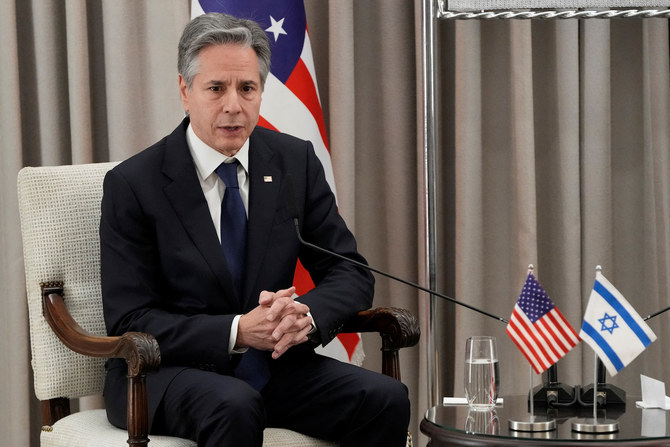

TEL AVIV: US Secretary of State Antony Blinken met Israeli Prime Minister Benjamin Netanyahu in Jerusalem on Wednesday to push for a ceasefire as the Gaza war enters its fifth month.
Israel and Hamas have been weighing a proposal, brokered by US, Qatari and Egyptian mediators, that would be expected to temporarily halt the fighting and see Gaza hostages freed and Palestinian prisoners released.
“There’s still a lot of work to be done,” Blinken said in Doha late on Tuesday after earlier stops in Saudi Arabia and Egypt on his fifth Middle East crisis tour since the October 7 attack sparked the war.
“But we continue to believe that an agreement is possible and indeed essential, and we will continue to work relentlessly to achieve it,” the US top diplomat told reporters.
For now, the war raged on unabated in Hamas-ruled Gaza, where the health ministry said at least 100 people were killed overnight and AFP journalists reported more heavy bombing of southern cities.
Israeli forces, in their campaign to destroy Hamas, have pushed steadily south, with the heaviest combat raging in the city of Khan Yunis in recent weeks.
Fear has grown among the more than one million Palestinians now crowded into Gaza’s far south, around the city of Rafah on the Egyptian border, as the battlefront has crept ever closer.
“I am terrified that Israel will begin a ground operation in Rafah,” said Dana Ahmed, 40, who was displaced from Gaza City with her three children and now lives in a tent in Rafah.
She said she spent a sleepless night as Israeli fighter jets roared through the sky and explosions shook the ground.
“I cannot imagine what will happen to us,” she said. “Where will we go now? The situation is catastrophic. I feel like I am living a horror movie.”
Intense fighting
Israeli Defense Minister Yoav Gallant warned earlier this week that the army “will reach places where we have not yet fought... right up to the last Hamas bastion, which is Rafah.”
The UN aid coordination office OCHA voiced alarm about looming major combat in the densely crowded area.
“Intensified hostilities in Rafah in this situation could lead to large-scale loss of civilian lives, and we must do everything possible within our power to avoid that,” said its spokesman Jens Laerke.
The bloodiest ever Gaza war started with Hamas’s unprecedented attack on Israel on October 7, which resulted in the deaths of about 1,160 people, mostly civilians, according to an AFP tally based on official Israeli figures.
Militants also seized around 250 hostages. Israel says 132 remain in Gaza, of whom 29 are believed to have died.
Israel vowed to eliminate Hamas and launched air strikes and a ground offensive that have killed at least 27,585 people, mostly women and children, according to the Gaza health ministry.
The campaign has devastated swathes of Gaza and displaced the majority of its 2.4 million people who have also endured dire shortages of food, water, fuel and medicine.
The humanitarian situation in long-blockaded Gaza has become “beyond catastrophic,” the International Federation of Red Cross and Red Crescent Societies said on Tuesday.
Hamas proposes truce
To bring relief, the warring parties have discussed a possible new ceasefire deal which would follow a first, week-long truce in November that saw more than 100 hostages freed, the Israelis among them in exchange for Palestinian prisoners.
Last week, a Hamas source said the proposed new truce calls for a six-week pause to fighting and a hostage-prisoner exchange, as well as more aid for Gaza, but negotiations have continued since.
Qatari Prime Minister Mohammed bin Abdulrahman Al-Thani said on Tuesday that Hamas had responded to a new proposal, adding that “the reply includes some comments, but in general it is positive.”
Blinken said he would discuss Hamas’s reply with Israeli leaders and Netanyahu’s office said the “details are being thoroughly evaluated” by the spy agency Mossad.
Netanyahu — who had yet to comment directly on the Hamas response — stressed that Israel’s overall war aim remained unchanged: “We are on the way to the total victory and we will not stop.”
Amid the Gaza war, Iran-backed groups in Lebanon, Iraq, Syria and Yemen have launched attacks in support of Hamas, and Israel, the United States and its allies have launched strikes on them.
Yemen’s Houthi rebels have for weeks targeted what they say are Israel-linked ships in the Red Sea and Gulf of Aden, disrupting global trade and prompting reprisals by US and British forces.
Last week, the United States also carried out strikes on Iran-backed groups in Syria and Iraq, killing dozens in retaliation for an attack that killed three US troops in Jordan.
Israel has also traded deadly cross-border fire with Lebanon’s Hezbollah movement and has repeatedly bombed Iran-linked targets in Syria.
Israeli strikes on the Syrian city of Homs on Wednesday killed 10 people, including at least six civilians, according to the Britain-based war monitoring group, the Syrian Observatory for Human Rights.