

Future stability of Pakistani rupee, bonds linked to peaceful elections, IMF review — experts 

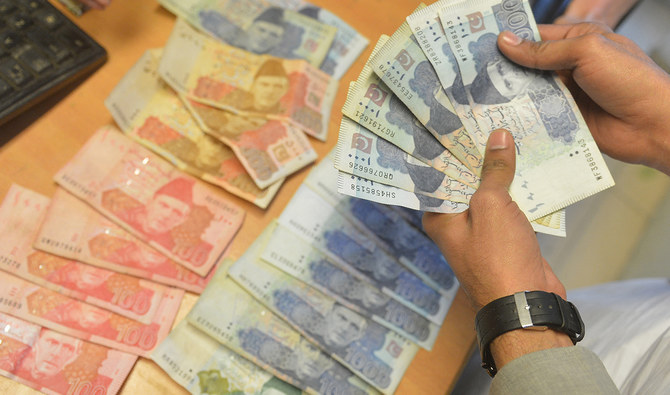
A money changer counts Pakistan's currency at a market in Karachi on January 6, 2023. (AFP/File)
Short Url
Updated 06 February 2024
Follow

Future stability of Pakistani rupee, bonds linked to peaceful elections, IMF review — experts 

  • The South Asian country of more than 241 million will be holding national elections on February 8
  • An IMF review is expected later this month, with Pakistan’s $1 billion dollar bonds maturing in April

KARACHI: The stability of Pakistan’s currency and international bonds is linked with a successful second review of the country’s ongoing International Monetary Fund (IMF) program and a peaceful transition of government after this week’s national elections, financial experts said on Tuesday.

Pakistan’s rupee has regained its value by 9 percent to about Rs279 against the US dollar from an all-time low of Rs307 in September last year, due to the government’s clampdown on illicit foreign currency trade and smuggling, completion of first review of the ongoing $3 billion IMF program and inflows from various sources.

Similarly, Pakistan’s international bonds also posted gains and remained top performer in Asia in Jan 2024, according to the analysts and Bloomberg data. The investors got almost 100 percent returns in 2023.

The South Asian nation of more than 241 million is now set to go to the ballot box on Feb 8 to elect a new government that is widely expected to negotiate a new IMF bailout after the current short-term facility expires in March.

Pakistani analysts believe the stability of the national currency and the bonds is based on the IMF review, which is due this month, and a smooth transition of the government.

“If the review goes smooth then chances are bright that the IMF and the new government will strike a new long-term deal,” Muhammad Sohail, chief executive officer (CEO) of the Karachi-based Topline Securities brokerage house, told Arab News.

“If that happens, I don’t see any substantial pressure on the Pakistani rupee and Eurobonds.”

However, Shahid Ali Habib, CEO of the Arif Habib Limited brokerage and securities firm, believes the rupee may still shed 4-6 percent of its value due to the interest rate differential and high inflation.

“A natural rupee devaluation has to take place because of the interest rate differential and high inflation rate that is likely to close the year at around 24 percent,” Habib told Arab News.

“I don’t see any sudden devaluation.”

He said the next IMF program was important for fiscal stability in Pakistan, warning that without it the situation would worsen to what it was in June last year, when Pakistan barely averted a sovereign debt default.

“I hope the next government will negotiate a fresh program with the IMF spanning over 4-5 years,” Habib added.

Pakistan’s caretaker finance minister, Dr. Shamshad Akhtar, has also hinted recently that the South Asian country may need a new IMF program.

Samiullah Tariq, a director at the Pakistan Kuwait Investment Company, believed a peaceful conduct of elections and a smooth transition of power would lead to capital market stability.

“There should be no problem in negotiating a new program with the IMF, because the things are under control,” he told Arab News.

The analyst, however, warned that any uncertainty may dent the performance of the country’s dollar bonds in the international market. 

Pakistan’s $1 billion dollar-denominated bond is maturing on April 15 this year. Last week, the central bank governor assured that the country was in a “comfortable position” to pay the amount upon the maturity of the bond.


EU, Pakistan sign €60 million loan agreement for clean drinking water in Karachi

Updated 17 December 2025
Follow

EU, Pakistan sign €60 million loan agreement for clean drinking water in Karachi

  • Project will finance rehabilitation, construction of water treatment facilities in Karachi city, says European Investment Bank
  • As per a report in 2023, 90 percent of water samples collected from various places in city was deemed unfit for drinking

ISLAMABAD: The European Investment Bank (EIB) and Pakistan’s government on Wednesday signed a €60 million loan agreement, the first between the two sides in a decade, to support the delivery of clean drinking water in Karachi, the EU said in a statement. 

The Karachi Water Infrastructure Framework, approved in August this year by the EIB, will finance the rehabilitation and construction of water treatment facilities in Pakistan’s most populous city of Karachi to increase safe water supply and improve water security. 

The agreement was signed between the two sides at the sidelines of the 15th Pak-EU Joint Commission in Brussels, state broadcaster Radio Pakistan reported. 

“Today, the @EIB signed its first loan agreement with Pakistan in a decade: a €60 million loan supporting the delivery of clean drinking water for #Karachi,” the EU said on social media platform X. 

Radio Pakistan said the agreement reflects Pakistan’s commitment to modernize essential urban services and promote climate-resilient infrastructure.

“The declaration demonstrates the continued momentum in Pakistan-EU cooperation and highlights shared priorities in sustainable development, public service delivery, and climate and environmental resilience,” it said. 

Karachi has a chronic clean drinking water problem. As per a Karachi Water and Sewerage Corporation (KWSC) study conducted in 2023, 90 percent of water from samples collected from various places in the city was deemed unsafe for drinking purposes, contaminated with E. coli, coliform bacteria, and other harmful pathogens. 

The problem has forced most residents of the city to get their water through drilled motor-operated wells (known as ‘bores’), even as groundwater in the coastal city tends to be salty and unfit for human consumption.

Other options for residents include either buying unfiltered water from private water tanker operators, who fill up at a network of legal and illegal water hydrants across the city, or buying it from reverse osmosis plants that they visit to fill up bottles or have delivered to their homes.

The EU provides Pakistan about €100 million annually in grants for development and cooperation. This includes efforts to achieve green inclusive growth, increase education and employment skills, promote good governance, human rights, rule of law and ensure sustainable management of natural resources.