

Yemen’s Houthi militia ‘ready for peace’ with Saudi Arabia

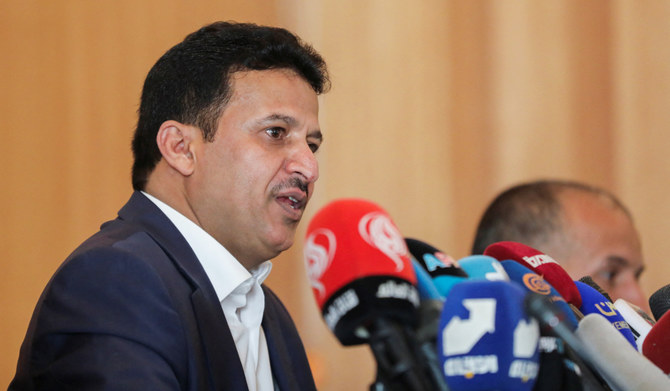
Hussein al-Ezzi, deputy foreign minister in the Houthi-led government, addresses a news conference in Sanaa, Yemen February 5, 2024. (REUTERS)
Short Url
Updated 05 February 2024
Follow

Yemen’s Houthi militia ‘ready for peace’ with Saudi Arabia

  • “America is the one assaulting us, and it will not escape retribution, and we will never remain mute about the aggression against our nation, and it will have no impact on our stance toward Gaza and Palestine”

AL-MUKALLA: Yemen’s Houthi militia is ready to make peace with Saudi Arabia, the groups’ deputy foreign minister said on Monday, accusing the US of obstructing efforts to reach a settlement.

Speaking to reporters in Sanaa, Hussein Al-Ezzi expressed “special gratitude” to Saudi Arabia for its unwillingness to join US-UK strikes on Yemen, adding that the militia is “eager” to enter peace negotiations with the Kingdom.

“Sanaa is prepared for peace with Riyadh despite the challenges posed by the US and its associated Yemeni groups,” Al-Ezzi said.

The US and UK have carried out about 300 strikes in Yemen since Jan. 12, the official said, threatening to make the US pay a “heavy price” for the attacks. “America is the one assaulting us, and it will not escape retribution, and we will never remain mute about the aggression against our nation, and it will have no impact on our stance toward Gaza and Palestine.”

Since November, the Houthis have seized a commercial ship and launched dozens of missiles and drones at civilian as well as military vessels in the Red Sea. Al-Ezzi said that the militia, in a show of support to Palestine, only targets Israel-linked ships or vessels on their way to the country.

US and UK military and commercial ships were added to the militia’s list of targets after the two countries launched strikes on Yemen, he added.

The Houthi warning to strike US and UK ships came as Houthi media and Yemenis in the Houthi-controlled western province of Hodeidah reported explosions on Sunday night when jets struck targets in the Ras Isa, Al-Zaydiyah and Al-Hawak districts. On Monday afternoon, the Houthi-run Al-Masirah TV channel claimed that the US and UK forces conducted attacks on Hodeidah’s Al-Katheeb area.

Meanwhile, Yemen’s internationally recognized government said that UN pressure to end its offensive on Hodeidah city in 2018 had led to the escalating Houthi violence on the Red Sea since last year.

Yemeni Information Minister Muammar Al-Eryani on Sunday blamed the UN and its former Yemen envoy, Martin Griffiths, for pressuring the Yemeni government to abandon its military offensive on the Houthi-controlled port city and sign the UN-brokered Stockholm Agreement.

Government forces controlled Hodeidah’s airport, as well as the city’s southern and eastern entrances, and were only a few kilometers from the city’s port before the UN urged an end to the offensive, he added.

At the time, the UN warned that conflict in Hodeidah would halt the supply of 70 percent of the country’s humanitarian aid and other essential items through the city’s port.

“The entire world is paying the price for ignoring government warnings about the dangers of allowing the Iranian regime and its arms in the region, most notably the Houthi militia, to control the city of Hodeidah and its ports,” Al-Eryani said, according to the SABA news agency.


Virtual museum preserves Sudan’s plundered heritage

Updated 6 sec ago
Follow

Virtual museum preserves Sudan’s plundered heritage

CAIRO: Destroyed and looted in the early months of Sudan’s war, the national museum in Khartoum is now welcoming visitors virtually after months of painstaking effort to digitally recreate its collection.
At the museum itself, almost nothing remains of the 100,000 artefacts it had stored since its construction in the 1950s. Only the pieces too heavy for looters to haul off, like the massive granite statue of the Kush Pharaoh Taharqa and frescoes relocated from temples during the building of the Aswan Dam, are still present on site.
“The virtual museum is the only viable option to ensure continuity,” government antiquities official Ikhlass Abdel Latif said during a recent presentation of the project, carried out by the French Archaeological Unit for Sudanese Antiquities (SFDAS) with support from the Louvre and Britain’s Durham University.
When the museum was plundered following the outbreak of the war between the regular army and the paramilitary Rapid Support Forces (RSF) in April 2023, satellite images showed trucks loaded with relics heading toward Darfur, the western region now totally controlled by the RSF.
Since then, searches for the missing artefacts aided by Interpol have only yielded meagre results.
“The Khartoum museum was the cornerstone of Sudanese cultural preservation — the damage is astronomical,” said SFDAS researcher Faiza Drici, but “the virtual version lets us recreate the lost collections and keep a clear record.”
Drici worked for more than a year to reconstruct the lost holdings in a database, working from fragments of official lists, studies published by researchers and photos taken during excavation missions.
Then graphic designer Marcel Perrin created a computer model that mimicked the museum’s atmosphere — its architecture, its lighting and the arrangement of its displays.
Online since January 1, the virtual museum now gives visitors a facsimile of the experience of walking through the institution’s galleries — reconstructed from photographs and the original plans — and viewing more than 1,000 pieces inherited from the ancient Kingdom of Kush.
It will take until the end of 2026, however, for the project to upload its recreation of the museum’s famed “Gold Room,” which had housed solid-gold royal jewelry, figurines and ceremonial objects stolen by looters.
In addition to the virtual museum’s documentary value, the catalogue reconstructed by SFDAS is expected to bolster Interpol’s efforts to thwart the trafficking of Sudan’s stolen heritage.