Pakistan’s Balochistan province declares 80% polling stations ‘sensitive’ amid rising attacks

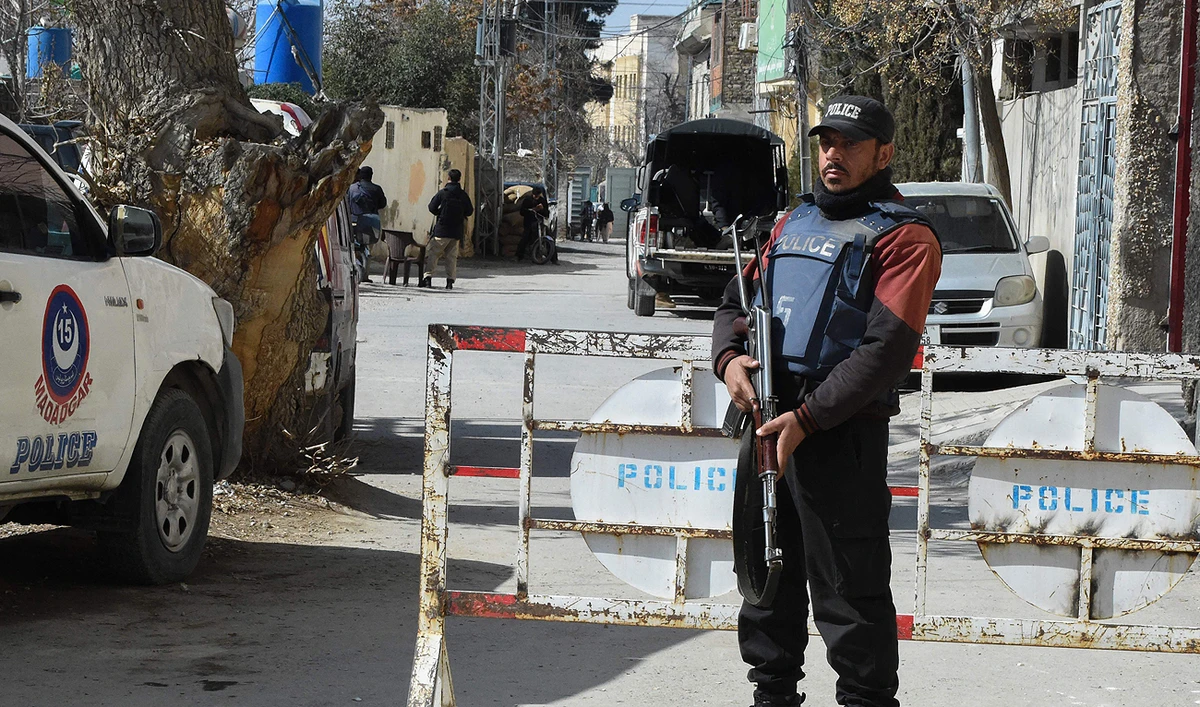
A policeman stands guard outside the provincial Election Commission office, in Quetta on February 5, 2024, ahead of the upcoming general elections. (AFP)
Short Url
Updated 05 February 2024
Follow

Pakistan’s Balochistan province declares 80% polling stations ‘sensitive’ amid rising attacks

  • Balochistan has seen over two dozen attacks on election candidates, security forces in last week 
  • 34% of over 5,000 polling stations declared “very sensitive,” 46% “sensitive,” home minister says

QUETTA: The government in Pakistan’s southwestern Balochistan has declared 80 percent of polling stations in the province “sensitive” and “highly sensitive” amid a rise in pre-election violence, an official confirmed on Monday, three days before millions are expected to vote in national elections.
Balochistan, Pakistan’s largest province by land but most underdeveloped by nearly all socio-economic indicators, has seen a rise in violence ahead of elections on Feb. 8, with over two dozens attacks recorded in the last week.
This included a blast at a rally led by former prime minister Imran Khan’s Pakistan Tehreek-e-Insaf (PTI) party in Sibi city on Jan. 30. On Feb. 4, a grenade attack was launched on the Election Commission of Pakistan’s (ECP) office in Nushki district while in a separate assault, unidentified gunmen attacked the station of the paramilitary Levies force in the mountainous Bolan region. No casualties were reported.
The Pakistan military killed 24 militants in a days-long operation that began on Jan. 29 when armed militants carried out coordinated attacks in Mach and Kolpur cities in Balochistan.
The province has for decades been the scene of a low-lying insurgency by ethnic Baloch militants fighting for independence from the Pakistani state.
“There are 5,028 polling stations in Balochistan, among which 34 percent of polling booths are ‘very sensitive’, 46 percent are ‘sensitive’ and 19 percent of the polling stations are ‘normal’,” Balochistan’s caretaker home minister, Muhammad Zubair Jamali, told Arab News.
On Sunday, Balochistan Information Minister Jan Achakzai announced a ban on public gatherings and election meetings in the provincial capital of Quetta in response to a threat alert involving a female suicide bomber. Achakzai also said the government would restrict Internet access in sensitive areas of the province.

The central government in Islamabad has repeatedly said polls would be held as per schedule on Feb. 8 despite security challenges.
Security expert Dr. Safdar Sial, who is also a researcher at the Pakistan Institute of Peace studies (PIPS), said maintaining security ahead of polls was proving to be “challenging” for the Balochistan government.
“Attacks by Baloch insurgents are largely low scale with occasional major attacks, such as the one that was witnessed in Mach,” Sial told Arab News.
“Baloch insurgents usually employ firing and grenades with hit-and-run tactics, but such attacks can be prevented by better vigilance and security deployment.”
EU, Pakistan sign €60 million loan agreement for clean drinking water in Karachi

Updated 17 December 2025
Follow

EU, Pakistan sign €60 million loan agreement for clean drinking water in Karachi

  • Project will finance rehabilitation, construction of water treatment facilities in Karachi city, says European Investment Bank
  • As per a report in 2023, 90 percent of water samples collected from various places in city was deemed unfit for drinking

ISLAMABAD: The European Investment Bank (EIB) and Pakistan’s government on Wednesday signed a €60 million loan agreement, the first between the two sides in a decade, to support the delivery of clean drinking water in Karachi, the EU said in a statement. 

The Karachi Water Infrastructure Framework, approved in August this year by the EIB, will finance the rehabilitation and construction of water treatment facilities in Pakistan’s most populous city of Karachi to increase safe water supply and improve water security. 

The agreement was signed between the two sides at the sidelines of the 15th Pak-EU Joint Commission in Brussels, state broadcaster Radio Pakistan reported. 

“Today, the @EIB signed its first loan agreement with Pakistan in a decade: a €60 million loan supporting the delivery of clean drinking water for #Karachi,” the EU said on social media platform X. 

Radio Pakistan said the agreement reflects Pakistan’s commitment to modernize essential urban services and promote climate-resilient infrastructure.

“The declaration demonstrates the continued momentum in Pakistan-EU cooperation and highlights shared priorities in sustainable development, public service delivery, and climate and environmental resilience,” it said. 

Karachi has a chronic clean drinking water problem. As per a Karachi Water and Sewerage Corporation (KWSC) study conducted in 2023, 90 percent of water from samples collected from various places in the city was deemed unsafe for drinking purposes, contaminated with E. coli, coliform bacteria, and other harmful pathogens. 

The problem has forced most residents of the city to get their water through drilled motor-operated wells (known as ‘bores’), even as groundwater in the coastal city tends to be salty and unfit for human consumption.

Other options for residents include either buying unfiltered water from private water tanker operators, who fill up at a network of legal and illegal water hydrants across the city, or buying it from reverse osmosis plants that they visit to fill up bottles or have delivered to their homes.

The EU provides Pakistan about €100 million annually in grants for development and cooperation. This includes efforts to achieve green inclusive growth, increase education and employment skills, promote good governance, human rights, rule of law and ensure sustainable management of natural resources.