

Pakistani parties fail to meet 5% legal quota for women candidates on general seats in upcoming polls

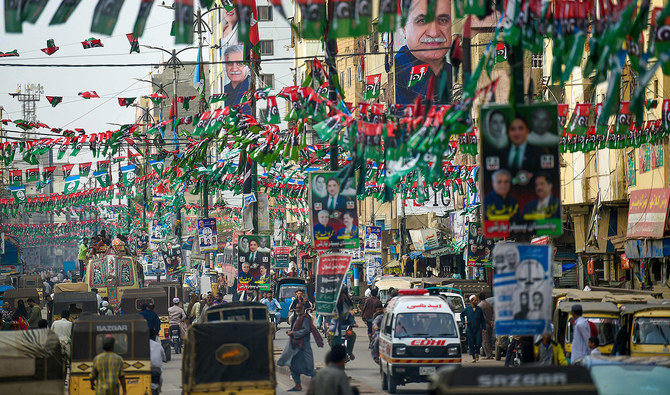
Pakistan Peoples Party (PPP) flags are hung across a street in Karachi on February 2, 2024, ahead of the general elections. (AFP)
Short Url
Updated 03 February 2024
Follow

Pakistani parties fail to meet 5% legal quota for women candidates on general seats in upcoming polls

  • Aurat Foundation, a women’s rights organization, highlights the Election Act 2017 violation in a letter to the ECP
  • Only MQM, PML-N met the benchmark and exceeded the minimum quota while awarding National Assembly tickets

KARACHI: A civil society organization working for women’s rights in Pakistan said on Saturday a number of political parties in the country had violated a major election provision requiring them to assign five percent of tickets for general seats to women in the national and provincial assemblies.

Pakistan has reserved seats for women to ensure female representation in the legislative process on both national and provincial levels to promote gender equality in governance.

However, Section 206 of the Election Act 2017 also makes it mandatory for all political factions to field women candidates on at least five percent of the general seats to make the electoral contest more inclusive.

The Aurat Foundation, known for its advocacy for women’s rights, highlighted the violation of the said provision in a letter addressed to Chief Election Commissioner Sikandar Sultan Raja ahead of the national polls slated for Feb. 8.

“We are dismayed to find that some political parties have not observed the legal requirement under section 206 of the [election] act and section 6 of the Code of Conduct for political parties, to award minimum 5% tickets to women candidates on general seats,” the letter said.

“Political parties submit an affidavit during the process of election schedule that they have complied with the provisions of the Act, including Section 206,” it added. “If they have not met the minimum requirement of awarding 5% tickets to women on general seats, this should be considered a case of ‘false declaration of information.’”

According to the data compiled by the organization, only Muttahida Qaumi Movement and Pakistan Muslim League-Nawaz had met the requirement by awarding 9.6 and 7.8 percent women candidates tickets on general seats for the National Assembly.

Others, including the Pakistan Peoples Party (4.5 percent), Jamaat-e-Islami (4.4 percent) and Awami National Party (3.3 percent), remained below the required benchmark.

Balochistan National Party and Jamiat-e-Ulama-e-Islam-Fazl did not field female candidates on any general seat for the National Assembly.

Most of the parties also violated the provision on the provincial level, according to the Pakistani women’s rights organization.


No casualties as blast derails Jaffar Express train in Pakistan’s south

Updated 26 January 2026
Follow

No casualties as blast derails Jaffar Express train in Pakistan’s south

  • Passengers were stranded and railway staffers were clearing the track after blast, official says
  • In March 2025, separatist militants hijacked the same train with hundreds of passengers aboard

QUETTA: A blast hit Jaffar Express and derailed four carriages of the passenger train in Pakistan’s southern Sindh province on Monday, officials said, with no casualties reported.

The blast occurred at the Abad railway station when the Peshawar-bound train was on its way to Sindh’s Sukkur city from Quetta, according to Pakistan Railways’ Quetta Division controller Muhammad Kashif.

No group immediately claimed responsibility for the bomb attack, but passenger trains have often been targeted by Baloch separatist outfits in the restive Balochistan province that borders Sindh.

“Four bogies of the train were derailed due to the intensity of the explosion,” Kashif told Arab News. “No casualty was reported in the latest attack on passenger train.”

The Jaffar Express stands derailed near Abad Railway Station in Jacobabad following a blast on January 26, 2026. (AN Photo/Saadullah Akhtar)

Another railway employee, who was aboard the train and requested anonymity, said the train was heading toward Sukkur from Jacobabad when they heard the powerful explosion, which derailed power van among four bogies.

“A small piece of the railway track has been destroyed,” he said, adding that passengers were now standing outside the train and railway staffers were busy clearing the track.

In March last year, fighters belonging to the Balochistan Liberation Army (BLA) separatist group had stormed Jaffar Express with hundreds of passengers on board and took them hostage. The military had rescued them after an hours-long operation that left 33 militants, 23 soldiers, three railway staff and five passengers dead.

The passenger train, which runs between Balochistan’s provincial capital of Quetta and Peshawar in the country’s northwest, had been targeted in at least four bomb attacks last year since the March hijacking, according to an Arab News tally.

The Jaffar Express stands derailed near Abad Railway Station in Jacobabad following a blast on January 26, 2026. (AN Photo/Saadullah Akhtar)

Pakistan Railways says it has beefed up security arrangements for passenger trains in the province and increased the number of paramilitary troops on Jaffar Express since the hijacking in March, but militants have continued to target them in the restive region.

Balochistan, Pakistan’s southwestern province that borders Iran and Afghanistan, is the site of a decades-long insurgency waged by Baloch separatist groups who often attack security forces and foreigners, and kidnap government officials.

The separatists accuse the central government of stealing the region’s resources to fund development elsewhere in the country. The Pakistani government denies the allegations and says it is working for the uplift of local communities in Balochistan.