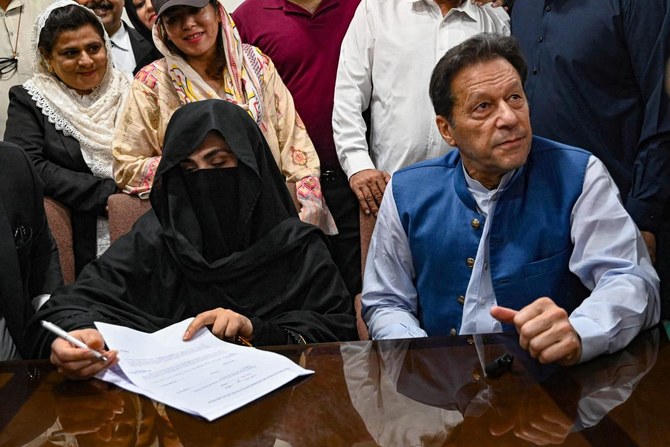
ISLAMABAD: A Pakistan court on Saturday ruled former prime minister Imran Khan’s marriage to his third wife illegal under Islamic law and sentenced the pair to seven years each in jail, his party said.
It is the third verdict in a week to attack the former international cricket star’s reputation, after he was given concurrent prison sentences of 10 years for leaking state secrets and 14 years for graft alongside his wife Bushra Bibi.
Khan, who was booted from office by a vote of no confidence in April 2022, insists nearly 200 offenses he has since been charged with have been fabricated by the military-led establishment to stop him from contesting elections on February 8.
The latest conviction centers on an Islamic law known as “iddat,” which dictates that a widowed or divorced woman must wait three months before remarrying, to leave no doubt about who the father is in the instance of a pregnancy.
“A court has declared the marriage of former prime minister Imran Khan & Busra Bibi illegal with 7 years imprisonment each,” his Pakistan Tehreek-e-Insaf (PTI) party said in a statement.
“This shameful case is illogical. All of this is happening for political goals,” said Khan’s lawyer Gohar Ali Khan, adding that the conviction and jail terms would be challenged in court.
Khan has been imprisoned in Rawalpindi for months, while Bibi surrendered this week and is being held at her home, declared a “sub-jail,” on the outskirts of the capital Islamabad.
“The charges of corruption and now these ones are an attempt to raise moral questions on his character,” lawyer Sabahat Rizvi, who was not involved in the case, told AFP Saturday.
“They are targeting him because they could not diminish his aura.”
Khan rose to power in 2018 with the backing of the military, but has been sidelined after losing their favor and waging a campaign of defiance against them.
The PTI has been severely hamstrung ahead of the vote, with scores of leaders jailed, supporters barred from holding rallies, and the party stripped of its talisman cricket bat symbol.
Few journalists have been given access to the court, but The Nation said Saturday the couple insisted they had waited the proper time before marrying.
The complaint against the marriage was raised in November last year by Khawar Maneka, Bibi’s ex-husband.
“The divorce deed presented by Khawar Maneka is a fabricated document,” The Nation newspaper reported Bibi as saying in a statement Friday to a special court session at Adiala jail, where Khan is being held.
“Khawar Maneka gave me a triple divorce in April 2017,” it quoted Bibi’s statement as saying.
“Imran Khan and I solemnized our marriage on January 1, 2018.”
The newspaper said the couple questioned why Maneka had waited so long to make his complaint, arguing he only raised the issue last year after being detained in a graft case.
Oxford-educated Khan earned a reputation as a playboy during his cricket-playing bachelor days, frequently photographed alongside society beauties and models.
His first marriage to Jemima Goldsmith — the daughter of a British multimillionaire — ended in divorce.
He then married Reham Nayyar, a television journalist who published a kiss-and-tell memoir after they divorced within a year.
Bibi, his third wife, rarely appears in public and wears a face-covering hijab when she does.


![]()

Pakistan court finds ex-PM Imran Khan’s marriage illegal
Short Url
https://arab.news/z52p4
Pakistan court finds ex-PM Imran Khan’s marriage illegal
- Third verdict in a week to attack the former international cricket star’s reputation


Latest updates


© 2026 SAUDI RESEARCH & PUBLISHING COMPANY, All Rights Reserved And subject to Terms of Use Agreement.