

Pakistan military kills 24 militants in Balochistan week before elections

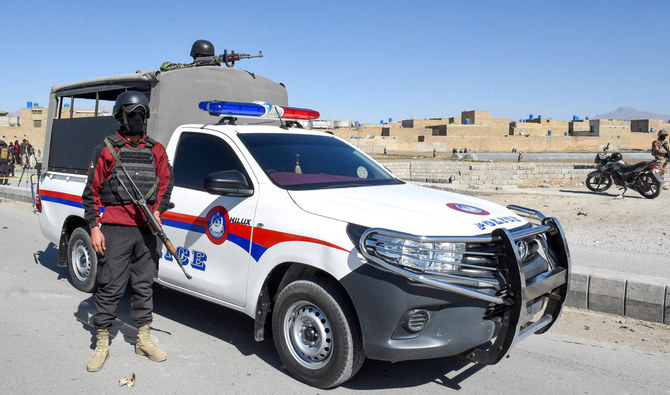
Security personnel stand guard at the site of a bomb blast in Quetta on February 1, 2024. (AFP)
Short Url
Updated 02 February 2024
Follow

Pakistan military kills 24 militants in Balochistan week before elections

  • Militants, including suicide bombers, targeted Mach and Kolpur complexes in Pakistan’s northwestern province
  • Baloch Liberation Army, the most prominent of separatist groups in Balochistan, claimed responsibility for the attack

KARACHI: Pakistan’s military has killed 24 militants in three days in the restive southwestern province of Balochistan, the military said in a statement on Friday, less than a week before national elections.

Four law enforcement personnel and two civilians have also been killed, the statement said.

Militant violence in Pakistan’s border areas has put authorities on alert ahead of next Thursday’s polls.

Militants, including suicide bombers, attacked Mach and Kolpur complexes in Balochistan, the military’s Inter Services Public Relations agency (ISPR) said on Tuesday.

The Baloch Liberation Army (BLA), the most prominent of several separatist groups in Balochistan, claimed responsibility for the attack.

The group aims to achieve independence for mountainous and mineral-rich Balochistan, Pakistan’s largest province by territory but the smallest in terms of population, which has seen a decades-long insurgency.

Balochistan borders Afghanistan to the north, Iran to the west and has a long coastline on the Arabian Sea. It has Pakistan’s largest natural gas field and is believed to hold many more undiscovered reserves.

It is also rich in precious metals including gold, the production of which has grown over recent years.

Balochistan is a key location in China’s huge multi-billion China Pakistan Economic Corridor (CPEC), part of President Xi Jinping’s massive Belt and Road infrastructure initiative.


Rating firm S&P says it won’t rush Iran war downgrades, sees risks for countries like Pakistan

Updated 12 March 2026
Follow

Rating firm S&P says it won’t rush Iran war downgrades, sees risks for countries like Pakistan

  • Agency says it is monitoring indebted energy importers as higher oil prices strain finances
  • Gulf economies seen better placed to weather shock, though Bahrain flagged as vulnerable

LONDON: S&P Global ‌said it would not make any knee-jerk sovereign rating cuts following the outbreak of war in the ​Middle East, but warned on Thursday that soaring oil and gas prices were putting a number of already cash-strapped countries at risk.

The firm’s top analysts said in a webinar that the conflict, which has involved US and Israeli strikes ‌against Iran and Iranian ‌strikes against Israel, ​US ‌bases ⁠and Gulf ​states, ⁠was now moving from a low- to moderate-risk scenario.

Most Gulf countries had enough fiscal buffers, however, to weather the crisis for a while, with more lowly rated Bahrain the only clear exception.

Qatar’s banking sector could ⁠also struggle if there were significant ‌deposit outflows in ‌reaction to the conflict, although there ​was no evidence ‌of such strains at the moment, they ‌said.

“We don’t want to jump the gun and just say things are bad,” S&P’s head global sovereign analyst, Roberto Sifon-Arevalo, said.

The longer the crisis ‌was prolonged, though, “the more difficult it is going to be,” he ⁠added.

Sifon-Arevalo ⁠said Asia was the second-most exposed region, due to many of its countries being significant Gulf oil and gas importers.

India, Thailand and Indonesia have relatively lower reserves of oil, while the region also had already heavily indebted countries such as Pakistan, Bangladesh and Sri Lanka whose finances would be further hurt by rising energy prices.

“We ​are closely monitoring ​these (countries) to see how the credit stories evolve,” Sifon-Arevalo said.