New jail term for Tunisian opposition chief Ghannouchi

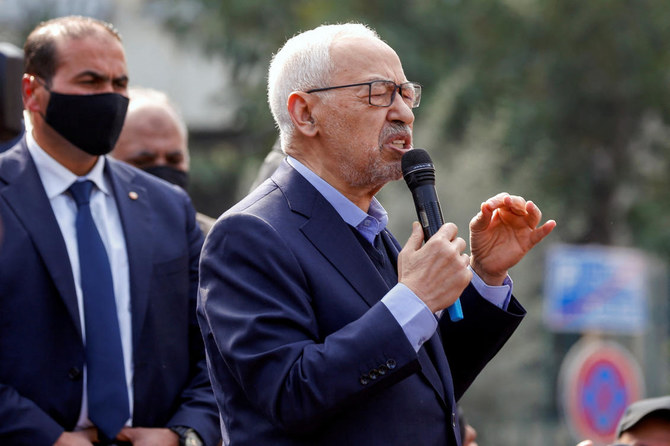
Rached Ghannouchi, the jailed leader of the Tunisian opposition party Ennahdha, was sentenced Thursday to a new three-year prison term for the illegal financing of his party, his lawyer said. (Reuters/File)
Short Url
Updated 01 February 2024
Follow

New jail term for Tunisian opposition chief Ghannouchi

  • A rival of Tunisia's President Kais Saied, Ghannouchi was sentenced for receiving "foreign financing" for the Islamist party
  • Ghannouchi, 82, was arrested in April 2023 for inciting violence and plotting against state security

TUNIS: Rached Ghannouchi, the jailed leader of the Tunisian opposition party Ennahdha, was sentenced Thursday to a new three-year prison term for the illegal financing of his party, his lawyer said.
A rival of Tunisia's President Kais Saied, Ghannouchi -- who was already serving a 15-month prison sentence over charges related to "terrorism" -- was sentenced for receiving "foreign financing" for the Islamist party, his lawyer Sami Triki told AFP.
His son-in-law Rafik Abdessalam, a former foreign minister, was tried in absentia in the same case and also sentenced to three years in prison.
In addition to the prison sentences for Ghannouchi and his son-in-law, Ennahdha was ordered to pay a fine of $1.17 million.
Ghannouchi, 82, was arrested in April 2023 for inciting violence and plotting against state security, after he said that eradicating differing political viewpoints from left-wing or Islamist parties might lead to a "civil war" in the North African country.
He was convicted last May and sentenced to 12 months in jail, which was then lengthened to 15 months on appeal in October.
His conviction followed a complaint from a police union over comments he had made in early 2022 during the funeral of an Ennahdha official.
He had said the official "did not fear the powerful nor tyrants", a comment which prosecutors said disparaged police officers.
"Ghannouchi has been in jail for a year at the doing of the prince (Saied)," veteran politician Ahmed Nejib Chebbi, who heads Tunisia's main opposition coalition the National Salvation Front, told AFP on Thursday.
"He has no guarantee of a fair trial. He has refused to present himself for trial, and he has my complete backing.
"When there is respect for human rights and freedoms and justice is independent, then we can talk about a fair trial," Chebbi added.
"All that's happening now is those in power taking revenge on their adversaries."
Ghannouchi, whose party dominated Tunisia following the 2011 revolt that toppled the dictatorship of Zine El Abidine Ben Ali, is the most well-known opposition figure imprisoned since Saied's power grab in July 2021.
Rights groups have since reported a crackdown on opposition figures, including politicians and businessmen.
They include the arrest on October 5 last year and jailing of Abir Moussi, head of the Free Destourian Party, a movement often described as nostalgic for the dictatorship independence hero Habib Bourguiba and his successor Ben Ali.


Washington presses Syria to shift from Chinese telecom systems

Updated 5 sec ago
Follow

Washington presses Syria to shift from Chinese telecom systems

  • Syria is exploring the possibility of procuring Chinese technology
  • It was unclear whether the United States ⁠pledged financial or logistical support to Syria to do so

DAMASCUS: The United States has warned Syria against relying on Chinese technology in its telecommunications sector, arguing it conflicts with US interests and threatens US national security, according to three sources familiar with the matter.
The message was conveyed during an unreported meeting between a US State Department team and Syrian Communications Minister Abdulsalam Haykal in San Francisco on Tuesday. Washington has been coordinating closely with Damascus since 2024, when Syria’s now President Ahmed Al-Sharaa ousted longtime leader Bashar Assad, who had a strategic partnership with China.
Syria is exploring the possibility of procuring Chinese technology to support its telecommunications towers and the infrastructure of local Internet service providers, according to a Syrian businessman involved in the procurement talks.
“The US side asked for clarity on the ministry’s plans regarding Chinese telecom equipment,” said ⁠another source briefed on ⁠the talks.
But Syrian officials said infrastructure development projects were time-critical and that Damascus was seeking greater vendor diversity, the source added.
SYRIAN OFFICIALS CITE US EXPORT CONTROLS AS TELECOMS BARRIER
Syria is open to partnering with US firms but the matter was urgent and export controls and “over-compliance” remained an issue, according to person familiar with the meeting in San Francisco.
A US diplomat familiar with the discussions told Reuters that the US State Department “clearly urged Syrians to use American technology or technology from allied countries in the telecoms sector.”
It was unclear whether the United States ⁠pledged financial or logistical support to Syria to do so.
Responding to Reuters questions, a US State Department spokesperson said: “We urge countries to prioritize national security and privacy over lower-priced equipment and services in all critical infrastructure procurement. If it seems too good to be true, it probably is.”
The spokesperson added that Chinese intelligence and security services “can legally compel Chinese citizens and companies to share sensitive data or grant unauthorized access to their customers’ systems” and promises by Chinese companies to protect customers’ privacy were “entirely inconsistent with China’s own laws and well-established practices.”
China has repeatedly rejected allegations of it using technology for spying purposes.
The Syrian Ministry of telecommunications told Reuters any decisions related to equipment and infrastructure are made “in accordance with national technical and security standards, ensuring data protection and service continuity.”
The ministry said it is also prioritizing the diversification of partnerships and technology sources to ⁠serve the national interest.
Syria’s telecom ⁠infrastructure has relied heavily on Chinese technology due to US sanctions imposed on successive Assad governments over the civil war that grew from a crackdown on anti-government protests in 2011.
Huawei technology accounts for more than 50 percent of the infrastructure of Syriatel and MTN, the country’s only telecom operators, according to a senior source at one of the companies and documents reviewed by Reuters. Huawei did not immediately respond to a request for comment.
Syria is seeking to develop its private telecommunications sector, devastated by 14 years of war, by attracting foreign investment.
In early February, Saudi Arabia’s largest telecom operator, STC, announced it would invest $800 million to “strengthen telecommunications infrastructure and connect Syria regionally and internationally through a fiber-optic network extending over 4,500 kilometers.”
The ministry of telecommunications says that US restrictions “hinder the availability of many American technologies and services in the Syrian market,” emphasizing that it welcomes expanding cooperation with US companies when these restrictions are lifted.
Syria has inadequate telecommunications infrastructure, with network coverage weak outside city centers and connection speeds in many areas barely exceeding a few kilobits per second.