Taliban reject UN team’s report on Al-Qaeda camps in Afghanistan

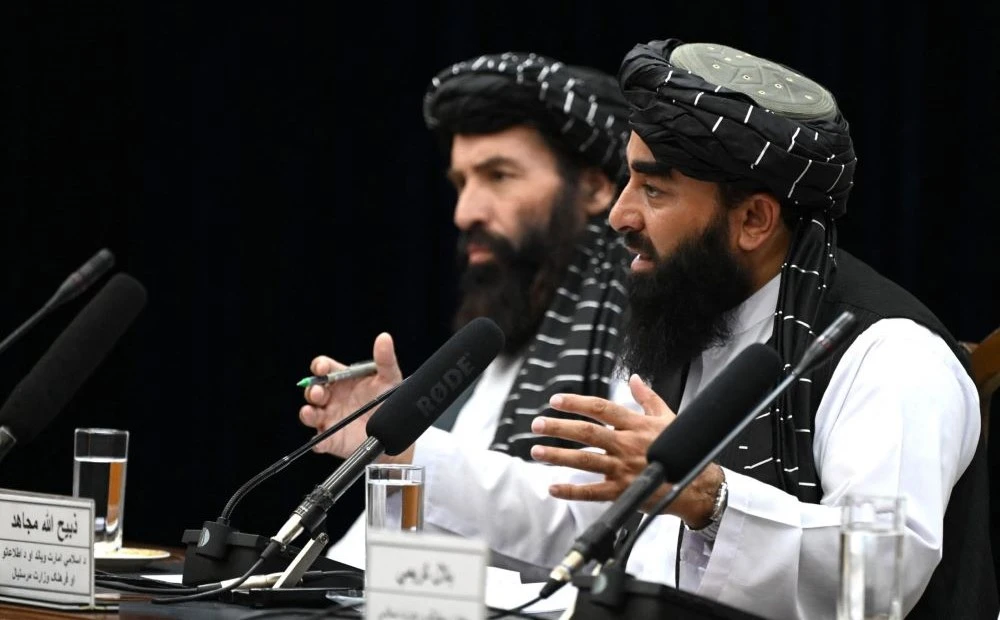
Taliban spokesman Zabihullah Mujahid, right, speaks during a press conference in Kabul, Afghanistan, June 30, 2022. (AFP)
Short Url
Updated 01 February 2024
Follow

Taliban reject UN team’s report on Al-Qaeda camps in Afghanistan

  • UN team says Al-Qaeda reportedly established eight new training centers
  • Taliban spokesman denies the group’s presence in Afghanistan

KABUL: Afghanistan’s Taliban government rejected on Thursday a recent UN Security Council report claiming that new Al-Qaeda training centers have been established on its soil.

The report was released this week by a UNSC committee pursuant to resolutions concerning Daesh, Al-Qaeda and associated individuals.

It was based on assessments by the UN sanctions monitoring team, which cites intelligence provided by member states to warn that Al-Qaeda “was reported to have established up to eight new training camps in Afghanistan” and that it “maintains safe houses to facilitate the movement between Afghanistan and the Islamic Republic of Iran.”

The report also said that Al-Qaeda maintained a “holding pattern in Afghanistan under Taliban patronage.”

Taliban chief spokesman Zabihullah Mujahid said in a statement that the allegation was “false” and a part of “propaganda” by the countries that supported Afghanistan’s previous pro-US administration.

“There is no one related to Al-Qaeda in Afghanistan, nor does the Islamic Emirate allow anyone to use the territory of Afghanistan against others,” he said.

The UN sanctions team found that a regional affiliate of Daesh — known as Islamic State Khorasan Province, or ISIS-K — remained the “greatest threat within Afghanistan,” while there was an observed strengthening of the Tehreek-e-Taliban Pakistan, the Pakistani Taliban reported to be operating from the country.

The reports said the TTP was “increasing attacks with a broader degree of autonomy to manoeuvre” and that “possibly with support” from Al-Qaeda it was “able to operate from Afghan territory across borders.”

Mujahid rejected the assessments as coming from sources that “stood by the occupation for their own interests for the past 20 years,” as he referred to two decades of US-led war, in which NATO forces were stationed in Afghanistan until the Taliban takeover in 2021.

The war was triggered by an American invasion, which toppled the first Taliban regime, after Washington accused them of sheltering Osama bin Laden, the leader of Al-Qaeda, following the Sept. 11, 2001 attacks in the US.

The US invasion led to 20 years of bloody fighting between Afghanistan’s new government supported by NATO troops and Taliban forces.

“We know that some member states of the Security Council have been defeated in Afghanistan, they will naturally spread their hatred and rumors,” Mujahid said.

“We hope that the UN Security Council remains neutral and does not reflect some opportunistic political and economic goals in its reports, which will ultimately question its status and credibility.”
US hotels seek World Cup boost after tourism dip under Trump

Updated 58 min ago
Follow

US hotels seek World Cup boost after tourism dip under Trump

  • At the US hotels that Meade Atkeson manages, a drop in tourism weighs heavily on business — but hoteliers like him hope that World Cup enthusiasm will soon eclipse wariness over President

WASHINGTON: At the US hotels that Meade Atkeson manages, a drop in tourism weighs heavily on business — but hoteliers like him hope that World Cup enthusiasm will soon eclipse wariness over President Donald Trump’s policies.
The US hospitality sector has been reeling from a tourism slump in the world’s biggest economy, which became the only major destination to see a drop in foreign visitors last year.
“Just financially, it’s difficult when international travel is down,” Atkeson told AFP, noting that such visitors tend to stay longer and spend more.
Foreign travelers account for nearly a quarter of business at the three hotels under Sonesta group that he manages — two in Washington and a third in Miami Beach.
Yet, in the first eleven months of 2025, US official data showed that inbound travel dropped by 5.4 percent.
Canadians were noticeably absent, with travel plunging by 21.7 percent from 2024, translating to about four million fewer people. The decline was nearly seven percent for French visitors.
Industry professionals see this as a consequence of Trump’s policies, even if they may not openly say so.
Visitors have chafed at the Republican president’s sweeping tariffs on foreign goods, broadsides against other countries, tightening immigration rules and portrayal of certain Democrat-led cities as ridden with crime.
Canadians “were asked to be the 51st state, right?” Atkeson said.
“If you talk to Canadians, many of them have chosen not to travel out of conscience” or on principle, he added.
Brazilian tourists meanwhile “can go anywhere they want,” he said. “And so they may have gone to Europe, they may have gone to the islands.”
‘Fear’
Thousands of kilometers away, the major resort city of Las Vegas in Nevada — boasting 150,000 hotel rooms — has also had a bad year.
Elsa Rodan, a chambermaid at the Bellagio resort and casino, says her establishment is “blessed” compared with others.
But even so, it has had to lower prices to attract guests, added Rodan, a representative of the Unite Here union who spoke at a Washington press conference.
Unite Here President Gwen Mills urges for a renewed effort to lobby the Trump administration over policies and rhetoric that she believes are jeopardizing the sector employing more than two million people.
According to her, hoteliers are not pushing the government enough.
Employers express “fear, the fear of picking your head up,” she said.
Hopefully ‘better’
Fewer visitors and overnight stays, alongside a drop in revenue, have triggered a $6.7 billion shortfall for Nevada hotels in 2025, according to the American Hotel and Lodging Association (AHLA).
But the organization hopes that 2026 will be a turning point — it is counting on the World Cup, from June 11 to July 19, to attract visitors.
Eleven US cities will be hosting matches.
“It’s being equated to having nearly 80 Super Bowls in just over a month,” AHLA spokesman Ralph Posner told AFP.
“The economic lift won’t be limited to host cities,” he added. “Destinations across the country are hoping to benefit as international visitors extend their trips and travel between markets.”
Las Vegas, for example, hopes to draw fans who might stop there before or after a game in Los Angeles or Kansas City.
Organizers say that besides the seven million spectators in stadiums, the World Cup is set to attract 20-30 million tourists.
The whole event, they believe, can generate $30 billion for the US economy.
“I hope that things will look better,” Atkeson said.
His Miami hotel is under renovations and cannot host much World Cup-related activity.
But his Washington establishments are highlighting their proximity to Philadelphia, where several matches will be held.
Another complication is war in the Middle East following US-Israeli strikes on Iran, which could snarl travel.
“It’s a little too soon to tell how we’re going to do with that, but we’ll see,” he said.