

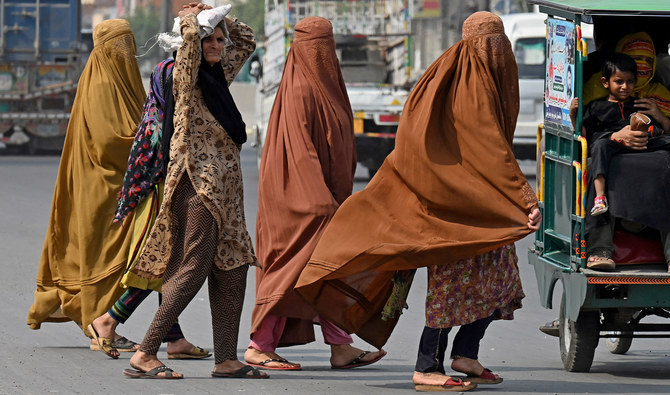

KARACHI: Pakistan’s three major religious parties have promised to ensure women’s empowerment and their right to inheritance in their election manifestos, with analysts noting that at least one of them offered solutions to women’s issues in Pakistan.
With less than a week left before millions of Pakistanis head to ballot boxes to elect their representatives for the next five years on Feb. 8, nearly all political parties have unveiled their manifestos and pledged to improve lives of people through various measures and initiatives.
The three religious parties, including the Jamiat Ulema-e-Islam (JUI), Tehreek-e-Labbaik Pakistan (TLP) and the Jamaat-e-Islami (JI), have assured of safeguarding women’s rights and ensuring equal employment opportunities for them among other things in their election manifestos.
In the 2018 general elections, the JUI secured nine seats, followed by the JI with three seats, and although the TLP could not win any parliamentary seat, it garnered 2.2 million votes nationwide. Collectively, the three parties amassed 4.7 million votes.
In the past, the JUI and JI, which were affiliated with the Muttahida Majlis-e-Amal (MMA) alliance, formed coalition governments in the center and in Balochistan after the 2002 elections, while the alliance governed the Khyber Pakhtunkhwa (KP) province. The JI has been a part of the PTI-led government in KP from 2013 till 2018, while the JUI has also joined other ruling coalitions in the past.
But despite limited successes, these parties have managed to impact electoral outcomes and underscored their significance in Pakistan’s politics. The JUI was instrumental in bringing a no-trust vote against former prime minister Imran Khan in April 2022 and the subsequent formation of a coalition government by the Pakistan Democratic Movement (PDM) alliance.
In its election manifesto, the JI said those denying women their share in property and wealth would not be allowed to participate in elections if it came to power.
“Immediate steps will be taken to give women the share of property from her father or husband’s property according to Shariah,” the JI manifesto read.
In many parts of Pakistan, women are often denied a share in property and wealth, despite Pakistan’s constitution and Shariah, the Islamic law, guaranteeing them.
The Pakistani government has considered various legislative measures to provide women with a share of property so that they might not have to fight for it in courts.
In 2021, the government introduced the Enforcement of Women’s Property Rights Act that aimed to ensure the protection of women’s inheritance right by the state. The legislation, adopted by all Pakistani provinces, allows women to file complaints with an ombudsperson to have their property right issues resolved swiftly.
However, many women have still not been able to exercise these rights due to a lack of strict implementation of laws.
The JI in its manifesto promised to end the tradition of dowry, killing of women in the name of “honor” and take steps to financially empower them.
“Steps will be taken to provide the working women a safe environment. Age relaxation will be given to a widow and divorced woman for government jobs,” it read.
“Laws will be made to encourage small industries. Women will be helped become financially strong by making them skillful.”
In its election manifesto, the JUI said it would take “practical steps” for the safety of women and provide them with equal education and employment opportunities.
The TLP manifesto said the party would establish a “special institution” for the protection of women’s rights and provide them their “legal and Shariah rights.”
While these parties touched upon different issues, analysts believed the JI had offered a “solution-based” manifesto, while the JUI and the TLP had been more focused on their religious vote.
“The manifestos of two other religious parties (the JUI and the TLP) are basically meant to attract the religious vote bank,” said Ajmal Jami, a Lahore-based television host and analyst.
He said the TLP’s manifesto was straight-forward, focusing primarily on a singular theme.
“They are not asking the state for certain measures other than the basic resolve that is about the last Prophet [Muhammad} and the importance of their belief,” Jami told Arab News.
Since its inception in 2015, the TLP has extensively campaigned in favor of the finality of Prophethood of Prophet Muhammad (Peace Be Upon Him), which forms the bases of its ideology.
“Other than this very basic point, there’s nothing concrete, they are trying to also address the importance of free electricity, but they are unable to tell us that how they would do that,” Jami said.
The analyst called the JUI’s manifesto “concerning.”
“The JUI’s manifesto is concerning, it is a very hardcore manifesto. And perhaps this is how the JUI’s religious politics can be discussed,” he said, adding the Maulana Fazl-ur-Rehman led party believed that “none other than a Muslim belonging to their sect” should be up there at important posts, such as the prime minister or the president.
“They have categorically written it in their manifesto about this very point,” he said. “And this might be and should be a problem or a matter of pain for minorities to equal Pakistanis.”
Muhammad Sami, a JUI spokesperson, said his party fully supported religious freedom of minorities and it was stressed in the manifesto as well.
“Our manifesto also advocates for the complete separation of the judiciary from administration and calls for changes in the law to align with Shariah principles,” Sami said.
“Additionally, it advocates for freedom of the press, provincial autonomy, tax exemption for essential food items, equalization of daily wages to the value of one tola (12 grams) of gold, free education, and free health care.”
It was also aimed at ending the control of a “few individuals” over the economy, confiscating wealth acquired through illegal means, and introducing an Islamic economic system, he added.
Wakil-ur-Rehman, a Karachi-based analyst with a focus on religious groups, agreed with Jami and said the JUI and TLP’s voters fully subscribed to what these parties were selling to them in their manifestos.
“The TLP was fifth largest vote-taker in 2018... it got these votes due to its hard-line stance on cartoons and other sacrilegious content [published internationally],” Rehman said. “Similarly, the language and slogans used by the JUI are bought by its targeted voters.”
He, however, hailed both parties for addressing the women’s issues.


