

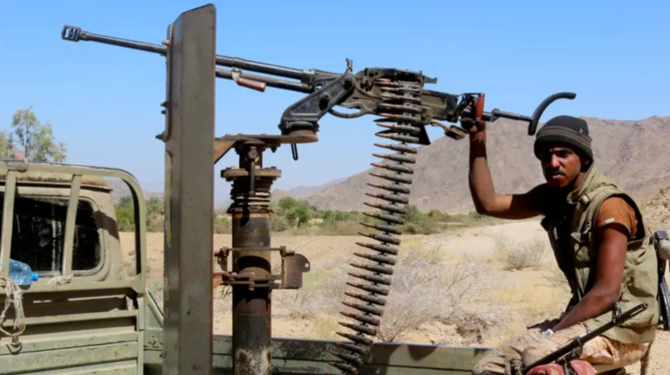

AL-MUKALLA: A Yemeni government soldier was killed and two more wounded on Wednesday when an explosive-rigged drone fired by the Iran-backed Houthis struck their location in the central province of Marib, the latest in a string of deadly drone attacks on government forces by the Yemeni militia.
Local media and officials said that the Houthis fired a drone at a gathering of the government’s Sheba Axis and Shabwa Defense forces in Hareb district, in the south of Marib province, killing one Sheba Axis soldier and injuring two others.
The strike happened only days after a soldier from the government’s Giants Brigades troops was killed and another was injured when the Houthis launched a guided missile at their location in the area of Hareb.
Yemeni government troops, backed by the Coalition to Restore Legitimacy in Yemen, gained control of Bayhan, Ouselan, and Aid in Shabwa’s southern region, as well as Hareb in nearby Marib, in January 2022, after severe combat with the Houthis.
Despite aggressive attacks on government troops in both provinces, the Houthis have not been able to recapture the areas for the past two years.
Fighting has largely abated on major flashpoint sites since the nationwide truce brokered by the UN entered into force in April 2022.
However, the Houthis have lately upped their drone, missile, and ground strikes on government forces in Marib, Shabwa, Taiz, Dhale, and Taiz, killing scores of combatants on both sides.
This Monday, the Yemeni army held a burial procession in Marib for 11 troops killed in battle with the Houthis.
In January, the Houthis organized military funeral processions in Sanaa and other places under their control for scores of their men who were killed on the battlefield.
Meanwhile, Yemeni rights organizations and activists have accused the Houthis of kidnapping and torturing a physician in Sanaa before leaving him to die in a hospital.
According to the Yemeni Network for Rights and Freedoms, an armed group linked to the Houthis kidnapped Mansour Al-Shabouti, a surgeon at Dr. Abdulkader Al-Mutawakel Hospital, from his home in Sanaa a few weeks ago for unknown reasons, tortured him, and released him this week in critical condition, before he was pronounced dead.
The Yemeni group denounced the execution of Al-Shabouti as “premeditated murder” and demanded a swift and open inquiry into his death.
“The Yemeni Network for Rights and Freedoms urged international human rights organizations affiliated with the United Nations and the European Union to put pressure on Houthi militias to stop kidnappings and arbitrary arrests, as well as to demand an immediate investigation into the death of Doctor Al-Shabouti and the release of all those kidnapped,” the Yemeni organization said on social media platform X.
An official from Yemen’s human rights ministry told Arab News on Wednesday that armed Houthis kidnapped the doctor from his home in Sanaa on April 15 and forcibly disappeared and tortured him before releasing him on Jan. 25.
The doctor suffered from chest infections and torture marks on his body after his release and he died on Jan. 27.
“The man was in good health, had a good professional reputation, was not politically affiliated, and worked as an oncology surgeon,” the official, who requested anonymity, said.
Yemeni Doctors in the Diaspora, an umbrella organization for dozens of Yemeni physicians living abroad, also released a statement denouncing the execution of Al-Shabouti, stating that he was “in good death” when he was abducted by “an unknown group” for an unknown cause.
Yemeni physicians urged the Houthis to conduct a probe and safeguard doctors.
“We demand a quick and transparent investigation into the circumstances of the deceased’s death. We also urge the authorities to fulfill their obligation to provide security for medical staff,” the doctors said.


