

Princess Reema rejects opposition to holding women’s tennis tourney in Saudi Arabia

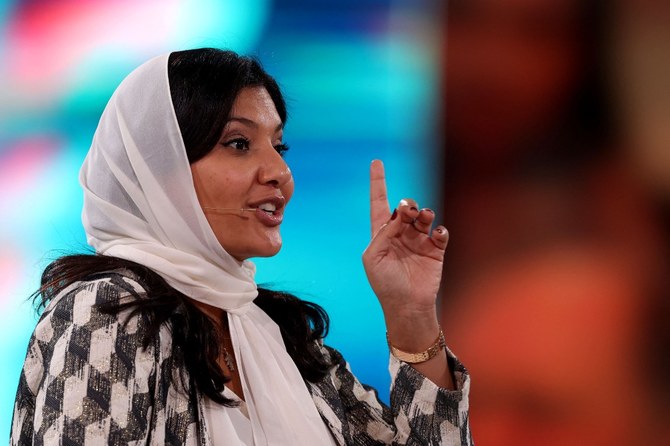
Princess Reema emphasized that sports should not be exploited as a tool to promote personal bias. (FILE/AFP)
Short Url
Updated 30 January 2024
Follow

Princess Reema rejects opposition to holding women’s tennis tourney in Saudi Arabia

  • Kingdom’s ambassador to US critical of tennis legends Martina Navratilova and Chris Evert who seek a ban
  • The former players’ view ‘denigrates’ the considerable progress of women in Saudi Arabia, says Princess Reema

RIYADH: Princess Reema bint Bandar, Saudi Arabia’s ambassador to the US, has rejected calls by tennis legends Chris Evert and Martina Navratilova for a ban on holding the Women’s Tennis Association Finals in Saudi Arabia.

Princess Reema’s comments in a statement on Monday come in the wake of an opinion piece written by Evert and Navratilova that was published in the Washington Post on Jan. 26. The two argue that the Kingdom does not have gender equity and should not be awarded the season-ending event.

Princess Reema wrote: “Sports should not be exploited as a tool to promote personal bias, agendas, or to penalize a society eager to embrace tennis and contribute to its growth.”

She added: “Failing to acknowledge the great progress women have made in Saudi Arabia denigrates our remarkable journey.”

“Like many women around the world, we looked to the legends of tennis as trailblazers and role models … glimmers of hope that women truly could achieve it all. But these champions have turned their back on the very same women they have inspired and it is beyond disappointing,” she said.

Women in Saudi Arabia now have opportunities in traditionally male-dominated sectors, such as the military, firefighting, law enforcement, and even space exploration, said Princess Reema.

She rejected the argument by Evert and Navratilova that women are not equal in Saudi Arabia society. “On this, let me simply say: get your facts straight. What is often referred to as ‘guardianship’ no longer describes the status of Saudi women today. Women do not need the approval of a guardian to travel, work, or be the head of their household.”

She added: Today, Saudi women own more than 300,000 businesses and roughly 25 percent of small and mid-sized start-up companies, which is about the same percentage as the United States. Women in Saudi now enjoy equal pay, leading the way towards something that should be universal.”

Princess Reema further said: “While there’s still work to be done, the recent progress for women, the engagement of women in the workplace, and the social and cultural opportunities being created for women are truly profound and should not be overlooked.”

Princess Reema said the Kingdom has over 330,000 registered female athletes, with 14,000 actively participating in tennis. Thousands of women serve as coaches, mentors, referees, and sports doctors in various capacities.

Princess Reema emphasized that portraying Saudi Arabia’s women as voiceless victims not only undermines their progress in sports but also detracts from the broader advancements made by women in the country.

The ambassador dismissed assertions that guardianship laws in the Kingdom restricted women’s freedom, adding that these rules were no longer in force.

She dissmissed claims that Saudi law considered women as property, urging the need for accurate information.

Highlighting the achievements of athletes such as Yasmeen AlDabbagh, Tahani AlQahtani, and Yara AlHogbani, the ambassador emphasized their contributions in challenging perceptions about women’s rights in Saudi Arabia.

Princess Reema called for a healthy debate on women’s progress and urged inclusive dialogue to avoid bias.

She expressed a willingness to welcome diverse perspectives and underscored the importance of fostering productive dialogue for the common cause of advancing women’s opportunities globally.


Threat to Kingdom’s security is ‘red line’ that will be ‘addressed and neutralized,’ Saudi envoy says

Updated 14 January 2026
Follow

Threat to Kingdom’s security is ‘red line’ that will be ‘addressed and neutralized,’ Saudi envoy says

  • Abdulaziz Alwasil tells UN Security Council the situation in southern Yemen is ‘a just cause with social and historic dimensions’ that can only be resolved through dialogue
  • Recent military activity in the south was unilateral, resulting in an escalation that harms the interests of Yemeni people and undermines efforts to address issues in the south, he said

NEW YORK CITY: Any attempt to threaten Saudi Arabia’s national security is a “red line” and will be met with decisive action, the Kingdom’s ambassador to the UN told the Security Council on Wednesday.

Speaking during a meeting of the council to discuss Yemen, Abdulaziz Alwasil said the situation in the south of the country is “a just cause with social and historic dimensions” that can only be resolved through dialogue.

“We stress that any attempt to threaten our national security is a red line, and we will not hesitate to take the necessary actions and steps to address it and neutralize it,” he added.

Alwasil reaffirmed Saudi Arabia’s support for Yemeni President Rashad Al-Alimi, the Presidential Leadership Council, and the Yemeni government in their efforts to achieve security, stability, development and peace while preserving national unity.

He said military activity by Southern Transitional Council forces in Hadramout and Al-Mahra on Dec. 2, 2025, was unilateral, did not have the approval of the Presidential Leadership Council, and was not carried out in coordination with the Coalition to Restore Legitimacy in Yemen.

It had resulted in an unjustified escalation that harmed the interests of the Yemeni people, undermined efforts to address the issues in the south, and ran counter to the coalition’s objectives, Alwasil added.

The Kingdom, working with its coalition partners, the Presidential Leadership Council and the Yemeni government, had moved to contain the situation by dispatching a military force to coordinate arrangements with the Southern Transitional Council in Aden, he said.

The aim was to ensure the return of the southern council’s forces to their previous positions outside of Hadramout and Al-Mahra, and the handover of camps to legitimate government forces and local authorities in line with agreed procedures, Alwasil added.

He expressed regret over the military operations that took place in Hadramout and Al-Mahra, close to Saudi Arabia’s southern border, which he said posed a direct threat to the Kingdom’s national security, as well as the security of Yemen and regional stability. Such steps were extremely dangerous, he added, and contradicted the principles on which the Coalition to Restore Legitimacy in Yemen had been founded.

Alwasil welcomed a prisoner and detainee exchange agreement signed in Muscat on Dec. 23, which he described as an important humanitarian measure to alleviate suffering and build confidence.

He praised Oman for hosting and sponsoring the consultations and supporting negotiations, and commended the efforts of UN’s special envoy for Yemen, Hans Grundberg, the International Committee of the Red Cross and all others that has played a part.

Regarding the political efforts to resolve the crisis, Alwasil said Saudi Arabia welcomed President Al-Alimi’s call for an inclusive conference in Riyadh to bring together all stakeholders to discuss just solutions to the situation in southern Yemen.

Preparations for the conference have begun, he added, in cooperation with the Yemeni government and southern representatives, reflecting the close ties between the two countries and their shared interests in stabilizing Yemen.

He urged all southern stakeholders to participate actively and constructively in the talks, to help find comprehensive and just solutions that meet the legitimate aspirations of the people of southern Yemen.

Alwasil called on all Yemeni forces and stakeholders to cooperate and intensify their efforts to reach a lasting political settlement that would ensure security and stability.

He described the southern issue as “a just cause with social and historic dimensions,” adding that “the only way to address it is through dialogue that leads to a comprehensive political solution” based on nationally and internationally agreed terms of reference.