

Pakistan plans to roll out new banknotes of all denominations — central bank chief

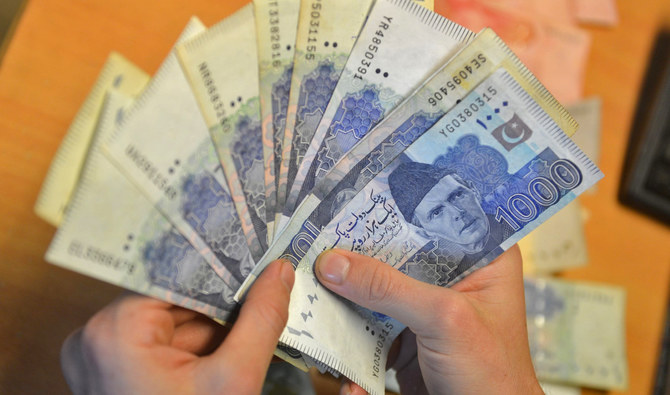
A money changer counts Pakistan's currency at a market in Karachi on January 6, 2023. (AFP/File)
Short Url
Updated 30 January 2024
Follow

Pakistan plans to roll out new banknotes of all denominations — central bank chief

  • The move appears to be aimed at combating counterfeit currency and the circulation of fake banknotes in market
  • The Pakistani central bank is expected to introduce new notes by March this year after completing all formalities

KARACHI: Pakistan’s central bank is working on introducing new currency notes of all denominations, its chief said on Monday, adding the new notes would have different designs and enhanced security features.

The State Bank of Pakistan (SBP) normally issues a new series of banknotes after every 10-15 years and demonetizes the earlier one with the approval of the government.

However, this is the first time the central bank has decided to replace currency notes of all denominations since the last issue of Rs5 and Rs50 notes in 2008.

“The features and the number of the notes will be changed in accordance with the international high standards,” Jamil Ahmed, the SBP governor, said in an informal conversation with reporters in Karachi.

While Ahmed did not share the reason behind the decision, it appeared to be aimed at combating counterfeit currency and the circulation of fake banknotes.

The move is expected to be materialized by March this year.

Ahmed said the new currency notes would be of different colors, distinct serial numbers, design and include “high security features.” He, however, assured the transition to new banknotes would not be abrupt.

Pakistan currently has Rs10, Rs20, Rs50, Rs100, Rs500, Rs1,000 and Rs5,000 banknotes in circulation.

The central bank issued the current banknotes on different occasions between 2005 and 2008, under then SBP governor Shamshad Akhtar, who is currently the caretaker finance minister of Pakistan.


Pakistan finance chief calls for stronger emerging market voice during Saudi conference

Updated 12 February 2026
Follow

Pakistan finance chief calls for stronger emerging market voice during Saudi conference

  • Aurangzeb tells Saudi state media developing economies must assume larger global role
  • Minister says AlUla conference can strengthen coordination among emerging economies

KARACHI: Pakistan’s Finance Minister Muhammad Aurangzeb on Thursday called for developing economies to play a greater role in shaping global economic governance in an interview on the sidelines of the AlUla Conference for Emerging Market Economies in Saudi Arabia.

The conference, hosted by the Kingdom’s Finance Ministry, brings together top government functionaries, central bank governors and policymakers from emerging markets to discuss debt sustainability, macroeconomic coordination and structural reforms amid global economic uncertainty.

In a conversation with the Saudi Press Agency, Aurangzeb described the conference as a timely platform for dialogue at a moment of heightened geopolitical tensions, trade fragmentation and rapid technological change, including advances in artificial intelligence.

“It is not merely about discussions but about translating deliberations into concrete policy actions and execution over the course of the year,” he said, according to a statement circulated by the Finance Division in Islamabad.

The minister said emerging markets’ growing share of global output and growth should be matched by greater influence in international decision-making.

He noted these economies must strengthen collective dialogue and coordinated policy responses to address shared challenges, adding that the global landscape had evolved significantly since the inaugural edition of the conference.

Aurangzeb expressed confidence that the outcomes of the AlUla Conference would contribute to strengthening coordination among emerging economies and reinforcing their collective voice in shaping a more inclusive and resilient global economic order, the statement added.