
ISLAMABAD: Pakistan and Iran on Monday resolved to consolidate ties and address common challenges through cooperation, the Pakistan prime minister’s office said, amid high-level meetings by the Iranian foreign minister during his ongoing visit to Islamabad.
The visit by the Iranian FM Hossein Amir Abdollahian comes less than two weeks after both countries traded missile strikes aimed at what they said were militant targets inside each other’s territory.
The strikes were the highest-profile cross-border intrusions between Pakistan and Iran in recent years and raised concerns about another conflict in the Middle East since Israel waged a war against Hamas on Oct. 7.
On Monday, FM Abdollahian held a series of high-level meetings, including with Pakistan PM Anwaar-ul-Haq Kakar, FM Jalil Abbas Jilani and Army Chief General Asim Munir, in an attempt to mend ties after the tit-for-tat strikes

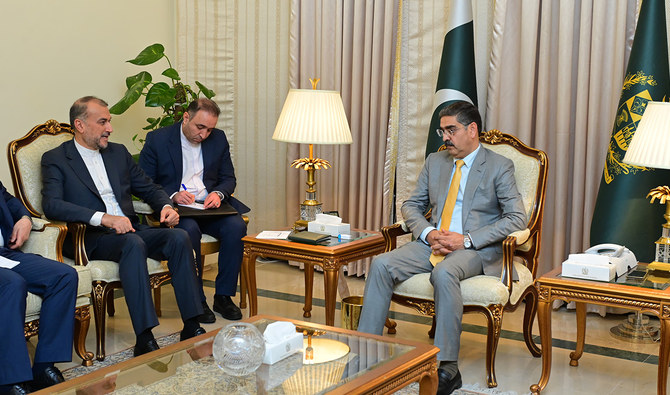
Iranian Foreign Minister Amir Abdollahian (right) shakes hands with the Caretaker Pakistan Prime Minister Anwaar-ul-Haq Kakar in Islamabad, Pakistan on January 29, 2024. (Photo courtesy: PMO)
In his meeting with the Iranian foreign minister, PM Kakar underscored close relations between both countries and stressed the need for a collaborative approach to common challenges.
“The Prime Minister reaffirmed Pakistan’s commitment to further consolidate bilateral ties,” PM Kakar’s office said in a statement after the meeting. “The Prime Minister also emphasized the need to address common challenges through collaborative and cooperative approaches, rooted in the respect for international law and the principles of the UN Charter, in particular, territorial integrity and sovereignty of both Pakistan and Iran.”
The strikes took place in the porous border region of Baluchestan, which is divided between Pakistan, Iran and Afghanistan, and has long been the scene of sporadic clashes between security forces and separatist militants and smugglers.
However, the two countries quickly moved to de-escalate tensions and sent their ambassadors, who were recalled after the strikes, to their respective postings last week, followed by FM Abdollahian’s visit to Islamabad on Sunday.
In his joint media briefing with his Pakistani counterpart Jilani on Monday, the Iranian FM said there was “no doubt” militants harboring along a shared border with Pakistan were supported by “third countries” as both neighbors agreed to form a foreign ministerial-level advisory body to review bilateral cooperation and challenges.
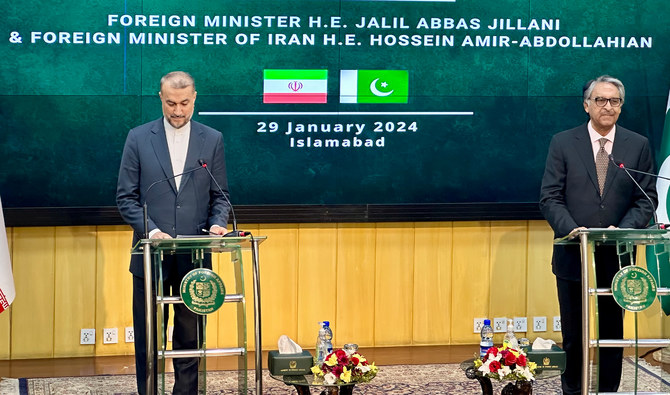
Pakistan's Foreign Minister Jalil Abbas Jilani (R) holds a joint press conference with his Iranian counterpart Hossein Amir-Abdollahian (L) at the Ministry of Foreign Affairs in Islamabad on January 29, 2024. (AN photo)
Pakistan has long accused rivals and neighboring Afghanistan and India of stoking unrest in its southwestern Balochistan province that borders Iran. Both deny the charge.
“We consider Pakistan’s security as a brotherly friendly and neighborly country as the security of the Islamic Republic of Iran, and the security of the whole region,” Abdollahian said.
“We have agreed to establish a high-ranking advisory committee at the level of the ministers of foreign affairs of the two countries, alternatively to meet in Islamabad and Pakistan,” he said, adding the committee would “oversee the progress that is being made in various areas of cooperation.”
In a separate meeting with Pakistan’s army chief, both sides emphasized on strengthening bilateral ties and fostering greater understanding of each other’s concerns, according to the Inter-Services Public Relations (ISPR), the Pakistani military’s media wing.
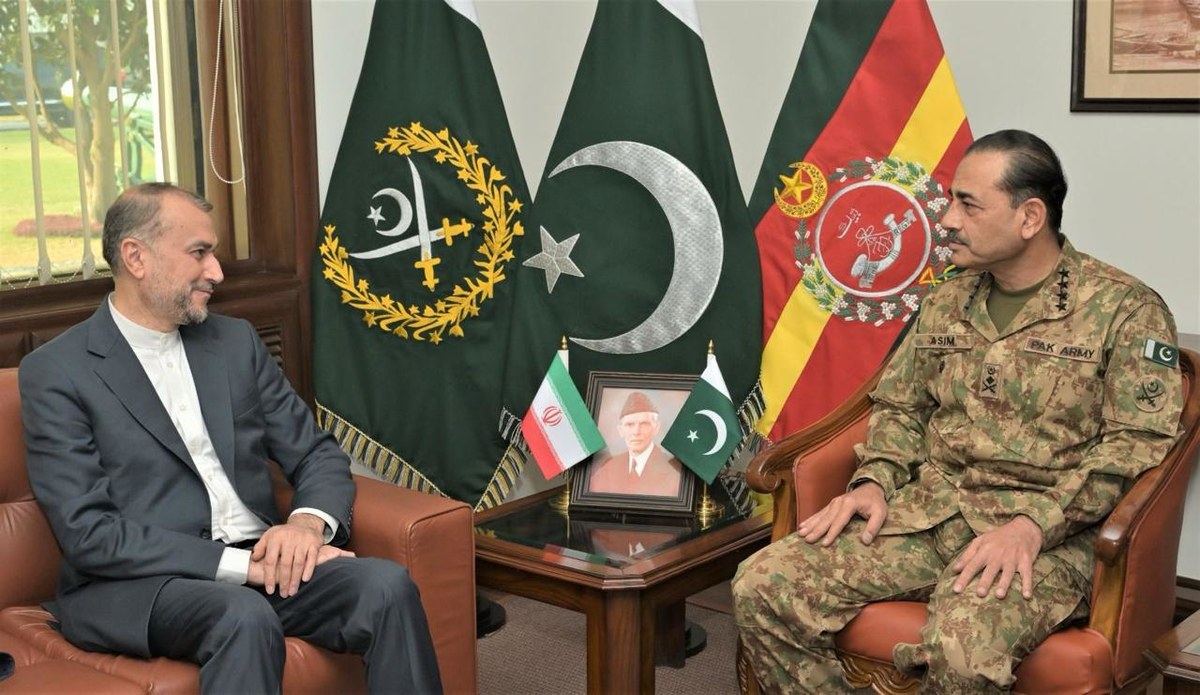
Pakistan's Army Chief General Asim Munir (right) in a meeting with the Iranian Foreign Minister Amir Abdollahian in Islamabad, Pakistan on January 29, 2024. (Photo courtesy: military's media wing)
“COAS (Chief of Army Staff) underscored the centrality of respecting the other state’s sovereignty and territorial integrity, calling it sacrosanct, inviolable and the most important cardinal of state-to-state relationship,” the ISPR said in a statement.
“Both sides agreed to operationalize the mechanism of deployment of military liaison officers in each other’s country at an early date to improve coordination and efficiency of response against common threats.”
They reiterated their commitment to peace, stability and prosperity in the border region which they said was an “indispensable requirement” for the well-being of people living on both sides, the ISPR added.