

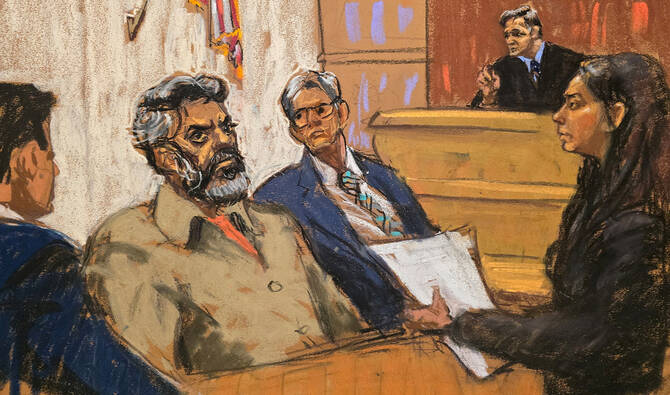
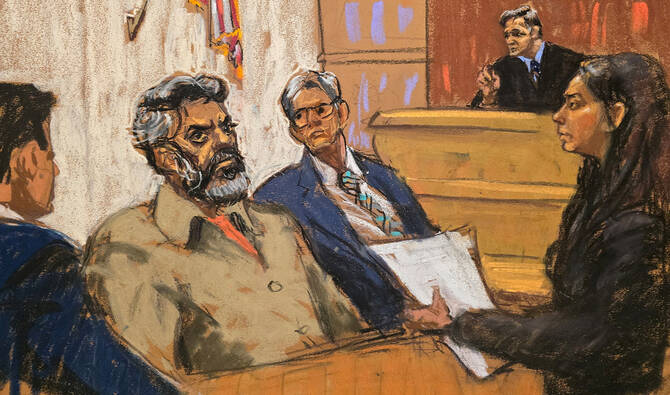
NEW YORK: A Pakistani business owner who tried to hire hit men to kill a US politician was convicted Friday in a trial that showcased allegations of Iran-backed plotting on American soil.
As the Iran war unfolded in the Mideast, Asif Merchant acknowledged in a US court that he sought to put an assassination in motion during the 2024 presidential campaign — a plot that was quickly disrupted by American investigators before it had a chance to proceed.
A jury in Brooklyn convicted Merchant on terrorism and murder for hire charges.
The verdict after only a couple hours of deliberations followed a weeklong trial that included remarkable testimony from Merchant himself.
Merchant told the jury he was carrying out instructions from a contact in the Islamic Republic’s powerful paramilitary Revolutionary Guard. According to Merchant, the handler never specified a target but broached names including then-candidate Donald Trump, then-President Joe Biden and Nikki Haley, the former UN ambassador who was also in the race for a time.
The Iranian government has denied trying to kill US officials.
The nascent plot fell apart after Merchant showed an acquaintance what he had in mind by using objects on a napkin to depict a shooting at a rally. He asked the man to help him hire assassins. Instead, he was introduced to undercover FBI agents who were secretly recording him, as had the acquaintance.
Merchant told the supposed hit men he needed services that could include killing “some political person” and paid them $5,000 in cash in a parked car in Manhattan.
“This man landed on American soil hoping to kill President Trump — instead, he was met with the might of American law enforcement,” US Attorney General Pam Bondi said in a statement released after the conviction.
Merchant’s attorney, Avraham Moskowitz, didn’t immediately reply to a message seeking comment.
Merchant, 47, worked for Pakistani banks for decades before going into clothing and other businesses. He has two families, in Pakistan and Iran, and he sometimes visited the US for his garment business.
Merchant testified that he met a Revolutionary Guard intelligence operative about three years ago. The contact gave him countersurveillance training and assignments including the assassination scheme, Merchant said.
He maintained that he had to do his handler’s bidding to protect loved ones in Iran. The defendant said he reluctantly went through the motions but thought he’d be arrested and explain his situation to authorities before anyone was killed.
“I was going along with it,” he said, speaking in Urdu through a court interpreter.
Prosecutors emphasized that Merchant admitted taking steps to enact the plan on behalf of the Revolutionary Guard, which the US considers a foreign terrorist organization, and he didn’t proactively go to authorities.
Instead, he was packing for a flight to Pakistan when he was arrested on July 12, 2024, a day before an unrelated attempt on Trump’s life in Butler, Pennsylvania. Officials said it appeared the Butler gunman acted alone but that they had been tracking a threat on Trump’s life from Iran, a claim that the Islamic Republic called “unsubstantiated and malicious.”
When Merchant subsequently spoke to FBI agents to explore the possibility of a cooperation agreement, he didn’t say he had acted out of fear for his family.
Prosecutors argued that he didn’t back up a defense of acting under duress. Merchant sought to persuade jurors he simply didn’t think the agents would believe him because they seemed to “think that I am some type of super-spy,” which he said he was “absolutely not.”


