India seeks to foster international cooperation at energy week next month

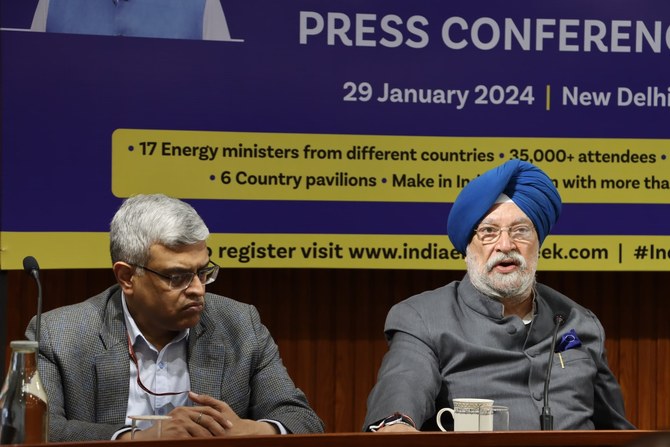
Indian Oil Minister Hardeep Singh Puri, right, speaks during a press conference in New Delhi on Jan. 29, 2024. (Ministry of Petroleum and Natural Gas)
Short Url
Updated 29 January 2024
Follow

India seeks to foster international cooperation at energy week next month

  • Saudi Arabia is an ‘important part’ of India Energy Week, minister says
  • Expert sees IEW as opportunity for closer Saudi-Indian energy cooperation

New Delhi: India is seeking to foster international cooperation to achieve its energy transition goals, the country’s oil minister said on Monday ahead of the 2024 India Energy Week. 

The South Asian country is set to welcome 17 ministers and more than 4,000 delegates from over 100 countries for the second edition of IEW, which will take place from Feb. 6 to 9 in the western state of Goa. 

During a press conference in New Delhi, Indian Oil Minister Hardeep Singh Puri expressed confidence in India’s energy outlook and described IEW as a “golden opportunity” for progress related to energy to be showcased and as a “platform for further development and growth.”

India aims to install 50 gigawatts of clean energy by the end of the decade and to reach net-zero emissions by 2070. The world’s most populous nation is still mostly powered by fossil fuels, with coal generating about 70 percent of India’s electricity and renewable energy contributing around 10 percent. 

The growth of IEW in its second year, which now has 30 percent more exhibitors than in 2023, is a “testament to India’s strong economic credentials and commitment to energy innovation,” Puri said. 

Saudi Arabia, which last year signed a number of agreements on energy cooperation with India, is also expected to take part at IEW next month. 

“Saudi Arabia is an important part of India Energy Week, with Aramco being one of the main platinum sponsors of the event,” Puri said. 

Saudi and Indian officials agreed to cooperate in renewable energy and energy security just last September, which was followed by an initial agreement on electrical interconnection and co-production of green and clean hydrogen. 

The event in Goa will be an opportunity for closer energy collaboration between India and the Kingdom, experts said.

“IEW provides a platform for both India and Saudi Arabia to reinforce collaboration in renewable and green technology,” Manish Mohan, director at the Confederation of Indian Industry, told Arab News. 

“Saudi Arabia is collaborating in a major way with India, and we want to reduce our carbon footprint and take significant steps to reduce emissions.” 

Saudi-Indian collaboration will be beneficial for New Delhi, said Lakshmi Priya, a fellow at the Indian Council of World Affairs.

“Cooperation with Saudi Arabia will help India in many ways. One, it will ensure hydrocarbon energy security for the ever-growing energy needs of India. Two, it will accelerate India’s transition to renewable energy,” Priya told Arab News. 

“Collaboration in green hydrogen has immense potential to enhance our efforts in the production and usage of green hydrogen. The understanding between PM Modi and Crown Prince Mohammed bin Salman will do wonders for energy cooperation.”


Russia slams Western peacekeeping plan for Ukraine

Updated 4 sec ago
Follow

Russia slams Western peacekeeping plan for Ukraine

  • “The new militarist declarations of the so-called Coalition of the Willing and the Kyiv regime together form a genuine ‘axis of war’,” Zakharova
  • She called the plans drafted by Kyiv’s allies “dangerous” and “destructive“

MOSCOW: Russia on Thursday slammed a plan for European peacekeepers to be deployed to Ukraine as “dangerous” and dubbed Kyiv and its allies an “axis of war,” dousing hopes the plan could be a step toward ending the almost four-year-war.
US President Donald Trump has been pushing the warring sides to strike a deal to halt the conflict, running shuttle diplomacy between Ukraine’s Volodymyr Zelensky and Russia’s Vladimir Putin in a bid to get an agreement across the line.
An initial 28-point plan which largely adhered to Moscow’s demands was criticized by Kyiv and Europe, and now Russia has slammed the attempts to beef-up protections for Ukraine should an elusive deal be reached.
Ukraine’s allies said they had agreed key security guarantees for Kyiv at a summit in Paris earlier this week, including a peacekeeping force.
But in its first comments since the summit, Moscow said the statements were far away from anything the Kremlin could accept to end its assault.
“The new militarist declarations of the so-called Coalition of the Willing and the Kyiv regime together form a genuine ‘axis of war’,” Russia’s foreign ministry spokeswoman Maria Zakharova said in a statement.
She called the plans drafted by Kyiv’s allies “dangerous” and “destructive.”
The remarks come as Russian strikes plunged hundreds of thousands in Ukraine into darkness, leaving families without heat in below-freezing temperatures — attacks that Zelensky said showed Russia was still set on war.

- ‘Legitimate military targets’ -

European leaders and US envoys announced earlier this week that post-war guarantees for Ukraine would include a US-led monitoring mechanism and a European multinational force to be deployed when the fighting stops.
But Moscow has repeatedly warned that it would not accept any NATO members sending peacekeeping troops to Ukraine.
“All such units and facilities will be considered legitimate military targets for the Russian Armed Forces,” Zakharova said Thursday, repeating a threat previously uttered by Putin.
Zelensky also said Thursday that a bilateral agreement between Kyiv and Washington for US security guarantees was “essentially ready for finalization at the highest level with the President of the United States” following talks between envoys in Paris this week.
Kyiv says legally-binding assurances that its allies would come to its defense are essential to convince Russia not to re-attack if a ceasefire is reached.
But specific details on the guarantees, the European force, and how it would engage have not been made public.
Zelensky said earlier this week he was yet to receive an “unequivocal” answer of what they would do if Russia does attack again after a deal.
Zelensky has also said that the most difficult questions in any settlement — territorial control of the eastern Donbas region and the fate of the Russian-occupied Zaporizhzhia nuclear power plant — were still unresolved.

- Russian strikes cut heating -

Ukraine was meanwhile scrambling to restore heating and water to hundreds of thousands of households after a new barrage targeted energy facilities in its Dnipropetrovsk and Zaporizhzhia regions.
“This is truly a national level emergency,” Borys Filatov, mayor of Dnipropetrovsk’s capital Dnipro, said on Telegram.
He announced power was “gradually returning to the hospitals” after the blackouts forced them to run on generators. The city authorities also extended school holidays for children.
About 600,000 households in the region remained cut off from power in Dnipropetrovsk, Ukrainian energy company DTEK said.
In a post on social media, Zelensky said the attacks “clearly don’t indicate that Moscow is reconsidering its priorities.”
In addition to the unrelenting pummelling of Dnipropetrovsk, Russia pressed on with its ground assault on the region, claiming to have taken another village there.
It is not one of the five Ukrainian regions that Moscow claims to have annexed.