

Saudi Arabia, Kenya discuss energy cooperation

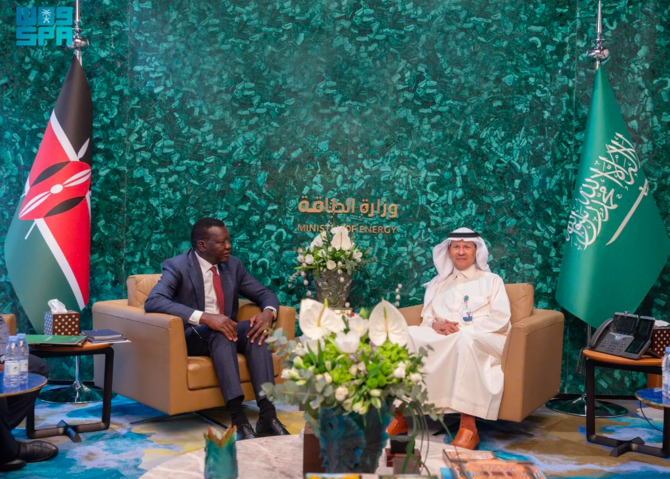
Saudi Energy Minister Prince Abdulaziz bin Salman meeting with Davis Chirchir, his Kenyan counterpart. SPA
Short Url
Updated 29 January 2024
Follow

Saudi Arabia, Kenya discuss energy cooperation

RIYADH: Trade collaboration between Saudi Arabia and Kenya is poised to strengthen as energy ministers met in Riyadh to discuss various topics, including the “Empower Africa” initiative.

Saudi Energy Minister Prince Abdulaziz bin Salman welcomed Davis Chirchir, his Kenyan counterpart, for talks focused on delivering solutions and advancements in various sectors, such as clean energy, communication, electronic health, and online education.

The meeting also explored opportunities for collaboration between the two countries, centering on enhancing cooperation in petroleum and its supplies, renewable energy, and energy efficiency, as well as exchanging expertise in project development, policies, and systems, as reported by the Saudi Press Agency.

Commenting on the official meeting, Kenya’s Ministry of Energy and Petroleum posted on its X account: “We are enthusiastic about seeking partnerships that can contribute to expediting the achievement of our development goals in the energy and petroleum sector.”

According to the Kenyan ministry, to meet its Nationally Determined Contributions of reducing greenhouse gas emissions by 32 percent, the country aims to attain 100 percent clean energy by 2030.

“Currently renewable energy accounts for over 92 percent of the energy mix,” the ministry said.

Energy is one of the key enablers of Kenya’s Vision 2030 and the Big 4 Agenda development programs. The country treats energy security as a matter of national priority, Kenya’s Department for Energy says on its website.

It adds that the Third Medium Plan 2017-2022 identifies energy as the country’s driver into “a newly-industrializing, middle-income economy, providing a high quality of life to all its citizens in a clean and secure environment.”

Nairobi, the same source adds, considers access to competitively priced, reliable, quality, safe and sustainable energy as an essential ingredient for the country’s social-economic development.

In October 2023, the Saudi energy minister unveiled a plan to provide electricity, telecommunication services, e-learning, and e-medical care to African countries.

The initiative, announced at the Middle East and North Africa Climate Week, will be jointly managed by the Kingdom’s health, energy, and communications ministries in cooperation with stc and Dawyiat.


Industry leaders highlight Riyadh’s Metro, infrastructure as investment catalysts

Updated 29 December 2025
Follow

Industry leaders highlight Riyadh’s Metro, infrastructure as investment catalysts

RIYADH: Saudi Arabia’s capital, Riyadh, is experiencing a transformative phase in its real estate sector, with the construction market projected to reach approximately $100 billion in 2025, accompanied by an anticipated annual growth rate of 5.4 percent through 2029.

The Kingdom is simultaneously advancing its data center capacity at an accelerated pace, with an impressive 2.7 GW currently in the pipeline. This expansion underscores the critical role of strategic land and power planning in establishing national infrastructure as a cornerstone of economic growth.

These insights were shared by leading industry experts during JLL’s recent client event in Riyadh, which focused on the city’s macroeconomic landscape and emerging trends across office, residential, retail, hospitality, and pioneering sectors, including AI infrastructure and Transit-Oriented Development.

Saud Al-Sulaimani, Country Lead and Head of Capital Markets at JLL Saudi Arabia, commented: “Riyadh is positioned at the forefront of Saudi Arabia’s Vision 2030, offering unparalleled opportunities for both investors and developers. National priorities are continuously recalibrated to ensure strategic alignment of projects and foster deeper collaboration with the private sector.”

He added: “Recent regulatory developments, including the introduction of the White Land Tax and the rent freeze, are designed to stabilize the market and are expected to drive renewed focus on delivering premium-quality assets. This dynamic environment, coupled with evolving construction cost considerations in select segments, is fundamentally reshaping the market landscape while accelerating progress toward our national objectives.”

The event further underscored the transformative impact of infrastructure initiatives. Mireille Azzam Vidjen, Head of Consulting for the Middle East and Africa at JLL, highlighted Riyadh’s transit revolution. She detailed the Riyadh Metro, a $22.5 billion investment encompassing 176 kilometers, six lines, and 84 stations, providing extensive geographic coverage, with a depth of 9.8 km per 100 sq. km. This strategic development generates significant TOD opportunities, with properties in proximity potentially commanding a 20-30 percent premium. JLL emphasized the importance of implementing climate-responsive last-mile solutions to enhance mobility and accessibility, particularly given Riyadh’s extreme temperatures.

Gaurav Mathur, Head of Data Centers at JLL, emphasized the rapid expansion of the Kingdom’s AI infrastructure, signaling a critical area for technological investment and innovation.

Focusing on the construction sector, Maroun Deeb, Head of Projects and Development Services, KSA at JLL, explained that the industry is actively navigating complexities such as skilled labor availability, material costs, and supply chain dynamics.

He highlighted the adoption of Building Information Modeling as a key driver for enhancing operational efficiency and project delivery.