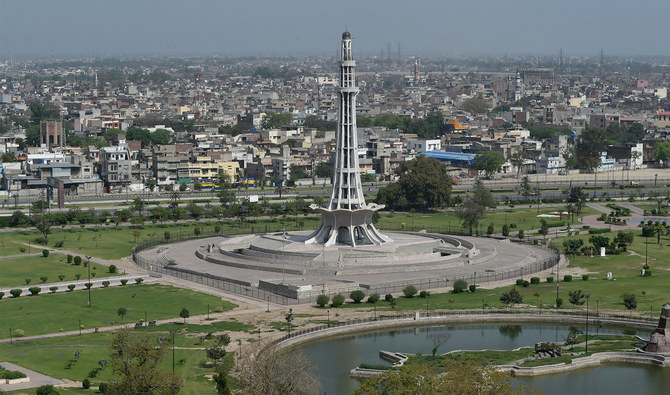

LAHORE: In the eastern city of Lahore, a 70-meter-tall tower provides a panoramic view of Pakistan’s second-largest city where political parties have, over the years, flexed their muscles by holding massive power shows. With national polls less than two weeks away, Minar-e-Pakistan, or the “Tower of Pakistan” is in the spotlight owing to its rich political and historical significance.
It was on March 23, 1940, that Pakistan’s founder, Muhammad Ali Jinnah and other leaders of the All-Pakistan Muslim League demanded a separate homeland for the Muslims of the sub-continent by passing the Lahore Resolution at this site. The government decided to commemorate the historic site by building a monument here. The foundation stone for the Minar-e-Pakistan monument— designed and supervised by Pakistani-Russian architect Nasreddin Murat-Khan— was laid on March 23, 1960 at the Greater Iqbal Park, while it was completed on October 21, 1968.
The powerful monument symbolizes a place where political struggles come to fruition, and revolutionary ideas are birthed. It comes as no surprise that political parties such as the Pakistan Peoples Party (PPP), the Pakistan Muslim League-Nawaz (PML-N) and the Pakistan Tehreek-e-Insaf (PTI), among others, have chosen this site to hold large rallies to show off their support among the masses.
Historian and associate professor of Lahore University of Management Sciences (LUMS) Dr. Ali Usman Qasmi said the venue used to be a “large green space” for denizens of the city who used to fly kites and hold celebrations. Famous former Pakistani cricketers Wasim Akram and Abdul Razzaq regularly played the sport here, Qasmi noted. Now, the “manicured lawns” and dancing fountains at the venue means the park is no longer a massive green space for citizens to enjoy social activities like they used to before. Instead, political parties regularly hold large gatherings here.
“It has a very central place when it comes to Pakistan’s history and politics, and this is the reason why major political actors have used it as a launch pad or used this space to affirm their support among the masses, to project themselves as national leaders,” Qasmi told Arab News recently.
When slain former prime minister Benazir Bhutto returned to Pakistan in April 1986, it was a seismic event in Pakistani politics. Bhutto arrived in Lahore, and held a massive public gathering at Minar-e-Pakistan, instead of landing in Karachi, Qasim noted.
PPP’s Aitzaz Ahsan remembers the day all too well when Bhutto arrived at the monument to rally the masses against then-military ruler General Zia-ul-Haq.
“When Shaheed Benazir Bhutto arrived back after years of exile, it seemed like one mass, one body of people from the airport to Minar-e-Pakistan,” Ahsan told Arab News, describing the scenes of a massive rally.
Ahsan said similar to Jinnah’s mausoleum in Karachi, Minar-e-Pakistan has also become an “attraction” for Pakistan’s masses over the years.
“Minar-e-Pakistan also became a measure as to how strong or how vibrant and widespread a movement or a party is,” Ahsan explained.
The most recent public gathering that was held at the venue was in October 2023, when former three-time prime minister Nawaz Sharif arrived in Pakistan after nearly four years of self-imposed exile. The massive power show marked Sharif’s return to electoral politics, cementing his place as Pakistan’s “comeback kid.”
PML-N leader Sheikh Rohale Asghar admitted people were less enthusiastic about the upcoming national polls in Lahore and throughout the country but it was due to the “bad weather.”
“The election [activities and enthusiasm] will increase slowly because the time left [for polls] is less now,” Asghar told Arab News.
Another major political event jolted Pakistan in October 2011 when cricketer-turned-politician Imran Khan’s Pakistan Tehreek-e-Insaf (PTI) held a massive show at Minar-e-Pakistan. Khan’s rally heralded a stark warning to his rivals, the Pakistan Peoples Party (PPP) and the Pakistan Muslim League-Nawaz (PML-N): the PTI had emerged as a major political player on the national scene.
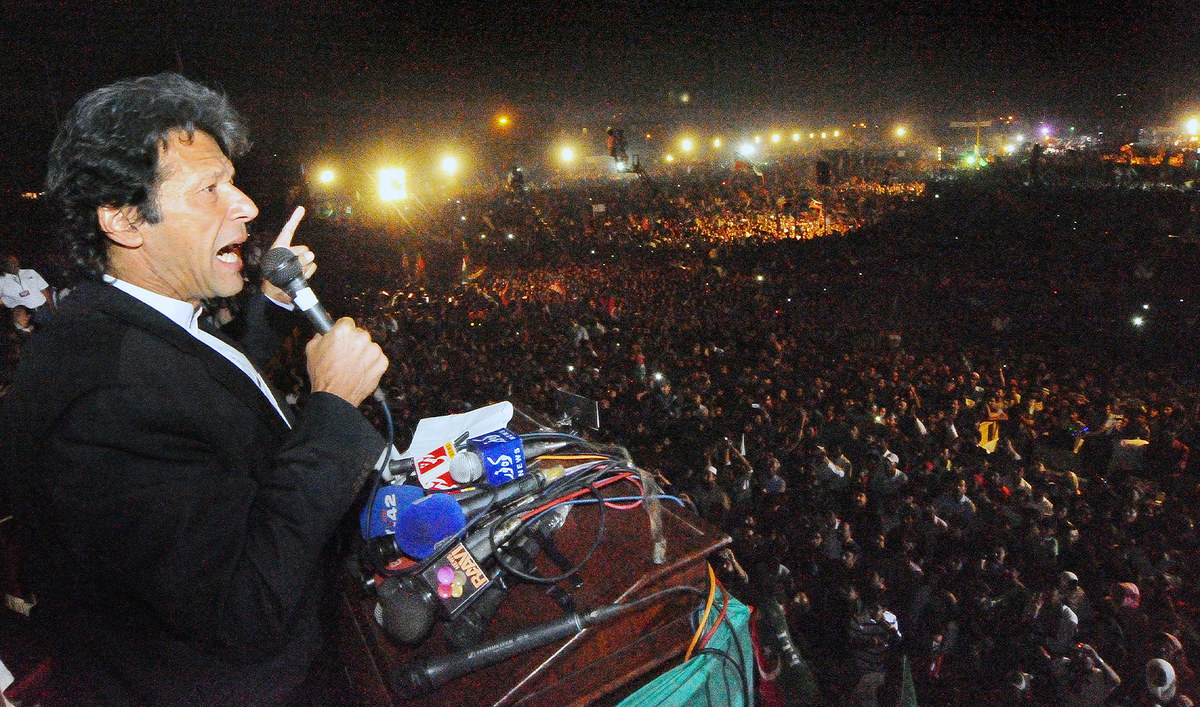
Pakistani politician and former cricketer Imran Khan addresses a rally in Lahore, Pakistan, on October 30, 2011. (AFP)
And Punjab, Pakistan’s most prosperous and populous province, was up for grabs.
PTI’s Salman Akram Raja, who is contesting as the party’s candidate from the NA-128 constituency in the city, feels his party is being unfairly restrained from holding a public gathering at the venue.
“Our popularity is intact and other parties do not have the popularity to hold big processions at Minar-e-Pakistan,” Raja told Arab News.
Ahsan agrees, saying only Sharif’s party has been given a “free run” by the state to campaign for the upcoming polls.
“He is the only leader and [his] party is the only one that has held a public meeting at Minar-e-Pakistan park,” Ahsan said. “It was an apology for a public meeting [because] a section of the park was cordoned off, there dinner and tables were set for after Nawaz Sharif’s speech.”