AfD in vote setback after huge protest wave in Germany

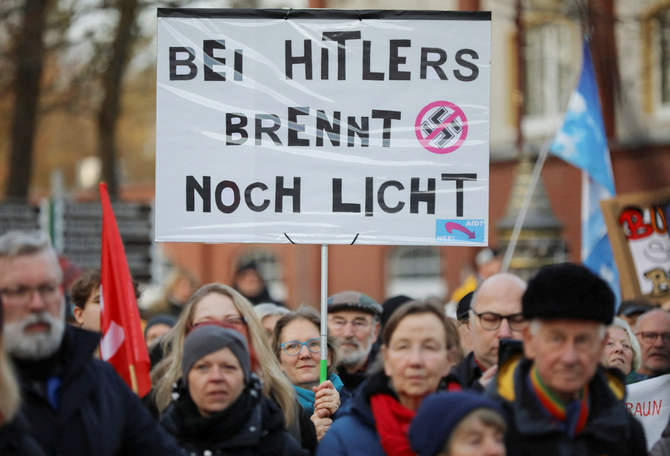
Demonstrators hold a placard reading, "Lights are still on at Hitler's", during a demonstration against the Alternative for Germany party (AfD), right-wing extremism and for the protection of democracy in Eichwalde near Berlin, Germany, January 27, 2024. (REUTERS)
Short Url
Updated 29 January 2024
Follow

AfD in vote setback after huge protest wave in Germany

  • A first poll since the protests showed support for the anti-immigration party slipping 1.5 percentage points

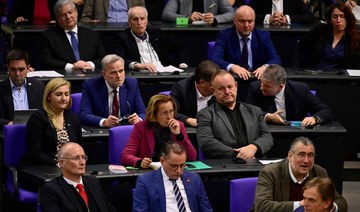
BERLIN: The far-right AfD party suffered a narrow electoral defeat on Sunday after huge protests swept across Germany against the anti-immigration group over revelations of debates about mass expulsions of immigrants.
A candidate from the mainstream center-right CDU won a slim victory over an AfD challenger in a run-off in eastern Thuringia for a district administrator post.
Over a million people have marched in recent days in cities from Hamburg to Dresden to Stuttgart in protest at the Alternative for Germany party and hundreds of thousands poured into the streets again on Saturday and Sunday.
The wave of mobilization was sparked by a January 10 report by investigative outlet Correctiv, which revealed that AfD members had discussed the expulsion of immigrants and “non-assimilated citizens” at a Potsdam meeting with extremists.
Sunday’s run-off vote in eastern Thuringia for a district administrator post was the first election since the outrage over the meeting.
After a first round vote in which the AfD’s Uwe Thrum topped the polls in the Saale-Orla district, he garnered 47.6 percent in the deciding round against 52.4 percent for CDU candidate Christian Herrgott.
Both the CDU and the center-left SPD heaved a sigh of relief at the result.
The leader of the CDU’s Thuringia branch Mario Voigt thanked voters for joining hands to “beat the purported Alternative,” while his SPD counterpart Georg Maier said the large voter turnout and mobilization of the civil society had led to the “very important result.”

The AfD had been hoping to notch up another victory after having secured its first district administrator position last June, also in Thuringia, and its first town mayor in July in neighboring Saxony-Anhalt.
Nationwide opinion polls put the AfD in second place after the conservatives, and well above Chancellor Olaf Scholz’s Social Democrats.
A first poll since the protests showed support for the anti-immigration party slipping 1.5 percentage points.
But the far-right party still tops surveys in three eastern states which are due to hold regional elections in September, even though local branches of the party in two of them — Saxony and Thuringia — have been classified as a “confirmed” extremist organization by Germany’s domestic intelligence agency.
The classification gives the agency more powers to monitor the branches, and had been accorded because of the AfD’s efforts to undermine democracy and for its anti-immigrant rhetoric.
The AfD also said that it has gained 1,900 new members since January 10, when the Correctiv report was published.
In his regular video address released Saturday, Scholz for the second week in a row urged the population to stand up against extremists.
“’Never again’ is not only directed at the state. ‘Never again’ requires everyone’s vigilance. Our democracy is not God-given, it is man-made. It is strong when we support it. It needs us when it is attacked,” he said.
At a weekend anti-Afd protest in Stuttgart, 56-year-old Wolfgang Nagel said that in many European countries “people are looking to turn back the clock and politicians are adopting an inward-looking discourse, focusing on their own nation and their own people.”
“It’s not the right way to go. It’s the road that leads to war... This nationalism has to go.”
Margrit Walter, 60, speaking at the same demonstration, said she was there to make a stand for her grandchildren.
“I don’t want us to live in a world of Nazis. It’s important to rise up against the extreme right.”


Nobel laureate Machado says US helped her leave Venezuela, vows return

Updated 6 sec ago
Follow

Nobel laureate Machado says US helped her leave Venezuela, vows return

  • Machado emerged on a hotel balcony in Oslo to cheering supporters early Thursday
  • “We did get support from the United States government to get here,” Machado said

OSLO: Nobel Peace laureate Maria Corina Machado said on Thursday that the United States helped her get to Norway from hiding in Venezuela, expressing support for US military action against her country and vowing to return home.
Machado, who vanished in January after challenging the rule of President Nicolas Maduro, emerged on a hotel balcony in Oslo to cheering supporters early Thursday after several days of confusion over her whereabouts.
“We did get support from the United States government to get here,” Machado told a press conference when asked by AFP about whether Washington had helped.
The Wall Street Journal reported that she wore a wig and a disguise on the high-risk journey, leaving her hide-out in a Caracas suburb on Monday for a coastal fishing village, where she took a fishing skiff across the Caribbean Sea to Curacao.
The newspaper said the US military was informed to avoid the boat being targeted by airstrikes. Once on the island, she took a private jet to Oslo early on Wednesday.
Machado thanked those who “risked their lives” to get her to Norway but it was not immediately clear how or when she will return to Venezuela, which has said it would consider her a fugitive if she left.
“Of course, the risk of going back, perhaps it’s higher, but it’s always worthwhile. And I’ll be back in Venezuela, I have no doubt,” she added.
Machado has been hailed for her fight for democracy but also criticized for aligning herself with US President Donald Trump, to whom she has dedicated her Nobel, and for inviting foreign intervention in her country.

- Military build-up -

The United States has launched a military build-up in the Caribbean in recent weeks and deadly strikes on what Washington says are drug-smuggling boats.
“I believe every country has the right to defend themselves,” Machado told reporters Thursday.
“I believe that President Trump’s actions have been decisive to reach the point where we are right now, in which the regime is weaker than ever, because the regime previously thought that they could do anything,” she continued.
Late Wednesday, Trump said the United States had seized a “very large” oil tanker near Venezuela, which Caracas denounced as “blatant theft.”
Maduro maintains that US operations are aimed at toppling his government and seizing Venezuela’s oil reserves.
Machado first appeared on a balcony of the Grand Hotel in the middle of the night, waving and blowing kisses to supporters chanting “libertad” (“freedom“) below.
On the ground, she climbed over metal barriers to get closer to her supporters, many of whom hugged her and presented her with rosaries.
She said she has missed much of her children’s lives while hiding, including graduations and weddings.

- ‘ Political risk’ -

Machado won the Peace Prize for “her struggle to achieve a just and peaceful transition from dictatorship to democracy.”
She has accused Maduro of stealing Venezuela’s July 2024 election, from which she was banned — a claim backed by much of the international community.
She last appeared in public on January 9 in Caracas, where she protested Maduro’s inauguration for his third term.
The decision to leave Venezuela and join the Nobel festivities in Oslo comes at both personal and political risk.
“She risks being arrested if she returns even if the authorities have shown more restraint with her than with many others, because arresting her would have a very strong symbolic value,” said Benedicte Bull, a professor specializing in Latin America at the University of Oslo.
While Machado is the ” undisputed” leader of the opposition, “if she were to stay away in exile for a long time, I think that would change and she would gradually lose political influence,” Bull said.
In her acceptance speech read by one of her daughters Wednesday, Machado denounced kidnappings and torture under Maduro’s tenure, calling them “crimes against humanity” and “state terrorism, deployed to bury the will of the people.”