

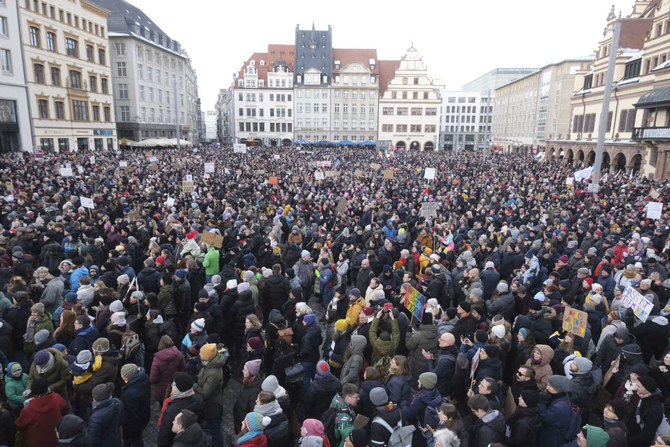
Hundreds of thousands protest against far right in Germany

Thousands gather to demonstrate against right-wing extremism, in the market square in Leipzig, Germany, Sunday Jan. 21, 2024. Thousands of people are expected to protest the far right in cities across Germany. (AP)
Short Url
Updated 22 January 2024
Follow

Hundreds of thousands protest against far right in Germany

  • Around 100,000 had turned up for the protest, according to local police, four times as many as were registered for the event

MUNICH, Germany: Hundreds of thousands joined rallies against the far-right AfD party in Germany on Sunday, capping a week-long wave of protest that has seen demonstrators turn out in unusually large numbers across the country.
Between Friday and Sunday alone, protests were organized in some 100 locations, with organizers Campact and Fridays for Future estimating that over 1.4 million people had gone out into the streets to send a “signal against the AfD and the rightwards drift in German society.”
The influx of demonstrators was so large in Munich on Sunday that organizers were forced to cancel a planned march and ask people to disperse for safety reasons.
Around 100,000 had turned up for the protest, according to local police, four times as many as were registered for the event.
Another 100,000 people gathered to protest in Berlin on Sunday evening, according to police figures cited by regional broadcaster RBB.
The wave of mobilization against the far-right party was sparked by a January 10 report by investigative outlet Correctiv, which revealed that AfD members had discussed the expulsion of immigrants and “non-assimilated citizens” at a meeting with extremists.
Among the participants at the talks was Martin Sellner, a leader of Austria’s Identitarian Movement, which subscribes to the “great replacement” conspiracy theory that claims there is a plot by non-white migrants to replace Europe’s “native” white population.

News of the gathering sent shockwaves across Germany at a time when the AfD is soaring in opinion polls, just months ahead of three major regional elections in eastern Germany where their support is strongest.
The anti-immigration party confirmed the presence of its members at the meeting, but has denied taking on the “remigration” project championed by Sellner.
Protests against the AfD and the far-right thinking behind the deportation plan first came together last weekend in Berlin and Potsdam, where the extremist meeting was held, and have gathered pace since.
On Sunday, demonstrators in the capital carried signs with slogans such as “no place for Nazis,” and waved their phone lights together in front of the German parliament.
“It’s good that something finally happened, that the silent majority isn’t so silent anymore,” IT worker Lydia Steffenhagen told AFP at the protest in Berlin.
In Dresden, the capital of the eastern region of Saxony, where the far-right party is leading in the polls, authorities had to alter the course of a protest march.
The procession was lengthened to make space for an “enormous number of participants,” police said on X, formerly Twitter.
Organizers estimated 70,000 people had joined a protest in Cologne, while in Bremen, local police said 45,000 people had turned out in the center to demonstrate.

Katrin Delrieux, 53, said she hoped the protests against the far right would “make a lot of people rethink” their positions.
“Some might not be sure whether they will vote for the AfD or not, but after this protest they simply cannot,” she told AFP in Munich.
Politicians, as well as church leaders and Bundesliga football managers have called on people to take a stand against the far right.
Chancellor Olaf Scholz, who joined a demonstration last weekend, said any plan to expel immigrants or citizens alike amounted to “an attack against our democracy, and in turn, on all of us.”
He urged “all to take a stand — for cohesion, for tolerance, for our democratic Germany.”
Interior Minister Nancy Faeser went so far as to say in the newspapers of the Funke press group that the far-right meeting was reminiscent of “the horrible Wannsee conference,” where the Nazis planned the extermination of European Jews in 1942.
The protests against the far right could “restore trust in democratic conduct,” Josef Schuster, the head of the Central Council of Jews in Germany, told broadcaster Welt TV.
Jews in the country had felt “huge uncertainty” added to by a wave of anti-Semitic incidents following the start of the Israel-Hamas war, Schuster said.


Ukraine to give revised peace plans to US as Kyiv readies for more talks with its coalition partners

Updated 10 December 2025
Follow

Ukraine to give revised peace plans to US as Kyiv readies for more talks with its coalition partners

  • Ukraine’s European allies are backing Zelensky’s effort to ensure that any settlement is fair and deters future Russian attacks.
  • The French government said Ukraine’s allies — dubbed the “Coalition of the Willing” — will discuss the negotiations Thursday by video

KYIV: Ukraine is expected to hand its latest peace proposals to US negotiators Wednesday, President Volodymyr Zelensky said, a day ahead of his urgent talks with leaders and officials from about 30 other countries supporting Kyiv’s effort to end the war with Russia on acceptable terms.
As tension builds around US President Donald Trump’s push for a settlement and calls for an election in Ukraine, Zelensky said his country would be ready for such a vote within three months if partners can guarantee safe balloting during wartime and if its electoral law can be altered.
Washington’s goal of a swift compromise to stop the fighting that followed Russia’s all-out invasion in February 2022 is reducing Kyiv’s room for maneuvering. Zelensky is walking a tightrope between defending Ukrainian interests and showing Trump he is willing to make some compromises.
Ukraine’s European allies are backing Zelensky’s effort to ensure that any settlement is fair and deters future Russian attacks.
The French government said Ukraine’s allies — dubbed the “Coalition of the Willing” — will discuss the negotiations Thursday by video. Zelensky said it would include those countries’ leaders.
“We need to bring together 30 colleagues very quickly. And it’s not easy, but nevertheless we will do it,” he said late Tuesday.
Zelensky’s openness to an election was a response to comments by Trump in which he questioned Ukraine’s democracy and suggested the Ukrainian leader was using the war as an excuse not to stand before voters. Those comments echo similar remarks often made by Russian President Vladimir Putin.
Zelensky told reporters late Tuesday he is “ready” for an election but would need help from the US and possibly Europe to ensure its security. He suggested Ukraine could be ready to hold balloting in 60 to 90 days if that proviso is met.
“To hold elections, two issues must be addressed: primarily, security — how to conduct them, how to do it under strikes, under missile attacks; and a question regarding our military — how they would vote,” Zelensky said.
“And the second issue is the legislative framework required to ensure the legitimacy of elections,” he said.
Previously, Zelensky had pointed out that a ballot can’t legally take place while martial law — imposed due to Russia’s invasion — is in place. He has also asked how a vote could happen when civilian areas of Ukraine are being bombarded by Russia and almost 20 percent of the country is under Moscow’s occupation.
Zelensky said he has asked lawmakers from his party to draw up legislative proposals allowing for an election while Ukraine is under martial law.
Ukrainians have on the whole supported Zelensky’s arguments, and have not clamored for an election. Under the law that is in force, Zelensky’s rule is legitimate.
Putin has repeatedly complained that Zelensky can’t legitimately negotiate a peace settlement because his five-year term that began in 2019 has expired.
US seeks closer ties with Russia
A new US national security strategy released Dec. 5 made it clear that Trump wants to improve Washington’s relationship with Moscow and “reestablish strategic stability with Russia.”
The document also portrays European allies as weak.
Russian Foreign Minister Sergey Lavrov praised Trump’s role in the Ukraine peace effort, saying in a speech to the upper house of parliament that Moscow appreciates his “commitment to dialogue.” Trump, Lavrov said, is “the only Western leader” who shows “an understanding of the reasons that made war in Ukraine inevitable.”
Trump’s peace efforts have run into sharply conflicting demands from Moscow and Kyiv.
The initial US proposal was heavily slanted toward Russia’s demands. To counter that, Zelensky has turned to his European supporters.
Zelensky met this week with the leaders of Britain, Germany and France in London, the heads of NATO and the European Union in Brussels, and then to Rome to meet the Italian premier and Pope Leo XIV.
Zelensky said three documents were being discussed with American and European partners — a 20-point framework document that is constantly changing, a document on security guarantees, and a document about Ukraine’s recovery.
Military aid for Ukraine declines
Europe’s support is uneven, however, and that has meant a decrease in military aid since the Trump administration this year cut off supplies to Kyiv unless they were paid for by other NATO countries.
Foreign military help for Ukraine fell sharply over the summer, and that trend continued through September and October, a German body that tracks international help for Ukraine said Wednesday.
Average annual aid, mostly provided by the US and Europe, was about 41.6 euros billion ($48.4 billion) between 2022–24. But so far this year Ukraine has received just 32.5 billion euros ($37.8 billion), the Kiel Institute said.
“If this slower pace continues in the remaining months (of the year), 2025 will become the year with the lowest level of new aid allocations” since the war began, it said.
This year, Denmark, Finland, Norway and Sweden have substantially increased their help for Ukraine, while Germany nearly tripled its average monthly allocations and France and the UK both more than doubled their contributions, the Kiel Institute said.
On the other hand, it said, Spain recorded no new military aid for Kyiv in 2025 while Italy reduced its low contributions by 15 percent compared with 2022–2024.