



BEIRUT: Hezbollah intensified operations against Israeli military sites over the last 24 hours in what a security source said was the “most intense exchange of fire” since Oct. 8.
Over 12 hours, the group targeted nine Israeli sites and gatherings, and mourned four fighters who were killed in the Israeli shelling of two homes in Beit Lif and Deir Aames.
Offensive operations escalated from Friday night to Saturday.
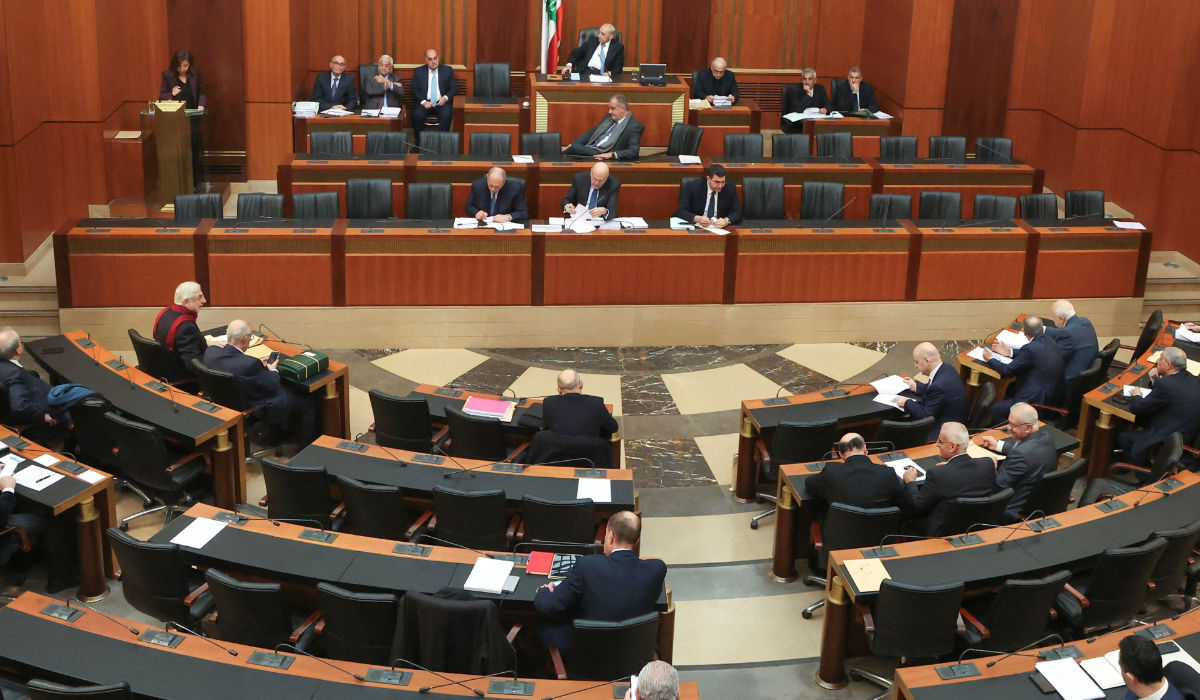
Speaker Nabih Berri leads a parliament session in Beirut, Lebanon. (Reuters)
Hezbollah said that its fighters targeted a gathering of Israeli soldiers south of the Al-Abbad site with missiles throughout Friday night until noon on Saturday.
HIGHLIGHT
Israeli warplanes carried out raids on the outskirts of Naqoura, Aita Al-Shaab and Blida towns.
Another gathering of soldiers was targeted in the vicinity of Doviv Barracks and Khirbet Ma’ar military base.
A Hezbollah statement said that it had targeted the vicinity of Jal Al-Alam with Burkan missiles.
A building in the Avivim settlement and positions and a deployment of soldiers near Metula were also targeted with the “appropriate weapons.”
In addition, a Hezbollah sniper unit targeted the new surveillance apparatus raised on Israel’s Zar’it Barracks and a gathering of soldiers on Cobra Hill with two Burkan missiles.
The militant group later announced that it targeted “spy equipment in the Al-Bahri site with the appropriate weapons.”
A security source described the military escalation over the past 24 hours as “the most intense since October, in terms of exchanging shelling and rounds of rockets.”
On Saturday morning, the coastal border area of Ras Al-Naqoura was subjected to Israeli machine gun fire.
Israeli warplanes, meanwhile, carried out raids on the outskirts of Naqoura, Aita Al-Shaab and Blida towns.
Israeli artillery shelling targeted the outskirts of the villages of Houla, Al-Dhaira, Ayta ash Shab and Tayr Harfa.
Hezbollah held a funeral procession for four fighters who were killed in two raids on two uninhabited houses in Beit Lif and Deir Aames.
They were Mohammed Ali Mazeh from Tayr Felsay, Islam Mohammed Zalzali from Deir Qanun En Nahr, Taleb Yahya Balhas from Seddiqine and Ali Fawzi Melhem from Majdal Selm.
During Zalzali’s funeral, Hezbollah MP Hassan Ezzedine said the southern front would “remain standing and open to support Gaza.”
He added: “In case of any development that expands this war, the resistance will not stand idly by. It is fully prepared to respond to any folly.
“It will be on the lookout and fight back twice as hard and deal a blow that this enemy could have never anticipated,” said the MP.
Ezzedine’s remarks came as Israeli news outlets reported that sirens were sounded in multiple settlements near the Lebanon border due to concerns about incoming drones.
The settlements of Dafna, Gosher, Ghajar, Dan, Shaar Yishuv and Senir in the Upper Galilee were alerted.
Israeli newspaper Yedioth Ahronoth reported that sirens were activated in the Shlomi settlement in Western Galilee due to concerns about missiles targeting the area.
Israeli Army Radio said four rockets fell from southern Lebanon in the Shlomi settlement.
Sirens were sounded again in the settlements of Dishon, Malikiyah, Jephthah, Ramot Naftali and Mebuat Hermon.
MP Mohammed Raad, leader of the Hezbollah parliamentary bloc, issued a stern warning to Israel on Saturday, warning the country to “avoid spreading its aggression from place to place in Lebanon,” as “the consequences would be grave.”
He added that Israel is “threatening us with a comprehensive war in Lebanon to achieve its conditions that reassure the settlers in the north so that they can return to their settlements.
“It is more important for us to reassure our people who have been displaced from their villages than to reassure your settlers.”
Raad warned that Israel’s security “should not come at the expense of our security.”
He said: “It is crucial for any international or regional agreement to acknowledge our stability, sovereignty, and right to our land and the positioning that we decide and choose.
“We are concerned with protecting our people and our country and preventing Israel from attacking our sovereignty. This is the resistance’s commitment; all sacrifices translate this commitment.”
Raad’s statement came in response to recent US and French diplomatic efforts that aimed to decouple Lebanon’s southern border from events in the Gaza Strip, and encourage a withdrawal of Hezbollah forces.


