

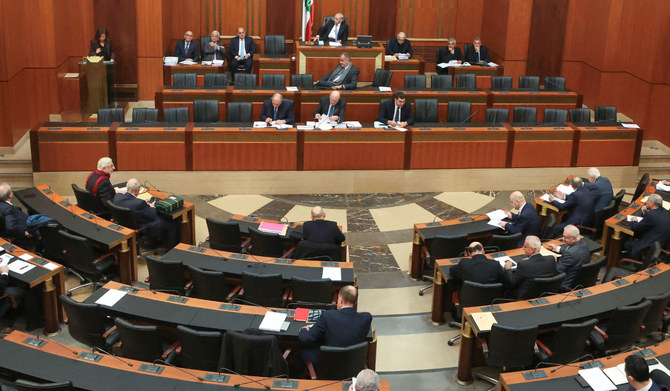

BEIRUT: Lebanon’s parliament late on Friday passed an amended budget for 2024 that experts said neglected to include crucial reforms that would help the country emerge from a financial meltdown gutting the public sector for nearly five years.
The draft was passed after three days of drawn-out disputes, including several heated exchanges in parliament’s chamber with caretaker premier Najib Mikati, highlighting the deep divisions that have paralyzed Lebanese politics, and prolonged a more than year-long vacuum at the presidency.
The budget, amended over the course of months from a version that had been submitted to parliament by Mikati, anticipated significantly higher state revenues earned through VAT and customs fees.
It also included measures that appeared to target those who had made illicit gains during Lebanon’s financial crisis, by fining companies who unfairly benefited from the central bank’s previous currency exchange platform and traders who used the central bank’s subsidies on imports to generate profit.
Since Lebanon’s economy began to unravel in 2019, the currency has lost around 95 percent of its value, banks have locked most depositors out of their savings and more than 80 percent of the population has sunk below the poverty line.
The crisis erupted after decades of profligate spending and corruption among the ruling elite, some of whom led banks that lent heavily to the state.
The government estimates losses in the financial system total more than $70 billion, the majority of which were accrued at the central bank.
The vested interests of the political and economic class have blocked key reforms required by the International Monetary Fund to unlock a $3 billion aid package for Lebanon, including legislation to resolve its banking crisis and unifying multiple exchange rates for the Lebanese pound.
The IMF had also urged Lebanon to consider increases in social spending “with the goal of protecting the most vulnerable.” It said last year that Lebanon “will be mired in a never-ending crisis” unless it implemented rapid reforms.
But speaking to legislators at Friday’s session, Mikati said the government “stopped the collapse that had been happening, and we began the recovery phase.” Around 40 of parliament’s 128 members requested to comment on the budget, with many objecting to his remarks.
The draft of the 2024 budget seen by Reuters used an exchange rate of 89,000 Lebanese pounds ($5.93) to the US dollar to calculate most tax revenues, while other calculations were set at a rate of 50,000 pounds.
The central bank last year devalued the official currency rate from the longtime peg of 1,500 to a rate of 15,000 pounds to the US dollar.
The Policy Initiative think tank said the draft budget “disproportionately burden middle and lower-income households compared to affluent ones” by lowering the threshold for businesses to pay VAT and offering tax exemptions for big businesses.
Sami Zoughaib, a Lebanese economics expert at The Policy Initiative, said the budget was an example of “Lebanese economic alchemy.”
“It serves no economic purpose and serves no particular vision beyond repeating a cycle of entropic decay for the state, the economy, and society,” he told Reuters. ($1 = 15,000.0000 Lebanese pounds) (Reporting by Maya Gebeily; editing by Diane Craft)


