MOSCOW: Russian President Vladimir Putin said a Russian military plane that crashed near the border with Ukraine on Wednesday was shot down by Ukrainian air defenses, whether on purpose or by mistake.
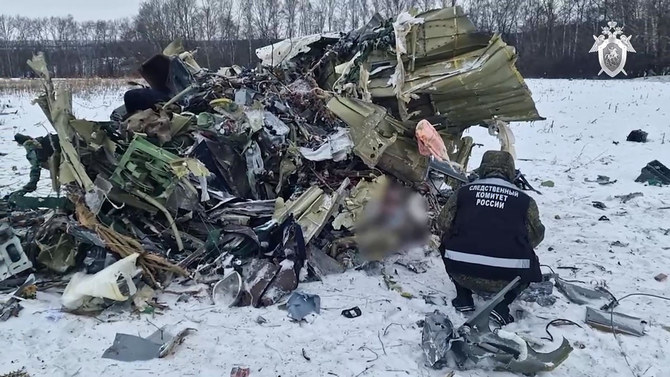
Moscow accuses Kyiv of downing the Ilyushin Il-76 plane in Russia’s Belgorod region and killing 74 people on board, including 65 captured Ukrainian soldiers en route to be swapped for Russian PoWs. It has not presented evidence.
Ukraine has neither confirmed nor denied that it shot down the plane and has challenged Moscow’s account of who was on board and what happened.
“I don’t know if they did it on purpose or by mistake, but it is obvious that they did it,” Putin said in televised comments, his first on the crash.
“In any case, what happened is a crime. Either through negligence or on purpose, but in any case it is a crime.”
Ukraine disputes Russia’s assertion that it was warned in advance that a plane carrying Ukrainian prisoners of war would be flying over Russia’s southwestern Belgorod region at that time.
It has also said there were discrepancies in a list published by Russian media of the 65 Ukrainians alleged to have been on the aircraft.
Putin said the plane could not have been brought down by Russian “friendly fire” because Russia’s air defense systems have safeguards to prevent them attacking their own planes.
“There are ‘friend or foe’ systems there, and no matter how much the operator presses the button, our air defense systems would not work,” he said.
Putin said the missiles fired were mostly likely American or French, but this would be established with certainty in two to three days.
An adviser to Ukrainian President Volodymyr Zelensky said Putin’s comments amounted to a “classic disinformation” campaign.
“First of all, look at it. We are fighting but (for Putin) Ukraine is doing something wrong in terms of the rules and customs of war,” Mykhailo Podolyak told Ukrainian television.
“And secondly, there is something much more important for the Russians. They want to take away our right to receive missiles from our partners for our air defense systems.”
Russia’s Investigative Committee earlier reported that Ukrainian identity documents and tattooed body parts had been recovered from the site of the crash.

Putin says Ukraine shot down plane, not clear if deliberately or in error
Short Url
https://arab.news/n4ken
Putin says Ukraine shot down plane, not clear if deliberately or in error
- Moscow accuses Kyiv of downing the Ilyushin Il-76 plane in Russia’s Belgorod region and killing 74 people on board
- “I don’t know if they did it on purpose or by mistake, but it is obvious that they did it,” Putin said
Faced with Trump, Greenlanders try to reassure their children
NUUK: In a coffee shop in Greenland’s capital Nuuk, Lykke Lynge looked fondly at her four kids as they sipped their hot chocolate, seemingly oblivious to the world’s convulsions.
Since Donald Trump returned to the White House last year with a renewed ambition to seize Greenland, international politics has intruded into the Arctic island’s households.
Dictated by the more or less threatening pronouncements of the US president, it has been an unsettling experience for some people here — but everyone is trying to reassure their children.
Lynge, a 42-year-old lawyer, relied on her Christian faith.
“There’s a lot of turmoil in the world,” she said. “But even if we love our country, we have even higher values that allow us to sleep soundly and not be afraid,” she said.
As early as January 27, 2025, one week after Donald Trump’s inauguration, the Greenlandic authorities published a guide entitled “How to talk to children in times of uncertainty?“
“When somebody says they will come to take our country or they will bomb us or something, then of course children will get very scared because they cannot navigate for themselves in all this news,” said Tina Dam, chief program officer for Unicef in the Danish territory.
- Unanswerable questions -
This guide — to which the UN agency for children contributed — recommends parents remain calm and open, listen to their children and be sensitive to their feelings, and limit their own news consumption.
As in many parts of the world, social media, particularly TikTok, has become the primary source of information for young people.
Today, children have access to a lot of information not meant for them, said Dam — “and definitely not appropriate for their age,” she added.
“So that’s why we need to be aware of that as adults and be protective about our children and be able to talk with our children about the things they hear — because the rhetoric is quite aggressive.”
But reassuring children is difficult when you do not have the answers to many of the questions yourself.
Arnakkuluk Jo Kleist, a 41-year-old consultant, said she talked a lot with her 13-year-old daughter, Manumina.
The teenager is also immersed in TikTok videos but “doesn’t seem very nervous, luckily, as much as maybe we are,” she added.
“Sometimes there are questions she’s asking — about what if this happens — that I don’t have any answers to” — because no one actually has the answer to such questions, she said.
- ‘Dear Donald Trump’ -
The Arctic territory’s Inuit culture also helped, said Kleist.
“We have a history and we have conditions in our country where sometimes things happen and we are used to being in situations that are out of our control,” said Kleist.
“We try to adapt to it and say, well, what can I do in this situation?“
Some Greenlandic children and teenagers are also using social media to get their message out to the world.
Seven-year-old Marley and his 14-year-old sister Mila were behind a viral video viewed more than two million times on Instagram — the equivalent of 35 times the population of Greenland.
Serious in subject but lighthearted in tone, the boy addresses the American president.
“Dear Donald Trump, I have a message for you: you are making Greenlandic kids scared.”
Accompanied by hard stares, some serious finger-wagging and mostly straight faces, he and his sister go on to tell Trump: “Greenland is not for sale.”
“It’s a way to cope,” his mother, Paninnguaq Heilmann-Sigurdsen, told AFP of the video. “It’s kid-friendly, but also serious.
“I think it’s a balance between this is very serious, but also, this is with kids.”
Since Donald Trump returned to the White House last year with a renewed ambition to seize Greenland, international politics has intruded into the Arctic island’s households.
Dictated by the more or less threatening pronouncements of the US president, it has been an unsettling experience for some people here — but everyone is trying to reassure their children.
Lynge, a 42-year-old lawyer, relied on her Christian faith.
“There’s a lot of turmoil in the world,” she said. “But even if we love our country, we have even higher values that allow us to sleep soundly and not be afraid,” she said.
As early as January 27, 2025, one week after Donald Trump’s inauguration, the Greenlandic authorities published a guide entitled “How to talk to children in times of uncertainty?“
“When somebody says they will come to take our country or they will bomb us or something, then of course children will get very scared because they cannot navigate for themselves in all this news,” said Tina Dam, chief program officer for Unicef in the Danish territory.
- Unanswerable questions -
This guide — to which the UN agency for children contributed — recommends parents remain calm and open, listen to their children and be sensitive to their feelings, and limit their own news consumption.
As in many parts of the world, social media, particularly TikTok, has become the primary source of information for young people.
Today, children have access to a lot of information not meant for them, said Dam — “and definitely not appropriate for their age,” she added.
“So that’s why we need to be aware of that as adults and be protective about our children and be able to talk with our children about the things they hear — because the rhetoric is quite aggressive.”
But reassuring children is difficult when you do not have the answers to many of the questions yourself.
Arnakkuluk Jo Kleist, a 41-year-old consultant, said she talked a lot with her 13-year-old daughter, Manumina.
The teenager is also immersed in TikTok videos but “doesn’t seem very nervous, luckily, as much as maybe we are,” she added.
“Sometimes there are questions she’s asking — about what if this happens — that I don’t have any answers to” — because no one actually has the answer to such questions, she said.
- ‘Dear Donald Trump’ -
The Arctic territory’s Inuit culture also helped, said Kleist.
“We have a history and we have conditions in our country where sometimes things happen and we are used to being in situations that are out of our control,” said Kleist.
“We try to adapt to it and say, well, what can I do in this situation?“
Some Greenlandic children and teenagers are also using social media to get their message out to the world.
Seven-year-old Marley and his 14-year-old sister Mila were behind a viral video viewed more than two million times on Instagram — the equivalent of 35 times the population of Greenland.
Serious in subject but lighthearted in tone, the boy addresses the American president.
“Dear Donald Trump, I have a message for you: you are making Greenlandic kids scared.”
Accompanied by hard stares, some serious finger-wagging and mostly straight faces, he and his sister go on to tell Trump: “Greenland is not for sale.”
“It’s a way to cope,” his mother, Paninnguaq Heilmann-Sigurdsen, told AFP of the video. “It’s kid-friendly, but also serious.
“I think it’s a balance between this is very serious, but also, this is with kids.”
© 2026 SAUDI RESEARCH & PUBLISHING COMPANY, All Rights Reserved And subject to Terms of Use Agreement.


