ISLAMABAD: Prime Minister Anwaar-ul-Haq Kakar has said Pakistan’s retaliatory strikes inside Iran after Tehran struck Pakistan earlier this month was a “message to the whole region,” particularly archrival India, of the consequences of violating the South Asian nation’s sovereignty.
Last week Islamabad said it had hit bases of the anti-Pakistan, separatist Balochistan Liberation Front and Balochistan Liberation Army, after Tehran said its missiles struck bases of militants from the ‘Iranian terrorist group,’ Jaish al Adl (JAA).
The tit-for-tat strikes by the two countries were the highest-profile cross-border intrusions in recent years and raised alarm about wider instability in the region since the war between Israel and Hamas erupted on Oct. 7.
Iran and Pakistan share a 900 km, largely lawless border, and have long suspected each other of supporting, or at least behaving leniently, toward some militant groups operating on the other side of the border. Both deny the charges.
On Monday, Pakistan and Iran announced in a joint statement that ambassadors of both countries had been asked to return to their posts by Jan. 26 while the Iranian foreign minister would visit Pakistan on Jan. 29.
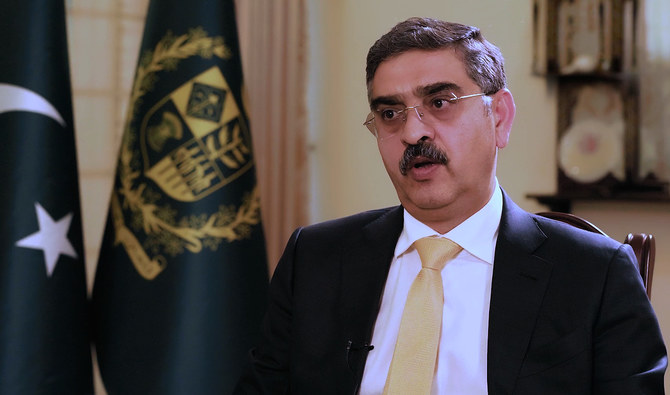
“There is desire on both sides for de-escalation but before that desire, what Pakistan demonstrated, the way we responded, that was a message to the whole of the region, it’s not just focused on Iran,” Kakar said in an interview to a local TV channel aired on Thursday.
“You have friends and foes in the region. If anyone violates your sovereignty, the intent of the state has been translated [with our response] and that was very important.”
When asked who in particular the message had been for, Kakar replied, “Of course India.”
Giving credit to Army Chief Gen. Asim Munir for taking the onus of the decision to carry out the attacks, he said not responding with airstrikes “was not an option” though it had been a “difficult decision” given Pakistan’s “brotherly” ties with Iran.
News of Iran’s airstrikes inside Pakistan came barely hours after Kakar met the Iranian foreign minister on the sidelines of the World Economic Forum in Davos, Switzerland.
In a separate interview, Kakar said teams from the two countries had met as per “diplomatic norms.”
“We had a very normal conversation on Pakistan-Iran bilateral relations and after a few hours we found out all this had happened,” Kakar told another TV channel.
“I was not just surprised, I was shocked and angered also. Like any Pakistani, I was angry and sad. If this had happened from India, which is an archenemy, you could always have expected this from them, but here, we still think they [Iran] are a brotherly Islamic country. So there was a great element of surprise that they would violate our sovereignty like this.”
But Pakistan’s “firm and swift response” had sent out a clear message, the PM added:
“That if anyone does this [attacks Pakistan] or thinks of doing this, then the answer for it would be very firm. It can’t happen that Pakistan will digest the violation of the sovereignty of its territory, no matter who does it, friend or foe.”


Pakistan’s response to Iranian airstrikes ‘message’ to whole region, India — PM
https://arab.news/b6nhb
Pakistan’s response to Iranian airstrikes ‘message’ to whole region, India — PM

- Islamabad and Tehran are moving to mend ties after exchanging military strikes earlier this month
- Carrying out retaliatory attacks was a “difficult decision” given brotherly ties with Iran, PM says

Pakistan opposition to continue protest over ex-PM Khan’s health amid conflicting reports
- Pakistan’s government insists that the ex-premier’s eye condition has improved
- Khan’s personal doctor says briefed on his condition but cannot confirm veracity
ISLAMABAD: Pakistan’s opposition alliance on Monday vowed to continue their protest sit-in at parliament and demanded “clarity” over the health of jailed former prime minister Imran Khan, following conflicting medical reports about his eye condition.
The 73-year-old former cricket star-turned-politician has been held at the high-security Adiala prison in Rawalpindi since 2023. Concerns arose about his health last week when a court-appointed lawyer, Barrister Salman Safdar, was asked to visit Khan at the jail to assess his living conditions. Safdar reported that Khan had suffered “severe vision loss” in his right eye due to central retinal vein occlusion (CRVO), leaving him with just 15 percent sight in the affected eye.
On Sunday, a team of doctors from various hospitals visited the prison to examine Khan’s eye condition, according to the Adiala jail superintendent, who later submitted his report in the court. On Monday, a Supreme Court bench led by Chief Justice Yahya Afridi observed that based on reports from the prison authorities and the amicus curiae, Khan’s “living conditions in jail do not presently exhibit any perverse aspects.” It noted that Khan had “generally expressed satisfaction with the prevailing conditions of his confinement” and had not sought facilities beyond the existing level of care.
Having carefully perused both reports in detail, the bench observed that their general contents and the overall picture emerging therefrom are largely consistent. The opposition alliance, which continued to stage its sit-in for a fourth consecutive day on Monday, held a meeting at the parliament building on Monday evening to deliberate on the emerging situation and discuss their future course of action.
“The sit-in will continue till there is clarity on the matter of [Khan's] health,” Sher Ali Arbab, a lawmaker from Khan's Pakistan Tehreek-e-Insaf (PTI) party who has been participating in the sit-in, told Arab News, adding that PTI Chairman Gohar Ali Khan and Opposition Leader in Senate Raja Nasir Abbas had briefed them about their meeting with doctors who had visited Khan on Sunday.
Speaking to reporters outside parliament, Gohar said the doctors had informed them that Khan’s condition had improved.
“They said, 'There has been a significant and satisfactory improvement.' With that satisfactory improvement, we also felt satisfied,” he said, noting that the macular thickness in Khan’s eye had reportedly dropped from 550 to 300 microns, a sign of subsiding swelling.
Gohar said the party did not want to politicize Khan’s health.
“We are not doctors, nor is this our field,” he said, noting that Khan’s personal physician in Lahore, Dr. Aasim Yusuf, and his eye specialist Dr. Khurram Mirza had also sought input from the Islamabad-based medical team.
“Our doctors also expressed satisfaction over the report.”
CONFLICTING ACCOUNTS
Despite Gohar’s cautious optimism, Khan’s personal physician, Dr. Yusuf, issued a video message on Monday, saying he could neither “confirm nor deny the veracity” of the government’s claims.
“Because I have not seen him myself and have not been able to participate in his care... I’m unable to confirm what we have been told,” Yusuf said.
He appealed to authorities to grant him or fellow physician, Dr. Faisal Sultan, immediate access to Khan, arguing that the ex-premier should be moved to Shifa International Hospital in Islamabad for specialist care.
Speaking to Arab News, PTI’s central information secretary Sheikh Waqas Akram said Khan’s sister and their cousin, Dr. Nausherwan Burki, will speak to media on Tuesday to express their views about the situation.
The government insists that Khan’s condition has improved.
“His eye [condition] has improved and is better than before,” State Minister Talal Chaudhry told the media in a brief interaction on Monday.
“The Supreme Court of Pakistan is involved, and doctors are involved. What medicine he receives, whether he needs to be hospitalized or sent home, these decisions are made by doctors. Neither lawyers nor any political party will decide this.”