Two Tunisian teenage migrants die in shipping container

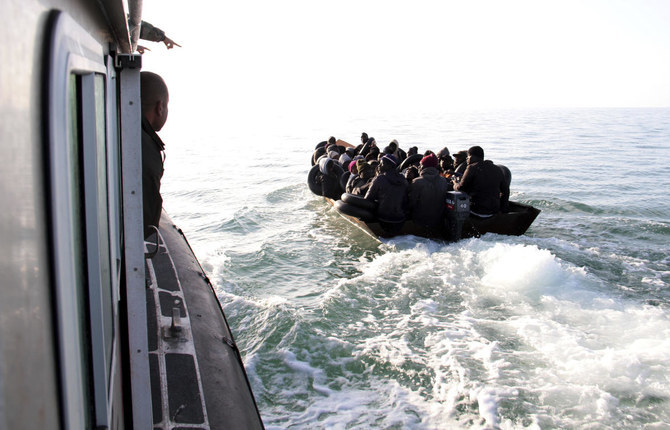
Two teenage would-be migrants from Tunisia died after hiding in a refrigerated container on a ship traveling to Europe, the country’s civil protection department said on Tuesday. (AP/File)
Short Url
Updated 24 January 2024
Follow

Two Tunisian teenage migrants die in shipping container

  • Two people aged 16 and 17 died after infiltrating a container transporting fruit and vegetables on a ship that was heading to a European country
  • The two minors were part of a group of four young people trying to migrate irregularly

TUNIS: Two teenage would-be migrants from Tunisia died after hiding in a refrigerated container on a ship traveling to Europe, the country’s civil protection department said on Tuesday.
“Two people aged 16 and 17 died after infiltrating a container transporting fruit and vegetables on a ship that was heading to a European country,” Mounir Riabi, the director of civil protection for the Tunis region, told AFP.
The two minors were part of a group of four young people trying to migrate irregularly, spending around eight hours in the cold container “before the ship’s crew became aware of their presence and returned to the port of Tunis,” Riabi said.
The two surviving members of the group were hospitalized and are “in a stable condition,” according to Riabi, saying that the group came from isolated interior regions of Tunisia.
Last week, the national guard announced the disappearance at sea of about 40 Tunisians who left from Sfax province, on Tunisia’s central coast, who were trying to reach Italy, whose island of Lampedusa lies around 150 kilometers (90 miles) away.
In 2023, more than 155,000 irregular migrants arrived in Italy, an increase of 50 percent over the previous year.
At 17,304 people, Tunisian migrants formed the second-largest contingent behind Guineans, at 18,204, according to numbers from the Italian interior ministry.
Declining economic conditions and lack of opportunities are an important factor motivating migrants to make risky journeys across the Mediterranean to Europe.
The Tunisian economy, hard-hit by the Covid-19 pandemic, the war in Ukraine, and a drought that devastated its agriculture in 2023, is at a near-standstill with a 1.3 percent growth rate last year and a youth unemployment rate around 38 percent.
The country concluded a loan agreement with the International Monetary Fund and a cash injection of $2 billion, but negotiations stalled when President Kais Saied rejected the reforms demanded by the fund.
The Tunisian state makes a point of repaying its debts, which hover around 80 percent of GDP, but lacks liquidity to provide its population with basic products, leading to repeated shortages of flour, sugar and rice.
Beyond its serious economic difficulties, Tunisia has been shaken by political tensions since Saied’s coup on July 25, 2021, aggravated in 2023 by the imprisonment of important opposition figures.


Medical charity ‘may have to halt Gaza operations in March’

Updated 7 sec ago
Follow

Medical charity ‘may have to halt Gaza operations in March’

  • MSF called this demand a “scandalous intrusion” but Israel says it was needed to stop extremists from infiltrating into humanitarian structures

PARIS: Banned from the Gaza Strip with 36 aid bodies, medical charity Doctors Without Borders said on Saturday it will have to end its operations there in March if Israel does not reverse its decision.

UN Secretary-General Antonio Guterres called on Friday for Israel to end a ban on humanitarian agencies that provided aid in Gaza, saying he was “deeply concerned” at the development.
Israel confirmed on Thursday that it was barring 37 major international humanitarian organizations from entering the Gaza Strip, accusing them 
of failing to provide the list of their employees’ names, which is now officially required for “security” reasons.

FASTFACT

MSF has approximately 40 international staff in the Gaza Strip and employs 800 Palestinian staff across eight hospitals.

MSF called this demand a “scandalous intrusion” but Israel says it was needed to stop extremists from infiltrating into humanitarian structures.
“To work in Palestine, in the occupied Palestinian territories, we have to be registered ... That registration expired on Dec. 31, 2025,” said Isabelle Defourny, a physician and president of MSF France, on France Inter.
“Since July 2025, we have been involved in a re-registration process, and to date, we have not received a response. We still have 60 days during which we could work without being re-registered, and so we would have to end our activities in March,” if Israel maintains its decision, she said.
MSF has approximately 40 international staff in the Gaza Strip and employs 800 Palestinian staff across eight hospitals.
“We are the second-largest distributor of water (in the Gaza Strip). Last year, in 2025, we treated just over 100,000 people who were wounded, burned, or victims of various traumas. We are second in terms of the number of deliveries performed,” the president of MSF France said.
According to her, the Israeli decision is explained by the fact that NGOs “bear witness to the violence committed by the Israeli army” in Gaza.
The UN chief “calls for this measure to be reversed, stressing that international non-governmental organizations are indispensable to life-saving humanitarian work and that the suspension risks undermining the fragile progress made during the ceasefire,” his spokesperson Stephane Dujarric said in the statement.
“This recent action will further exacerbate the humanitarian crisis facing Palestinians,” he added.
Several NGOS have said the requirements contravene international humanitarian law or endanger their independence.
On Thursday, 18 Israel-based left-wing NGOs denounced the decision to ban their international peers, saying “the new registration framework violates core humanitarian principles of independence and neutrality.”
In November, authorities in Gaza said more than 70,000 people had been killed there since the war broke out.
Nearly 80 percent of buildings in Gaza have been destroyed or damaged by the war, according to UN data, leaving infrastructure decimated.
About 1.5 million of Gaza’s more than 2 million residents have lost their homes, said Amjad Al-Shawa, director of the Palestinian NGO Network in Gaza.