Nearly 400 migrants repatriated from Tunisia, IOM says

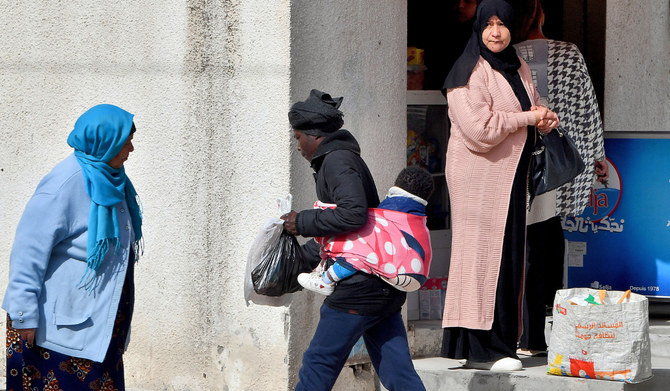
A woman with her baby on her back walks in the Tunis suburb of Bhar Lazreg on February 24, 2023. (AFP)
Short Url
Updated 20 January 2024
Follow

Nearly 400 migrants repatriated from Tunisia, IOM says

  • The number of departures surged in Tunisia following a speech last February by President Kais Saied in which he denounced “hordes of illegal migrants” as a demographic threat to the country

TUNIS: Nearly 400 migrants from sub-Saharan Africa have been repatriated from Tunisia to their home countries in recent days, the International Organization for Migration or IOM said.
The IOM has facilitated “the safe and dignified voluntary return” of 392 people, largely from Burkina Faso, Gambia, Mali, and Senegal, according to a statement from the UN agency.
Upon arrival in their countries, they will receive “tailored reintegration services to rebuild their lives and reintegrate into their communities,” the statement said.
In 2023, the agency assisted 2,557 migrants who wanted to return from Tunisia to their country of origin, a 45 percent jump since 2022.
It added that the repatriation took place in collaboration with the Tunisian government and local authorities, including those in Sfax, the epicenter of migration from Tunisia to Europe, and Medenine and Tataouine, two disadvantaged areas in southern Tunisia.
Tunisia intercepted nearly 70,000 people during irregular migration attempts over the first 11 months of 2023, more than double the number in 2022, according to statistics shared by the National Guard.
Of that figure, 77.5 percent were foreigners, mostly from sub-Saharan Africa, and the remainder were Tunisians, compared to 59 percent foreigners in 2022.
The number of departures surged in Tunisia following a speech last February by President Kais Saied in which he denounced “hordes of illegal migrants” as a demographic threat to the country.
Migrants and refugees in Tunisia are facing “daily institutional violence,” including “arbitrary” arrests, “forced displacements” and “expulsions toward the borders” with Libya and Algeria, according to a report by the World Organization Against Torture published in mid-December.
The report said authorities have engaged in numerous human rights violations, noting that the country is under “continued pressure from Europe to reduce irregular migration in the Mediterranean.”


GCC ambassadors hold discussions with Japan’s ruling party regarding Iran

Updated 8 sec ago
Follow

GCC ambassadors hold discussions with Japan’s ruling party regarding Iran

  • KONO Taro, head of the LDP’s international relations, participated in the high-level discussions alongside other senior officials
  • Dr. Ghazi Faisal Binzagr, Saudi Arabia’s ambassador to Japan, described the meeting as a timely opportunity to exchange views on the evolving regional situation

TOKYO: Gulf Cooperation Council (GCC) ambassadors met on Tuesday with leaders of Japan’s ruling Liberal Democratic Party (LDP) to explore deeper collaboration across multiple fields and tackle pressing issues related to Iran.

KONO Taro, head of the party’s international relations, participated in the high-level discussions alongside other senior officials.

Dr. Ghazi Faisal Binzagr, Saudi Arabia’s ambassador to Japan, described the meeting as a timely opportunity to exchange views on the evolving regional situation.

Ambassador Binzagr emphasized that during periods of heightened tension, open dialogue with trusted partners like Japan is essential. He noted that diplomacy and clear communication are vital for defusing conflict and maintaining regional stability.

Saudi Ambassador Binzagr further noted that the Gulf countries and Japan share a longstanding history of cooperation founded on mutual trust and common objectives of stability and prosperity. He stated, “In times such as these, it is precisely these enduring partnerships that allow constructive dialogue to prevail, and that help ensure that wisdom and restraint guide the path toward peace and stability in our region."

Kono underscored the strong bonds and active cooperation between Japan and the GCC, noting that Japan views its ties with the GCC as a strategic partnership.