

7.1 earthquake strikes western China, but no casualties reported yet from sparsely populated area

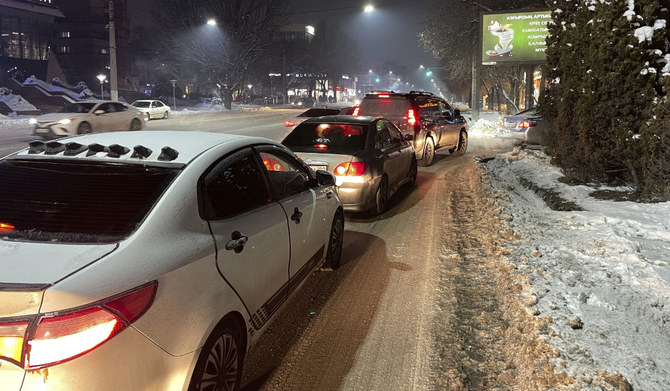
People sit inside their cars parked in a street after leaving their flats in apartment buildings after the earthquake in Almaty, Kazakhstan, Monday, Jan. 22, 2024. (AP)
Short Url
Updated 23 January 2024
Follow

7.1 earthquake strikes western China, but no casualties reported yet from sparsely populated area

  • The earthquake struck in a rural area populated mostly by Uyghurs, a Turkic ethnicity that is predominantly Muslim and has been the target of a state campaign of forced assimilation and mass detention in recent years

BEIJING: A magnitude 7.1 earthquake struck a sparsely populated part of China’s western Xinjiang region early Tuesday, downing power lines, destroying at least two homes and prompting authorities to suspend trains, local authorities and state media reported. No fatalities or injuries were immediately reported.
Xinhua News Agency cited the China Earthquake Networks Center as saying the quake rocked Uchturpan county (Wushi county in Mandarin) in Aksu prefecture shortly after 2 a.m.
Two houses collapsed, Aksu authorities said, and around 200 rescuers were dispatched to the epicenter, according to state broadcaster CCTV. The Xinjiang railway authority suspended dozens of trains and sealed off the affected sections, CCTV reported. The quake downed power lines but electricity was quickly restored to the region, Aksu authorities reported.
The US Geological Survey said the quake measured 7.0 magnitude and occurred in the Tian Shan mountain range, “a seismically active region, though earthquakes of this size occur somewhat infrequently.” It said the largest quake in the area in the past century was a 7.1-magnitude one in 1978 about 200 kilometers (124 miles) to the north of one early Tuesday.
State broadcaster CCTV said there were 14 aftershocks since the main quake, with two registering above 5 magnitude.
The earthquake struck in a rural area populated mostly by Uyghurs, a Turkic ethnicity that is predominantly Muslim and has been the target of a state campaign of forced assimilation and mass detention in recent years.
Uchturpan county at the quake’s epicenter is recording temperatures well below freezing, with lows down to negative 18 degrees C (just below zero F) forecast by the China Meteorological Administration this week. Parts of northern and central China have shivered under frigid cold snaps this winter, with authorities closing schools and highways several times due to snowstorms.
The tremors were felt hundreds of kilometers (miles) away. Ma Shengyi, a 30-year-old pet shop owner living in Tacheng, 600 kilometers (373 miles) from the epicenter, said her dogs started barking before she felt her apartment building shudder. The quake was so strong her neighbors ran downstairs. Ma rushed to her bathroom and started to cry.
“There’s no point in running away if it’s a big earthquake,” Ma said. “I was scared to death.”
Chandeliers swung, buildings were evacuated and a media office building near the epicenter shook for a full minute, Xinhua reported. A video posted by a Chinese Internet user on Weibo showed residents standing outside on the streets bundled in winter jackets, and a photo posted by CCTV showed a cracked wall with chunks fallen off.
Tremors were felt across the Xinjiang region and in the neighboring countries Kyrgyzstan and Kazakhstan. In the Kazakh capital of Almaty, people left their homes, the Russian news agency Tass reported.
Videos posted on the Telegram messaging platform showed people in Almaty running down the stairs of apartment blocks and standing outside in the street after they felt strong tremors. Some people appeared to have left their homes quickly and were pictured standing outside in freezing temperatures in shorts.
Earthquakes are common in western China, including in Gansu, Qinghai, Sichuan and Yunnan provinces, as well as the Xinjiang region and Tibet.
An earthquake that struck Gansu in December killed 151 people and was China’s deadliest earthquake in nine years.


Youth voters take center stage in Bangladesh election after student-led regime change

Updated 38 min 40 sec ago
Follow

Youth voters take center stage in Bangladesh election after student-led regime change

  • About 45% of Bangladeshis eligible to vote in Thursday’s election are aged 18-33
  • Election follows 18 months of reforms after the end of Sheikh Hasina’s 15-year rule

DHAKA: When he goes to the polls on Thursday, Atikur Rahman Toha will vote for the first time, believing that this election can bring democratic change to Bangladesh.

A philosophy student at Dhaka University, Toha was already eligible to vote in the 2024 poll but, like many others, he opted out.

“I didn’t feel motivated to even go to vote,” he said. “That was a truly one-sided election. The election system was fully corrupted. That’s why I felt demotivated. But this time I am truly excited to exercise my voting rights for the first time.”

The January 2024 vote was widely criticized by both domestic and international observers and marred by a crackdown on the opposition and allegations of voter fraud.

But the victory of the Awami League of ex-Prime Minister Sheikh Hasina was short-lived, as a few months later the government was ousted by a student-led uprising, which ended the 15-year rule of Bangladesh’s longest-serving leader.

The interim administration, led by Nobel laureate Muhammad Yunus, took control in August 2024 and prepared a series of reforms to restructure the country’s political and institutional framework and organize the upcoming vote.

About 127.7 million Bangladeshis are eligible to cast their ballots, according to Election Commission data, with nearly a third of them, or 40.4 million, aged 18-29. Another 16.9 million are 30-33, making it a youth–dominated poll, with the voters hopeful the outcome will help continue the momentum of the 2024 student-led uprising.

“We haven’t yet fully transitioned into a democratic process. And there is no fully stable situation in the country,” Toha said. “After the election we truly hope that the situation will change.”

For Rawnak Jahan Rakamoni, also a Dhaka University student, who is graduating in information science, voting this time meant that her voice would count.

“We are feeling that we are heard, we will be heard, our opinion will matter,” she said.

“I think it is a very important moment for our country, because after many years of controversial elections, people are finally getting a chance to exercise their voting rights and people are hoping that this election will be more meaningful and credible. This should be a fair election.”

But despite the much wider representation than before, the upcoming vote will not be entirely inclusive in the absence of the Awami League, which still retains a significant foothold.

The Election Commission last year barred Hasina’s party from contesting the next national elections, after the government banned Awami League’s activities citing national security threats and a war crimes investigation against the party’s top leadership.

The UN Human Rights Office has estimated that between July 15 and Aug. 5, 2024 the former government and its security and intelligence apparatus, together with “violent elements” linked to the Awami League, “engaged systematically in serious human rights violations and abuses in a coordinated effort to suppress the protest movement.”

It estimated that at least 1,400 people were killed during the protests, with the majority shot dead from military rifles.

Rezwan Ahmed Rifat, a law student, wanted the new government to “ensure justice for the victims of the July (uprising), enforced disappearances, and other forms of torture” carried out by the previous regime.

The two main parties out of the 51 contesting Thursday’s vote are the Bangladesh Nationalist Party and Jamaat-e-Islami. Jamaat, which in 2013 was banned from political participation by Hasina’s government, heads an 11-party alliance, including the National Citizen Party formed by student leaders from the 2024 movement.

“I see this election as a turning point of our country’s democratic journey … It’s not just a normal election,” said Falguni Ahmed, a psychology student who will head to the polls convinced that no matter who wins, it will result in the “democratic accountability” of the next government.

Ahmed added: “People are not voting only for their leaders; they are also voting for the restoration of democratic credibility. That’s why this election is very different.”