

How Israel-Hamas war in Gaza is testing the limits of the UN’s effectiveness

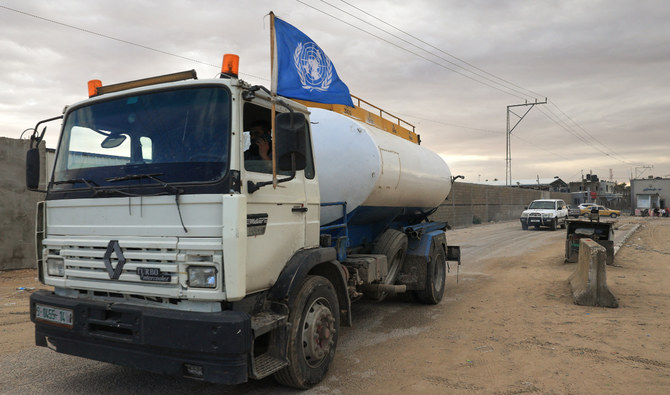
A truck carrying fuel decorated with a UN flag crosses into Rafah in the southern Gaza Strip on November 15, 2023. (AFP/File)
Short Url
Updated 22 January 2024
Follow

How Israel-Hamas war in Gaza is testing the limits of the UN’s effectiveness

  • Failure to secure a ceasefire and increase aid deliveries has laid bare the world body’s shortcomings, experts warn
  • US vetoes in cases where Security Council has tried to reprimand Israel blamed for undermining faith in world body

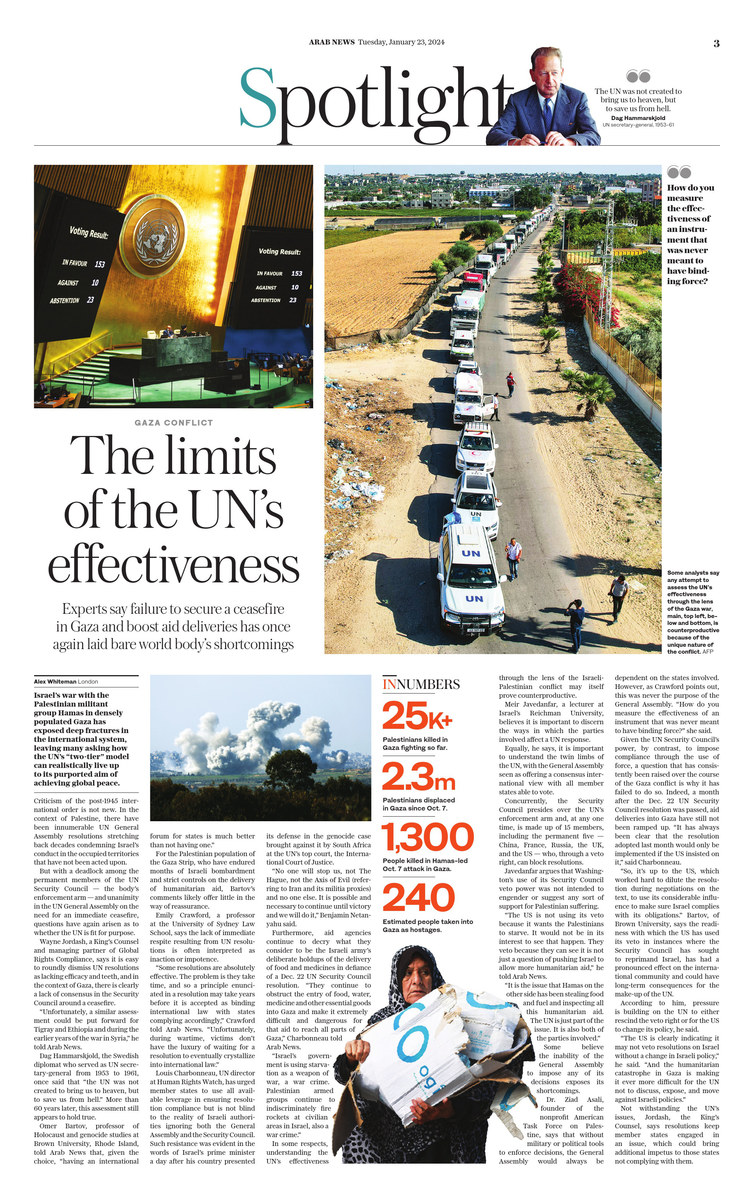
LONDON: Israel’s war with the Palestinian militant group Hamas in densely populated Gaza has exposed deep fractures in the international system, leaving many asking how the UN’s “two-tier” model can realistically live up to its purported aim of achieving global peace.

Criticism of the post-1945 international order is not new. In the context of Palestine, there have been innumerable UN General Assembly resolutions stretching back decades condemning Israel’s conduct in the occupied territories that have not been acted upon.

But with a deadlock among the permanent members of the UN Security Council — the body’s enforcement arm — and unanimity in the UN General Assembly on the need for an immediate ceasefire, questions have again arisen as to whether the UN is fit for purpose.

Wayne Jordash, a King’s Counsel and managing partner of Global Rights Compliance, says it is easy to roundly dismiss UN resolutions as lacking efficacy and teeth, and in the context of Gaza, there is clearly a lack of consensus in the Security Council around a ceasefire.

“Unfortunately, a similar assessment could be put forward for Tigray and Ethiopia and during the earlier years of the war in Syria,” he told Arab News.
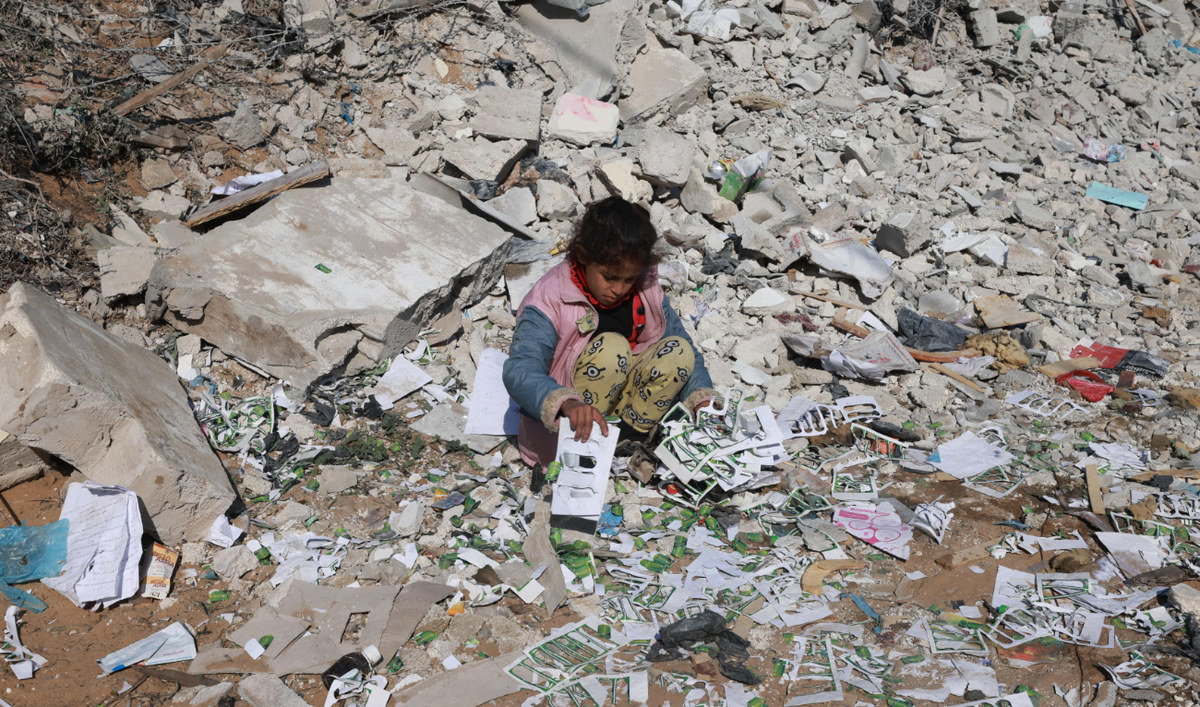


A Palestinian girl looks for salvageable items amid the destruction on the southern outskirts of Khan Yunis in the war-battered Gaza Strip on January 16, 2024. (AFP)

Dag Hammarskjold, the Swedish diplomat who served as UN secretary-general from 1953 to 1961, once said that “the UN was not created to bring us to heaven, but to save us from hell.” More than 60 years later, this assessment still appears to hold true.

Omer Bartov, professor of Holocaust and genocide studies at Brown University, Rhode Island, told Arab News that, given the choice, “having an international forum for states is much better than not having one.”

For the Palestinian population of the Gaza Strip, who have endured months of Israeli bombardment and strict controls on the delivery of humanitarian aid, Bartov’s comments likely offer little in the way of reassurance.

INNUMBERS

  • 25,000+ Palestinians killed in Gaza fighting so far.
  • 2m+ Palestinians displaced in Gaza since Oct. 7.
  • 1,300 People killed in Hamas-led Oct. 7 attack in Gaza.
  • 240 Estimated people taken into Gaza as hostages.

Emily Crawford, a professor at the University of Sydney Law School, says the lack of immediate respite resulting from UN resolutions is often interpreted as inaction or impotence.

“Some resolutions are absolutely effective. The problem is they take time, and so a principle enunciated in a resolution may take years before it is accepted as binding international law with states complying accordingly,” Crawford told Arab News.

“Unfortunately, during wartime, victims don’t have the luxury of waiting for a resolution to eventually crystallize into international law.”
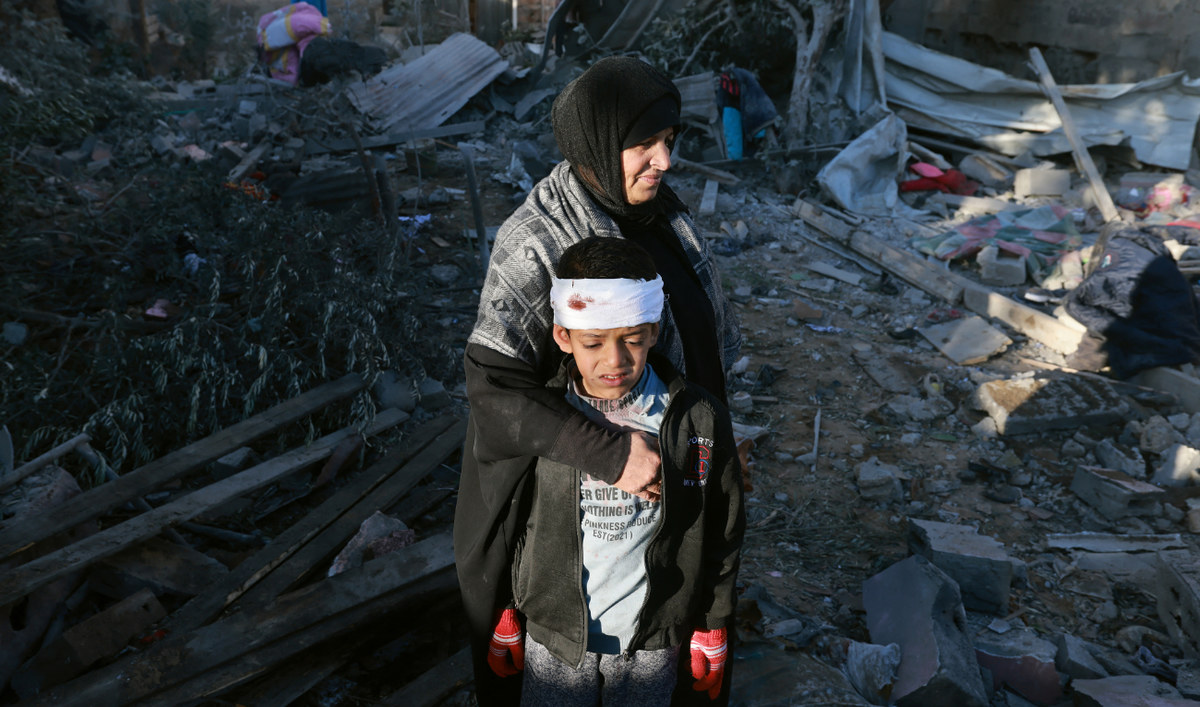


A Palestinian woman embraces an injured boy as they check the rubble of a building following Israeli bombardment, on January 18, 2024 in Rafah in the southern Gaza Strip. (AFP)

Louis Charbonneau, UN director at Human Rights Watch, has urged member states to use all available leverage in ensuring resolution compliance but is not blind to the reality of Israeli authorities ignoring both the General Assembly and the Security Council.

Such resistance was evident in the words of Israel’s prime minister a day after his country presented its defense in the genocide case brought against it by South Africa at the UN’s top court, the International Court of Justice.

“No one will stop us, not The Hague, not the Axis of Evil (referring to Iran and its militia proxies) and no one else. It is possible and necessary to continue until victory and we will do it,” Benjamin Netanyahu said.

Furthermore, aid agencies continue to decry what they consider to be the Israeli army’s deliberate holdups of the delivery of food and medicines in defiance of a Dec. 22 UN Security Council resolution.

“They continue to obstruct the entry of food, water, medicine and other essential goods into Gaza and make it extremely difficult and dangerous for that aid to reach all parts of Gaza,” Charbonneau told Arab News.

“Israel’s government is using starvation as a weapon of war, a war crime. Palestinian armed groups continue to indiscriminately fire rockets at civilian areas in Israel, also a war crime.”
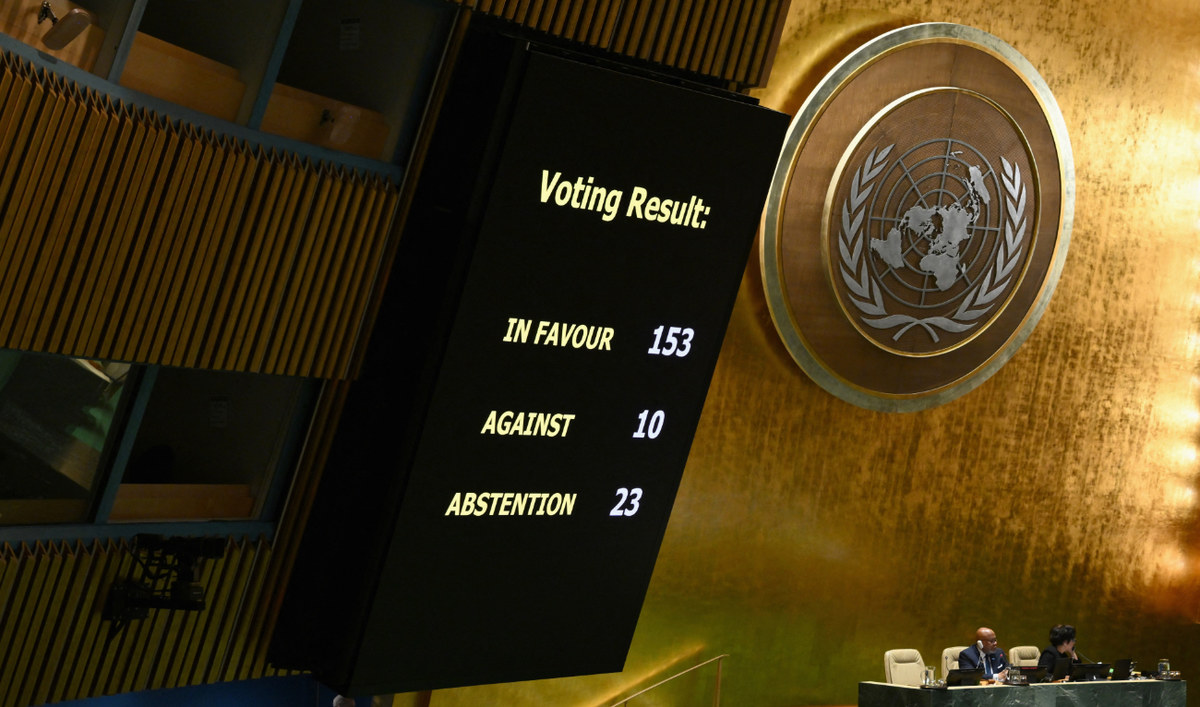


A general view shows voting results during a UN General Assembly meeting to vote on a non-binding resolution demanding “an immediate humanitarian ceasefire” in Gaza on December 12, 2023. (AFP/File)

In some respects, understanding the UN’s effectiveness through the lens of the Israeli-Palestinian conflict may itself prove counterproductive.

Meir Javedanfar, a lecturer at Israel’s Reichman University, believes it is important to discern the ways in which the parties involved affect a UN response.

Equally, he says, it is important to understand the twin limbs of the UN, with the General Assembly seen as offering a consensus international view with all member states able to vote.

Concurrently, the Security Council presides over the UN’s enforcement arm and, at any one time, is made up of 15 members, including the permanent five — China, France, Russia, the UK, and the US — who, through a veto right, can block resolutions.

Javedanfar argues that Washington’s use of its Security Council veto power was not intended to engender or suggest any sort of support for Palestinian suffering.

“The US is not using its veto because it wants the Palestinians to starve. It would not be in its interest to see that happen. They veto because they can see it is not just a question of pushing Israel to allow more humanitarian aid,” he told Arab News.

“It is the issue that Hamas, on the other side, has been stealing food and fuel and inspecting all this humanitarian aid. The UN is just part of the issue. It is also both of the parties involved.”


Trucks with humanitarian aid wait to enter the Palestinian side of Rafah on the Egyptian border with the Gaza Strip on December 11, 2023. (AFP/File)

Some believe the inability of the General Assembly to impose any of its decisions exposes its shortcomings.

Dr. Ziad Asali, founder of the non-profit American Task Force on Palestine, says that without military or political tools to enforce decisions, the General Assembly would always be dependent on the states involved.

However, as Crawford points out, this was never the purpose of the General Assembly. “How do you measure the effectiveness of an instrument that was never meant to have binding force?” she said.

Given the UN Security Council’s power, by contrast, to impose compliance through the use of force, a question that has consistently been raised over the course of the Gaza conflict is why it has failed to do so.

Indeed, a month after the Dec. 22 UN Security Council resolution was passed, aid deliveries into Gaza have still not been ramped up.

“It has always been clear that the resolution adopted last month would only be implemented if the US insisted on it,” said Charbonneau.

“So, it’s up to the US, which worked hard to dilute the resolution during negotiations on the text, to use its considerable influence to make sure Israel complies with its obligations.”
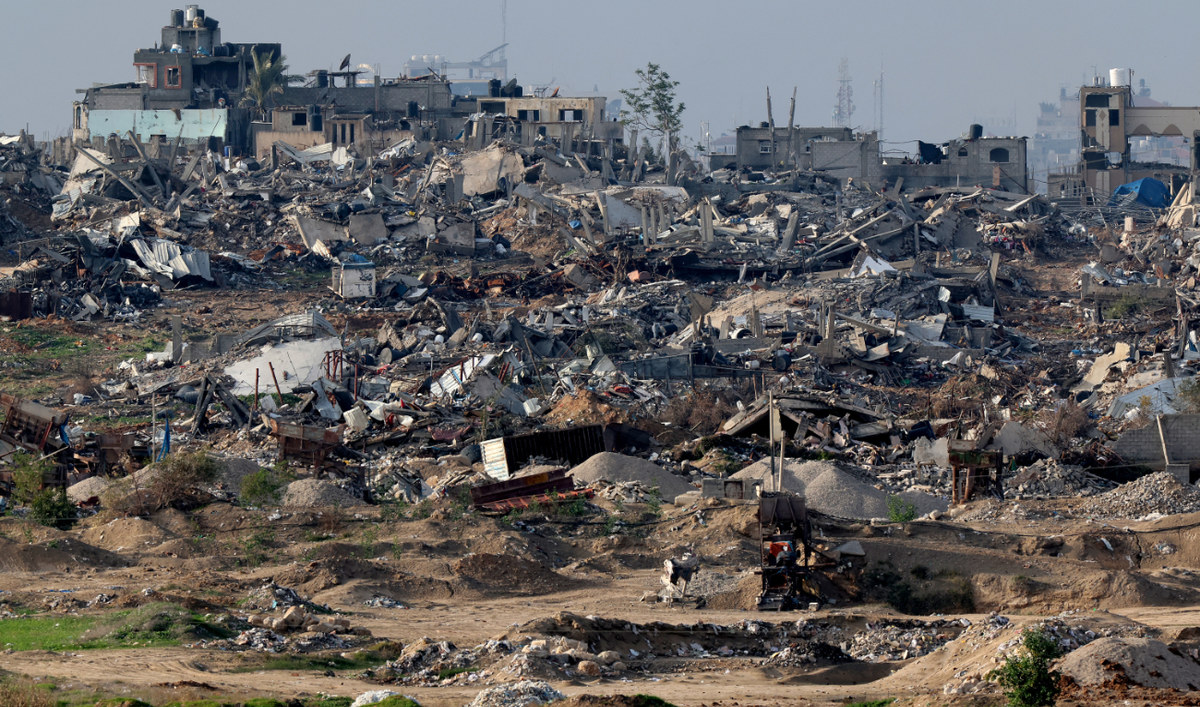


A picture taken from southern Israel shows destroyed buildings in the Gaza Strip on January 17, 2024. (AFP)

Bartov, of Brown University, says the readiness with which the US has used its veto in instances where the Security Council has sought to reprimand Israel, has had a pronounced effect on the international community and could have long-term consequences for the make-up of the UN.

According to him, pressure is building on the UN to either rescind the veto right or for the US to change its policy, he said.

“The US is clearly indicating it may not veto resolutions on Israel without a change in Israeli policy,” he said. “And the humanitarian catastrophe in Gaza is making it ever more difficult for the UN not to discuss, expose, and move against Israeli policies in Gaza.”
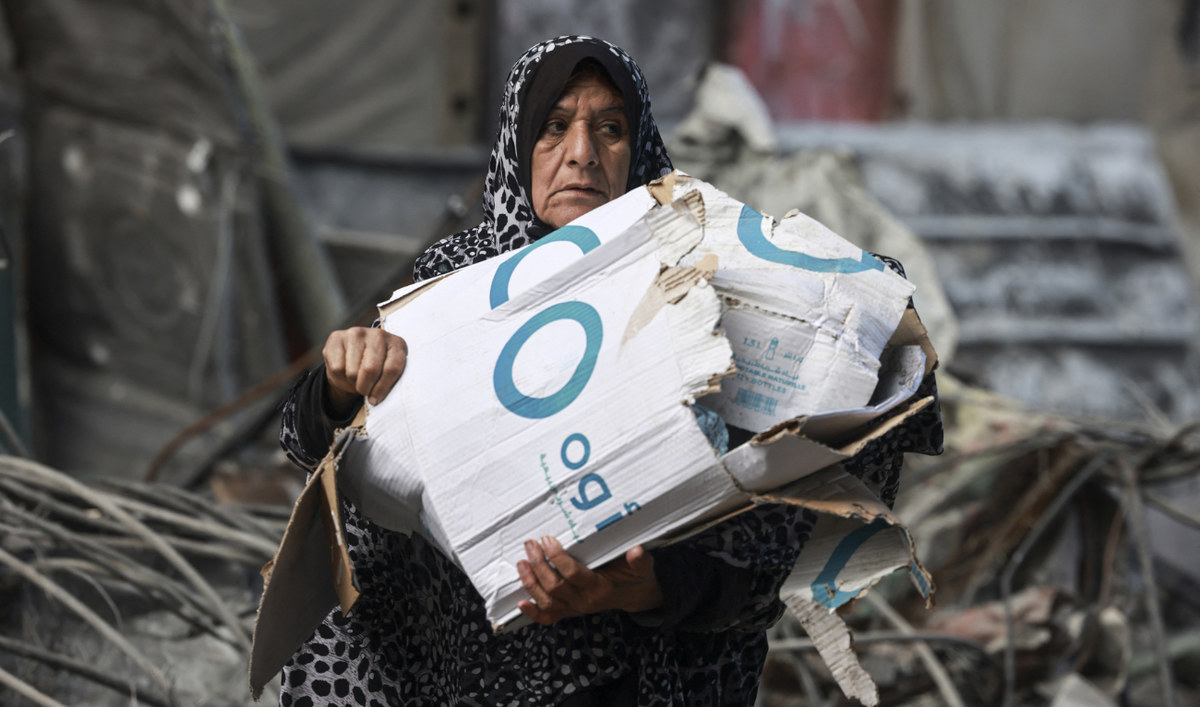


A woman carries cardboard boxes to use for a fire in Rafah on the southern Gaza Strip on January 14, 2024. (AFP)

Notwithstanding the UN’s issues, Jordash, the King’s Counsel, says resolutions keep member states engaged in an issue, which could bring additional impetus to those states not complying with them.

For instance, non-compliant states could suffer reputational costs or find themselves subjected to sanctions.

Likewise, Charbonneau believes the need for members to continue to “use all their leverage with recalcitrant governments” could not be overstated.


How 1,000 days of war pushed Sudan’s health system to the brink of collapse

Updated 23 min 43 sec ago
Follow

How 1,000 days of war pushed Sudan’s health system to the brink of collapse

  • After nearly three years of fighting, attacks on hospitals, mass displacement and disease outbreaks are crippling care nationwide
  • As humanitarian needs soar, doctors and aid agencies warn Sudan’s health system cannot survive without peace and access

LONDON: After more than 1,000 days of war, Sudan’s health system is buckling under the combined weight of violence, displacement, disease and hunger, pushing millions of civilians toward a crisis with few historical parallels.

What began as a power struggle between the Sudanese Armed Forces and the paramilitary Rapid Support Forces has evolved into what UN agencies now describe as the world’s largest humanitarian and health emergency.

According to the World Health Organization, more than 20 million people in Sudan now require health assistance, while an estimated 33.7 million — roughly two-thirds of the population — are expected to need humanitarian aid this year.

(AFP/File)

At least 21 million people face acute food insecurity, with famine already confirmed in parts of North Darfur and South Kordofan.

“One thousand days of conflict in Sudan have driven the health system to the brink of collapse,” Dr. Shible Sahbani, WHO’s representative in Sudan, said in a statement. “Under the strain of disease, hunger and a lack of access to basic services, people face a devastating situation.”

The health system’s deterioration has been swift and severe. Since the war began in April 2023, WHO has verified 201 attacks on health care, resulting in 1,858 deaths and 490 injuries.

More than one third of health facilities nationwide — 37 percent — are now non-functional, depriving millions of people of essential and lifesaving care.

“Healthcare facilities are being attacked, there is a shortage of medicines and supplies, and a lack of financial and human resources to operate health services,” Sahbani said. “This means that the system is on the verge of collapse.”

In the hardest-hit regions, particularly Darfur and Kordofan, the picture is even bleaker.

Aid groups estimate that in some areas up to 80 percent of health facilities are no longer operational, leaving overstretched clinics struggling to cope with outbreaks of cholera, malaria, dengue and measles.

“The weather and conditions in Sudan are conducive to the spread of malaria and dengue fever by mosquitoes,” Sahbani said. “Outbreaks of vaccine-preventable diseases, such as measles and polio, are also being reported in many states right now.”

A view of the burnt Khartoum Teaching Hospital building. (Reuters/File)

Sudan is now the world’s largest displacement crisis. An estimated 13.6 million people have been forced from their homes — around 9.3 million internally displaced and a further 4.3 million seeking refuge in neighboring countries.

Overcrowded displacement sites, poor sanitation and the collapse of routine health and water services have created ideal conditions for disease outbreaks. Cholera has now been reported in all 18 states, dengue in 14 states, and malaria in 16.

“As the relentless conflict renders some areas inaccessible, particularly in the Darfur and Kordofan regions, the population’s health needs continue to increase,” Sahbani said.

“To meet these mounting needs and prevent the crisis from spiraling out of hand, WHO and humanitarian partners require safe and unimpeded access to all areas of Sudan, and increased financial resources.”

Children are bearing the heaviest burden of Sudan’s collapse. According to the UN children’s agency, UNICEF, roughly half of those expected to need humanitarian assistance in 2026 are children.

“For the children of Sudan, the world is 1,000 days late,” Edouard Beigbeder, UNICEF’s regional director for the Middle East and North Africa, said in a statement.

Patients suffering from cholera receive treatment at a rural isolation centre in Wad Al-Hilu in Kassala state in eastern Sudan. (AFP/File)

“Since fighting erupted in April 2023, Sudan has become one of the largest and most devastating humanitarian crises in the world, pushing millions of children to the brink of survival.”

More than 5 million children have been displaced — the equivalent of 5,000 children displaced every day — often repeatedly, as violence follows families from one location to another.

“Millions of children in Sudan are at risk of rape and other forms of sexual violence, which is being used as a tactic of war, with children as young as one reported among survivors,” Beigbeder said.

Malnutrition is compounding the crisis. In North Darfur alone, nearly 85,000 children suffering from severe acute malnutrition were treated between January and November 2025 — “equivalent to one child every six minutes.”

“The collapse of health systems, critical water shortages and the breakdown of basic services are compounding the crisis, fueling deadly disease outbreaks and placing an estimated 3.4 million children under five at risk,” Beigbeder said.

Hunger is worsening Sudan’s health crisis.

“Sudan was once considered to be the food basket of the entire region,” Sahbani said. “Today, it is facing one of the most serious food crises in the world: more than 21 million people face high levels of acute malnutrition and food insecurity.”

Children under five and pregnant or breastfeeding women are particularly vulnerable. “We estimate that nearly 800,000 children under the age of five will have suffered severe acute malnutrition in 2025,” Sahbani added.

People walk past on the grounds of a damaged hospital in Khartoum. (AFP/File)

UNICEF warns that the breakdown of maternal and child health services has turned childbirth into a life-threatening event, particularly in displacement camps where access to skilled care and surgical facilities is limited or nonexistent.

A Port Sudan-based doctor, who asked to remain anonymous, said the cumulative impact of the war had shattered the country’s health system, with facilities, staff and infrastructure systematically dismantled.

“After a thousand days of awful war, the health system in Sudan remains in a dire situation,” the doctor told Arab News.

“The health system and of course the infrastructure have seen direct attack, where 75 percent of the hospitals and health facilities sustained damage, either via direct shelling or looting of their equipment.”

The conflict has also hollowed out Sudan’s medical workforce. “Many of the health personnel and workforce had to flee, as they were targeted themselves,” the doctor said, warning that the loss of staff has sharply reduced the country’s ability to deliver even basic care.

A hospital director shows the bullet and shell holes on one of the internal walls of the Saudi hospital in Khartoum's twin-city Omdurman. (AFP/File)

The collapse of routine services has accelerated the spread of disease, particularly among children. “We started to see the emergence of outbreaks of vaccine-preventable diseases like diphtheria and measles — many outbreaks that we are seeing among children,” the doctor said.

Damage to water infrastructure has further compounded the crisis. “Attacks on water stations led to outbreaks like cholera and hepatitis E with high fatalities among pregnant women,” the doctor added.

Reversing the damage will require far more than short-term emergency aid, the doctor said.

“Sudan’s health system requires huge rehabilitation and rebuilding,” they said, stressing that the consequences of inaction extend well beyond Sudan’s borders. “Health is now global health — whenever there is an outbreak somewhere, there is a risk of it spreading all over.”

The doctor called for urgent international support to stabilize services and rebuild infrastructure.

“There is a need for urgent donations to fill the huge gap in life-saving health services to the people and also to rebuild the health infrastructure,” they said, adding that support must focus on areas of greatest need, “especially conflict areas as well as areas that have been freed of the RSF where now people are returning.”

As international access remains constrained and funding dwindles, much of the burden of care has fallen on Sudanese communities themselves — including diaspora-funded initiatives and volunteer-run clinics and the Emergency Response Rooms

“The conflict has exacerbated all the vulnerabilities Sudan’s health system faced before the war,” Dr. Majdi Osman, a University of Cambridge scientist and founder of Nubia Health, a diaspora-funded clinic in Wadi Halfa in Sudan’s Northern State, told Arab News.

A cholera patient sits on his bed at an isolation unit outside the Bashayer Hospital, south of Khartoum. (AFP/File)

“Decades of under-investment, especially outside of Khartoum, left the health system fragile, but the current violence has pushed it into a state of collapse.”

Supply chains have fragmented, driving up costs and limiting access to essential medicines. “Getting basic medicines has become a challenge but somehow health workers in Sudan are adapting and have been able to get medicines to communities in need,” Osman said.

“For patients with chronic diseases, the war has forced an impossible choice. Stay in a collapsing system or flee across dangerous routes to reach Egypt just to access life-saving treatment that should be a basic right.

“We are seeing families separated and lives risked on these journeys because the local medical infrastructure can no longer sustain the continuous care required for conditions like kidney disease or cancer.”

Despite the devastation, Sudan’s medical workforce has not disappeared. “Sudan does not lack medical expertise; it lacks the infrastructure and stability,” Osman said.

In Wadi Halfa, displaced doctors have arrived from Khartoum, Blue Nile and other conflict-affected regions. “At Nubia Health we are trying to provide them with the resources they need to support health in their communities,” Osman added.

A Doctors Without Borders (MSF) medical team urgently evacuates a Sudanese refugee from Touloum camp to the Iriba hospital at the Touloum refugee camp in the Wadi Fira province, Chad. (AFP/File)

Some organizations are attempting to restore fragments of the national health system. The Sudanese American Physicians Association, a leading humanitarian medical group, has sent a large delegation to Sudan to assess conditions and reopen facilities.

“Our delegation is on the ground to help reopen and restore essential hospital services disrupted by war — starting with the most critical hospitals across the health system’s resiliency, not only in Khartoum but also across the country,” Dr. Anmar Homeida, SAPA’s strategic adviser, told Arab News.

On Wednesday, SAPA announced the reopening of Bahri Teaching Hospital, one of the state’s largest referral facilities, “which represents a lifeline for children, mothers, and people with chronic and hard-to-treat conditions,” said Homeida.

“The impact we’re aiming for is simple: reduce preventable deaths, help local medical providers and humanitarian personnel deliver quality care to people in need, and support families returning home and those still displaced across the country, especially from Darfur and Kordofan, to have quality access to healthcare.

“With Sudan’s health system severely damaged and outbreaks spreading, reopening functional referral hospitals in Khartoum and supporting frontline services across other states is a practical step toward stabilizing communities and enabling recovery.”

Despite insecurity and access constraints, WHO says it continues to deliver lifesaving assistance wherever possible.

Members of Sudanese armed forces sit on an army vehicle in Omdurman. (Reuters/File)

Since April 2023, the agency has delivered more than 3,300 metric tons of medicines and medical supplies worth around $40 million, including treatments for cholera, malaria, dengue and severe malnutrition.

About 24 million people have received cholera vaccinations, while more than 3.3 million have accessed care at WHO-supported hospitals, primary health facilities and mobile clinics.

More than 112,400 children with severe acute malnutrition have received treatment at WHO-supported stabilization centers.

“WHO is doing what we can, where we can, and we know we are saving lives and rebuilding the health system,” Sahbani said. “Despite the challenges, we are also working on recovery of the health system.”

Aid agencies are clear that humanitarian action alone cannot resolve Sudan’s crisis. “Humanitarian action can save lives, but it cannot replace the protection that only peace can provide,” Beigbeder said.

WHO, UNICEF and Sudanese doctors are united in their call for an end to the fighting and unimpeded humanitarian access.

“All parties must uphold their obligations under international humanitarian law: protect civilians, stop attacks on infrastructure, and allow safe, sustained and unimpeded humanitarian access across Sudan,” Beigbeder said.

For Osman, the message to donors is equally stark.

A doctor visits a cholera patient at an isolation unit outside the Bashayer Hospital, south of Khartoum. (AFP/File)

“Firstly, the international community needs to move quickly and support Sudanese, community-led efforts that are delivering care today,” he said.

“When I recently visited Sudan, I was expecting to see a global response to the world’s largest humanitarian crisis. I found almost nothing.

“Secondly, the best cure for Sudan’s health crisis is peace. We can’t allow children in Sudan to go through another 1,000 days of conflict to pass otherwise we risk the health of a whole generation growing up in this pointless war.”