

5 things we learned from Saudi Arabia’s AFC Asian Cup win over Kyrgyzstan

1 / 2
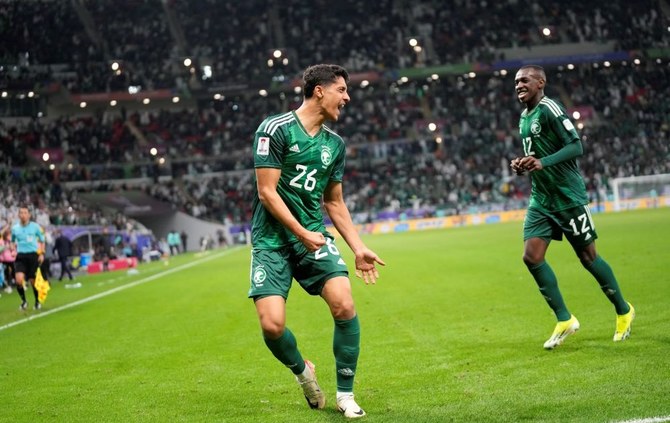
Saudi Arabia’s Faisal Alghamdi celebrates after scoring his side’s second goal during the Asian Cup Group F game against Kyrgyzstan at Ahmad Bin Ali Stadium, Doha, Qatar, Jan. 21, 2024. (AP Photo)
2 / 2
Saudi players celebrate their 2-0 win over Kyrgyzstan. (X / @SaudiNT)
Short Url
Updated 22 January 2024
Follow

5 things we learned from Saudi Arabia’s AFC Asian Cup win over Kyrgyzstan

  • 2-0 win left Roberto Mancini’s men with a maximum of six points, but performances have been modest
  • Mancini listed South Korea, Japan, Iran and Australia as those expected to lift the trophy

Saudi Arabia defeated Kyrgyzstan 2-0 on Sunday to advance to the knockout stage of the AFC Asian Cup in Qatar. Here are five things we learned from the game

On paper, perfect so far

Two games, six points and a place in the last 16, it could not have gone any better for Saudi Arabia in terms of results. The target was always to get to the next stage as quickly and smoothly as possible and that has been achieved. Coach Roberto Mancini can utilize his squad, rest some players and give others playing time in the final group game against Thailand and it is his job to get the team firing at full capacity when the knockout action starts.

He will not be judged at the group stage — where it is a results business — as results have been perfect. There are bigger challenges ahead and this is where the man who masterminded Italy’s European success in 2021 can earn his money. The former Inter Milan and Manchester City boss surely knows that the performances have not been great so far and he looked frustrated on the sidelines on Sunday but the platform for this tournament has been built and there is a real chance of winning three from three at the group stage.

Lack of intensity

After the game, Mancini said that the performance against 11 men was better than it was against ten and then nine. There was not, however, much time to make that comparison as the Central Asians saw their first red card after just eight minutes and the second soon after the break.

That is not Mancini’s fault and such developments do change the flow of a game but there was a distinct lack of attacking intensity from the Green Falcons. It is not always easy to play against a team that is focused only on defence and produced some physical challenges but there was not enough energy or urgency.

This should have been a time to use the advantage to create space and then opportunities for the attackers to get into the scoring habit. Instead, there were few chances created and not enough work done to find space. Compared to a team like Iraq, who never stopped running and working against Japan, Saudi Arabia need to bring more intensity to their game.

Kanno steps forward

In an attacking sense, this was one of the best performances from Mohamed Kanno for some time and in a game against an opponent struggling with red cards, the Al-Hilal midfielder could focus more on trying to get forward than usual.

His goal was superbly taken, getting himself in the right position at the far post to volley home with precision. He was a constant threat and came within inches of a second. The 29 year-old is now a senior player and needs to produce these sort of performances.

It helps other, less experienced players like Abdulrahman Ghareeb, who has looked Saudi Arabia’s liveliest attacking threat so far when he has played, and Faisal Al-Ghamdi who has also impressed and got a goal. Mancini has shown that he is prepared to select younger talent and this has, for the most part, paid dividends.

Al-Dawsari waiting to fire

Salem Al-Dawsari has been the team’s attacking talisman for some time but he was not at his best in this game. The Asian Player of the Year could not get going and lost possession time and time again. His movement and passing were also not at their usual levels.

It was not a surprise that he was taken off just after the hour. The game was virtually won — better to keep him as fresh as possible for the challenges ahead. It was noticeable, however, that as he walked off the pitch towards the bench, Al-Dawsari did not seem too happy — whether that was down to his own performance or a reaction to being substituted, only he knows. Everyone is aware that if Saudi Arabia are going to be successful in Qatar, they need their star firing.

Mancini right about favorites but…

After the game finished, Mancini was quick to point out to reporters that Saudi Arabia are not among the favorites at the tournament. He listed South Korea, Japan, Iran and Australia as those expected to lift the trophy. Few would disagree but then South Korea and Japan, the top two in Asia according to most, have not exactly been impressive so far. South Korea needed a last-minute own goal to get a point against Jordan. Japan lost to Iraq. Both of these teams would love to have Saudi Arabia’s record in the tournament while Iran only beat Hong Kong 1-0.

But these teams know that these are still early days in the competition. In history, few teams manage to impress right from the beginning and win without hiccups.

Once the knockout stage starts, there are going to be those that step it up a level but at the moment, it is looking very open indeed.


History-chasing Djokovic and Alcaraz to meet in Australian Open final after epic semifinal wins

Updated 4 sec ago
Follow

History-chasing Djokovic and Alcaraz to meet in Australian Open final after epic semifinal wins

  • Carlos Alcaraz striving to become the youngest man ever to complete a career Grand Slam
  • Novak Djokovic is aiming to be the oldest man in the Open era to win a Grand Slam title
MELBOURNE: Novak Djokovic finally beat one of the two men who have been blocking his path to an unprecedented 25th Grand Slam singles title when he edged Jannik Sinner in five sets Friday to reach the Australian Open final.
To get that coveted No. 25, he’ll next have to beat the other: top-ranked Carlos Alcaraz.
They’re both chasing history in Sunday’s championship decider, with the 22-year-old Alcaraz striving to become the youngest man ever to complete a career Grand Slam.
The top-ranked Alcaraz also had to come through a grueling five-setter. He fended off No. 3 Alexander Zverev 6-4, 7-6 (5), 6-7 (3), 6-7 (4), 7-5 in a match that started in the warmth of the afternoon Friday and, 5 hours and 27 minutes later, became the longest semifinal ever at the Australian Open.
That pushed the start of Djokovic’s match against Sinner back a couple of hours, and the 38-year-old Djokovic finally finished off a 3-6, 6-3, 4-6, 6-4, 6-4 win just after 1:30 a.m.
“It feels surreal,” Djokovic said of his 4-hour, 9-minute triumph. “Honestly, it feels like winning already tonight. I know I have to come back … and fight the No. 1 of the world. I just hope that I’ll have enough gas to stay toe-to-toe with him.
“That’s my desire. Let the God decide the winner.”
Djokovic was at the peak of his defensive powers, fending off 16 of the 18 breakpoints he faced against the two-time defending Australian Open champion. It ended a run of five losses to Sinner, and a run of four semifinal exits for Djokovic at the majors.
“Had many chances, couldn’t use them, and that’s the outcome,” Sinner said. “Yeah, it hurts, for sure.”
Alcaraz and Sinner have split the last eight major titles between them since Djokovic won his last title at the 2023 US Open.
Nobody knows how to win more at Melbourne Park than Djokovic. He has won all 10 times he’s contested the Australian Open final.
He said he saw Alcaraz after the first of the semifinals was over and he congratulated him on reaching his first final at Melbourne Park.
“He said sorry to delay,” Djokovic later explained. “I told him ‘I’m an old man, I need to go earlier to sleep!”
Djokovic, aiming to be the oldest man in the Open era to win a Grand Slam title, was kept up late.
“I’m looking forward to meeting him on Sunday,” he said.
Final 4
With the top four seeds reaching the Australian Open men’s semifinals for just the fifth time, Day 13 was destined to produce some drama. The season-opening major had been a relatively slow burn, until the back-to-back five-setters lasting a combined 9 hours and 36 minutes.
Alcaraz and Zverev, the 2025 runner-up, surpassed the 2009 classic between Rafael Nadal and Fernando Verdasco as the longest ever Australian Open semifinal.
Medical timeout
Alcaraz was as close as two points from victory in the third set but was hampered by pain in his upper right leg and his medical timeout became contentious.
He said initially it didn’t feel like cramping because the pain seemed to be just in one muscle, the right adductor, and he needed an assessment.
He navigated the third and fourth sets and was behind in the fifth after dropping serve in the first game. He kept up the pressure but didn’t break back until Zverev was serving for the match. He then won the last four games.
“I think physically we just pushed each other to the limit today. We pushed our bodies to the limit,” Alcaraz said. “Just really, really happy to get the win, that I came back. I just rank this one in the top position of one of the best matches that I have ever won.”
Believe
Asked how he was able to recover despite being so close to defeat, Alcaraz admitted he was struggling but said kept “believing, believing, all the time.”
“I’ve been in these situations, I’ve been in these kinds of matches before, so I knew what I had to do,” he said. “I had to put my heart into the match. I think I did it. I fought until the last ball.”
Zverev was demonstrably upset about the time out out in the third set, taking it up with a tournament supervisor, when his rival was given the three-minute break for treatment and a massage on the leg.
After the match, he maintained that he didn’t think it was right, but he didn’t think it should overshadow the match.
“I don’t want to talk about this right now, because I think this is one of the best battles there ever was in Australia,” he said “It doesn’t deserve to be the topic now.”