

5 things learned from Saudi Arabia’s win over Oman at AFC Asian Cup

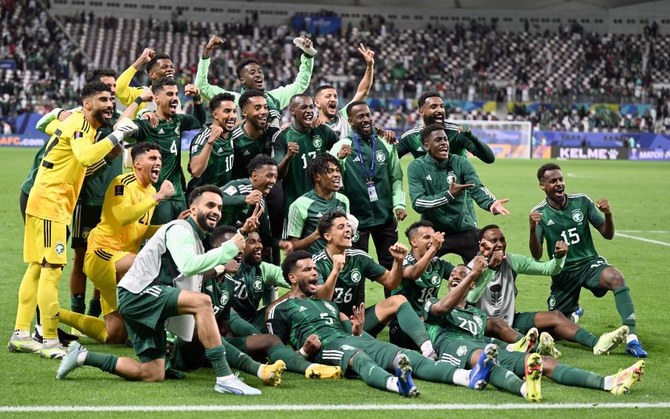
Saudi players celebrate their late win over Oman at the AFC Asian Cup in Qatar. (AN Photo/Basheer Saleh)
Short Url
Updated 17 January 2024
Follow

5 things learned from Saudi Arabia’s win over Oman at AFC Asian Cup

  • Stoppage-time victory may have galvanising effect on players looking to make Round of 16 against Kyrgyzstan on Sunday
  • Value of bench was proven when Abdulrahman Ghareeb produced a moment of magic just three minutes after entering the field of play by dancing through the Omani defense and firing home the equalizer

RIYADH: Saudi Arabia came back from a goal down to defeat Oman 2-1 late on in the opening game of their AFC Asian Cup campaign on Tuesday.

Here are five things learned from the action in Doha.

Turning point for manager Mancini, players

There had been plenty of controversy leading up to the game which featured an explosive press conference from head coach Roberto Mancini that made headlines around the world.

In it, he said that Salman Al-Faraj, Sultan Al-Ghannam, and Nawaf Al-Aqidi had been left out of the squad for trying to pick and choose their games, a claim all three players denied.

No one knows the thoughts of those who made the squad but seeing their club-mates in the headlines cannot have made for the best team atmosphere.

The last-gasp victory should give the Italian manager the chance to draw a line under the whole episode and focus on winning the trophy for the first time since 1996.

If the Green Falcons do end up lifting the cup next month, Ali Al-Bulaihi’s winning goal deep in stoppage time will surely be seen as a turning point both on and off the pitch.

Worrying defeat only just averted

The last-minute jubilation should not mask the fact that it was almost a terrible start for Saudi Arabia. With 13 minutes remaining, a loss was very much on the cards and only a 96th-minute winner prevented a draw.

Had it ended in defeat, it could have been a hugely damaging one. Given the negativity that was in the air following the previous day’s press conference, it could have sent Saudi Arabia’s Asian Cup campaign spiralling into chaos.

Now there is something to build on. Every Italian knows that the 1982 World Cup-winning team did not taste victory in a single game in the group stage. It can take time for a team to find its rhythm and momentum, especially when a coach is relatively new.

Despite the tightness of the game, in some ways, it was a perfect start. A win against a tough opponent but a wake-up call that means Saudi Arabia will know they have to improve.

Substitutes made real difference

There was a general lack of creativity for much of the game, a quality that is sorely needed against a well-organized defence such as Oman’s.

Mancini remained patient however even when the opponents started to sit back more and focus on defending their lead.

The introduction of Abdulrahman Ghareeb and Feras Al-Buraikan made a difference. The former produced a moment of magic just three minutes after he entered the field of play to dance through the defense and grab the equalizer.

From that point on, there was only one team that was going to win it and that was Saudi Arabia.

Al-Buraikan caused problems with his movement and energy in the final third and, had Saudi Arabia not won, there would have been a lot of questions asking why the in-form Al-Ahli striker had not started the game.

Mancini demonstrated that when the pressure is on, he can keep his cool, and his players showed that they will keep going until the end.

Abdulhamid shows his class once more

Saud Abdulhamid impressed the watching world during the 2022 World Cup with a series of fine performances which saw him linked to a move to Italy.

Since then, he has continued building on his reputation which now has him regarded as one of the best right-backs in Asia.

On current form, it is hard to think of any better and he just exudes confidence and authority in everything he does. The Al-Hilal man made more passes than any of the Oman players, with only seven of his 60 going astray.

He deserved an assist for his cushioned header on the stroke of half-time that was very nearly converted by Sami Al-Najei, and almost headed home late in the game with the ball going just wide.

Defensively, Oman got very little joy from his side of the pitch and, all in all, it was a fine performance that bodes well for the rest of the tournament.

Early 2nd-round spot now up for grabs

The basic objective of any group stage is getting out of it, but the ideal outcome is to book a place in the Round of 16 with a game to spare.

Victory against Kyrgyzstan on Sunday will give Mancini and his men some much appreciated breathing space. It will mean that the boss can indulge in some rotation to keep his key players fresh and give others some playing time to ensure there is no rustiness for later in the competition.

The Central Asian team lost their opener 2-0 to Thailand and were very much second best in that game. There will be plenty that will encourage Mancini but then again, Kyrgyzstan will be desperate to get some points on the board or their Asian Cup adventure could end up being virtually over.

Still, Saudi Arabia’s target will be nothing less than another three points and early progress to the knockout stages.


From Jeddah to the world stage: Bader Idrees and Saudi Arabia’s tennis rise

Updated 10 sec ago
Follow

From Jeddah to the world stage: Bader Idrees and Saudi Arabia’s tennis rise

RIYADH: As tennis continues to gain momentum throughout Saudi Arabia, several local players are beginning to emerge on the national and international scene. One of them is Saudi national team player Bader Idrees, whose journey mirrors the Kingdom’s evolving relationship with the sport.

Idrees’ first exposure to tennis came at a time when the local game was still developing. His interest began in early 2010 after watching his older sister train regularly.

“I was five years old when I used to watch my older sister playing tennis every day,” he told Arab News. “One of her coaches recommended that I try it out, and from the first hit, I fell in love with the sport.”

Now 20 years old, Idrees finds himself progressing alongside a country that is investing heavily in tennis. Over the past three months alone, Saudi Arabia has hosted the Six Kings Slam, the WTA Finals, and the Next Gen ATP Finals, an indication of its growing ambitions on the global tennis stage.

A defining moment in Idrees’ development came at the 2025 WTA Finals, where he reached a personal milestone in his role as a hitting partner for some of the world’s best players.

“It was one of the best experiences I’ve had so far,” he said. “To actually see the players and train with them was an eye-opening experience for me.”

The exposure offered by hosting elite tournaments has had a direct impact on aspiring Saudi athletes, providing valuable insight into the professional game.

“Seeing how players prepare for matches — from how they behave off the court to actually practicing on the court — was an amazing experience,” he said.

Beyond individual growth, Idrees believes the broader sporting ecosystem benefits from welcoming international events to the Kingdom.

“Hosting these events motivates every Saudi athlete,” Idrees said. “Foreign players get to know the country and the players who represent it, and it pushes us to perform better knowing that the world is watching.”

That motivation has translated into concrete goals. Idrees is planning a busy start to the year, with four international tournaments scheduled for January.

“I feel very positive about what I’ve accomplished so far, so hopefully I can kick off with a strong start in 2026.”

Despite recent progress, Idrees credits his early development at home as the foundation of his success.

“I don’t think I would be at this level if I weren’t in Saudi Arabia, and if I didn’t meet my coach Wajih there, who played a big role in my journey,” Idrees said.

To further advance his career, he later relocated to Cairo, where increased competition and exposure helped accelerate his development.

“That experience, combined with my coach’s motivation, made me believe I could truly go pro,” he said.

The journey was not without challenges. Idrees reflected on the limitations that once existed in the local tennis landscape.

“Tennis has grown massively in Saudi Arabia over the last few years,” he said. “But before that, we didn’t always have the best facilities or infrastructure. That’s why seeing the progress now makes me happy.”

Today, that transformation is happening at a rapid pace — something Idrees notices each time he returns home from international competition.

“Month by month,” as he puts it.

Whether in Riyadh, Jeddah, or Dammam, the changes are increasingly visible. Looking ahead, Idrees is optimistic about the next generation of Saudi players.

“I wouldn’t be surprised to see the kids playing at the under-10 and under-12 level find themselves in the top 500 or 300 within the next 10 years,” he said. “I see the discipline and motivation in them, and it truly is something special.”

He is also realistic about his own development compared with today’s young talents.

“I wasn’t at this level at 10, 12 years old,” he admitted. “Training with kids at that age now, I’m genuinely impressed. It’s why I’m feeling very positive about their future.”

With growing infrastructure, elite-level exposure, and rising ambition, Idrees’ story represents more than personal achievement. It highlights how Saudi Arabia’s expanding role as a host of global sporting events is reshaping its tennis landscape — and how a new generation of players may be poised to make an impact on the world stage in the years ahead.